
By Julia Borys ’22
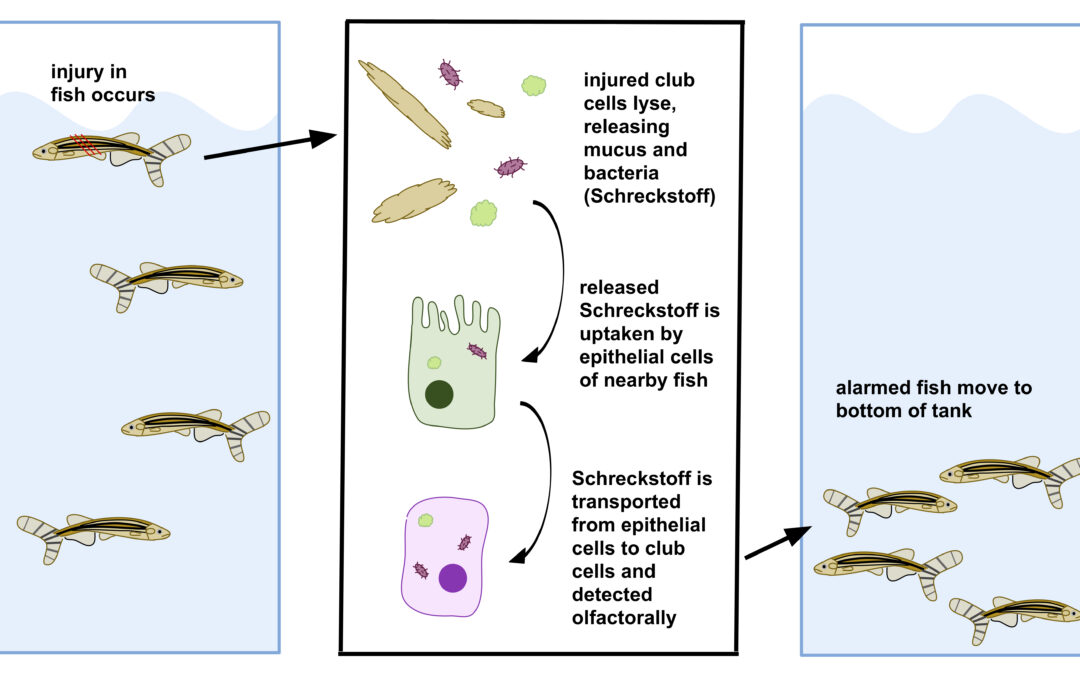
Individual animals often use alarm signals from their own species (conspecifics) to respond to the presence of a threat. By employing a mechanism such as this, the individual has a better chance of avoiding harm. Freshwater fish are known to display relatively dramatic behavioral changes when the injury of another is detected. The signal by which fish are alarmed is thought to be produced by club cells, which are large cells near the surface of the fish. These club cells are also responsible for the indirect uptake of surrounding bacteria or mucus, which are part of an alarm substance called Shreckstoff. This substance elicits a behavioral response through olfactory detection, where fish typically freeze and move to the bottom of the tank. The work performed by Chia et al. considers the path in which Shreckstoff is uptaken and what environmental factors produce alarm behavior as seen in zebrafish (Danio rerio).
Initially, it was unknown whether the uptake of material by club cells was directly through the environment or indirectly through other cells. This was tested by exposing zebrafish to various substances, such as mucus, different types of bacteria, or even other small cells. Each substance and cell was radioactively labeled and its travel was observed over time. The substances were seen to be primarily uptaken by epithelial and goblet cells, later making their way into club cells and other deeper cells (Fig. 1). The small cells that were internalized into club cells were seen to be motile, suggesting a form of cell invasion. These results suggest this invasion is possibly performed by neutrophils, a type of white blood cell known to invade other cells and remain motile. If these cells are indeed neutrophils, then club cells can be seen as an intermediate between the innate and adaptive immune responses.
After determining how Schreckstoff moved into the club cells, Chia et al. wanted to know what components of Schreckstoff were important in provoking the alarm response within zebrafish. Different killed species of bacteria (bacterial lysates), such as Pseudomonas aeruginosa and Staphylococcus saprophyticus, were introduced to the fish and their reaction was observed. Some bacterial strains induced a stronger effect than others, but generally fish were seen to freeze and move to the bottom of the tank. They were rarely seen to dart back and forth, which is another alarm response that occurs in zebrafish.
To determine whether or not bacteria was the sole chemical within Schreckstoff that is responsible for alarm behavior, zebrafish behavior was tested against germ-free larval lystates that were derived from embryonic stages. When exposed to this germ-free lysate, alarm behavior was observed in the zebrafish. However, rather than freezing and moving to the bottom of the tank, a 32% increase in darting activity was observed in the population instead. This increase in movement was similar to when the population was exposed to adult fish skin lysate, however more freezing was observed than in the germ-free test. These results provide evidence for not only a bacterial component in provoking alarm behavior, but a fish-specific component as well.
While both the bacterial and fish-specific components of Schreckstoff are detected by the olfactory system, each may result in a separate neural pathway. This would allow for the zebrafish to respond properly depending on the present danger. If primarily the fish-specific component is detected, a predator likely injured a conspecific fish. For this reason, darting may assist in escape. If the bacterial component in primarily present, darting will not prevent infection. Instead, it is more beneficial to move away from the infected area.
By working as a potential bridge between innate and adaptive immunity, club cells may participate in the tolerance of gut bacteria. Since, club cells accumulate alarm substances, it is important for these substances to indeed be a threat, or else energy would be spent producing a false alarm. Additionally, lystate-induced signaling in zebrafish is not reliant on the death of the affected individual. The alarm signal allows both the surrounding population and the individual itself to react to the potential threat and take the necessary precautions.
Chia, J.S.M., Wall, E.S., Wee, C.L. et al. Bacteria evoke alarm behaviour in zebrafish. Nat Commun 10, 3831 (2019).
