
By Victoria Holman ’21
Ejaculation allocation is dependent on the assessment of competition risk and dietaary condition in neriid flies.
Nature produces all kinds of peculiar sexual traits in animals but some of the most interesting ones come out of the competition created by sexual selection. Sexual selection is a subset of natural selection which acts directly on heritable traits that affect reproduction, and it produces some very unique secondary sexual traits. Male traits are often exaggerated by male competition, a form of intrasexual selection, in order to increase their access to a female.
There are many forms of intrasexual selection that occur prior to copulation. These are usually in the form of aggressive contests over resources and mating partners but wait it doesn’t stop there! Some unusual cases of male-male competition occur post gamete transfer and one of these known phenomenon is sperm competition. This plays out as a physical battle between sperm of two or more rival males which attempt to fertilize a singular egg. This rivalry has evolved in species which have mate polygyny or multiple sexual partners which encourages female promiscuity. Females who take multiple mates in a short period of time create a selection pressure on the males, constructing a diverse set of behaviours and strategies that ensure that a male has maximum paternity in offspring.
Bateman’s hypothesis states that male reproductive success is limited by their access to females, they have relatively cheap and abundant gametes and therefore can invest prudently. Yet in certain male insects, the presence of a nuptial gift for the female increases the cost of the seminal transfer. In the case of the neriid fly Telostylinus angusticollis, their ejaculates contain costly seminal proteins which have led to the development of strategic ejaculate allocation strategies. These help male flies enhance their fertilisation success by adjusting their seminal output to outcompete males investing in the same female.
Parker and colleagues in 1997 theorised that males would allocate more sperm when they detected an increased risk of competition, such as mating with a non-virgin female. But they failed to account for the cost of transferring higher seminal volumes. In this case, the seminal transfer should also be condition-dependent, so take into consideration the organisms access to metabolic and nutritional resources. Allot of studies have demonstrated this through manipulation of nutritional access of adult males but have neglected to look at the effect of juvenile nutritional access to the post-copulatory performance of adults.
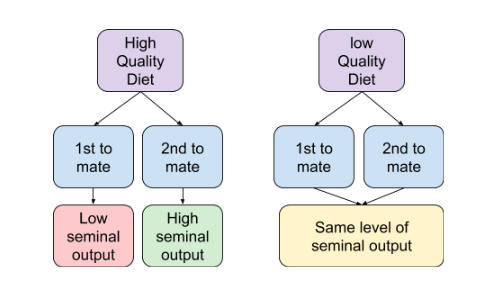
This is where the Wylde and colleagues come in, they predicted that increased access to resources in the juvenile stage of life along with an increased competition risk would result in a larger ejaculate in adult males. They randomly assigned adult male Telostylinus angusticollis to either high or low energy larval diet treatments, as well as with a designated mating sequence (either being the first or second to mate). This ensured all combinations of the male condition and mating sequence were fulfilled and that their relationship could be tested.
What is really interesting about this study, is that to make sure they could differentiate between the seminal investments of the first and second male to mate, they added rhodamine 110 (green) or rhodamine B (red) fluorophores to their larval diets. These dyes have been shown to have very little toxicity, to be similar in structure and have the bonus of covalently binding to proteins. This allows the ejaculates to be labelled and subsequently tracked without genetic modification, unlike the commonly used Green Fluorescent Protein (GFPs). The fluorescent signal intensity was measured and used as a proxy to determine the amount of seminal transfer.
Their results showed that males with high condition larval diets had higher mating success and were able to allocate ejaculates strategically. They increased seminal transfer when they perceived competition risk from another male. This showed that males with access to highly nutritional resources in the juvenile stage have further reproductive benefits outside of being larger and stronger as adults. They also have more plasticity in sperm allocation, depending on perceived risk, so are able to save resources for future matings. The low condition diet group, however, did not show a significant difference in the seminal allocation between mating first or second. They were not able to allocate ejaculate strategically and are thought to always invest maximally. This is due to the fact that they have less access to mates due to their smaller size, weakened territory defence and performance in combat due to a poor diet as a juvenile.
Wylde and colleagues contributed to our understanding of sperm competition and its role in sexual selection. They revealed that there is a significant link between the effects of an organisms dietary condition and their perceived competition risk on ejaculation investment. Using Telostylinus angusticollis in future studies could further our understanding of the underlying mechanisms that ensure paternity in intrasexual competition.
Wylde, Zachariah, et al. “Effects of Condition and Sperm Competition Risk on Sperm Allocation and Storage in Neriid Flies.” Behavioral Ecology, 2019, doi:10.1093/beheco/arz178.
Parker GA, Ball MA, Stockley P, Gage MJ. 1997. Sperm competition games: a prospective analysis of risk assessment. Proc Biol Sci. 264:1793–1802.
