
By Natalie Cady ’23
An important part of understanding animal behavior is understanding their social networks. Like humans, animals socialize and communicate in many different ways. For a long time, scientists have believed the social interactions and networks of wild giraffe to be random, but recent studies have provided significant evidence that suggest nonrandom social patterns.
The basic social system of wild giraffe consists of fission-fusion dynamics, where individuals and subgroups within a larger group split and merge frequently. Other animals that participate in a fission-fusion system include, but are not limited to, elephants, hyaenas, kangaroos, dolphins, and whales. The observational study on wild giraffe examined the effects of seasonality on social connectedness, as well as the long-term social network stability throughout the three and a half years of field work.
Pilanesberg National Park in the Bojanala Region of South Africa experiences wet and dry seasons throughout the year, meaning periods of food scarcity and food abundance for wild giraffe. A lack of availability of food in the dry seasons often means higher competition among members within the community. Recent studies have also found that increased food abundance has led to greater social cohesion among killer whales, supporting the researchers prediction that less social connections will occur during times of food scarcity. In addition to food, mating and breeding appear to be correlated to seasonality as well. It was observed that birthing peaks occurred during the early dry season and with 14 months of gestation, contraception peaks would have occurred in the middle to late wet season. Such mating and breeding patterns
added reason for social connections to be lower in the dry season, as most females tend to hide with their newborn as a form of protection against prey.
Using the simple ratio index, the researchers were able to quantify the social interactions of the approximately 180 wild giraffe living on the range between 2012 and 2016. Social interactions were recorded by observing the giraffes solo, in duos, and in groups larger than six. Individual giraffe were distinguished by their unique and lifelong coat pattern that researchers determined by photographing every sighting and comparing them to baseline photographs. Quantifying the social interactions then allowed the researchers to test for correlations between different wet and dry seasons in a longer time span as well the differences within seasons.
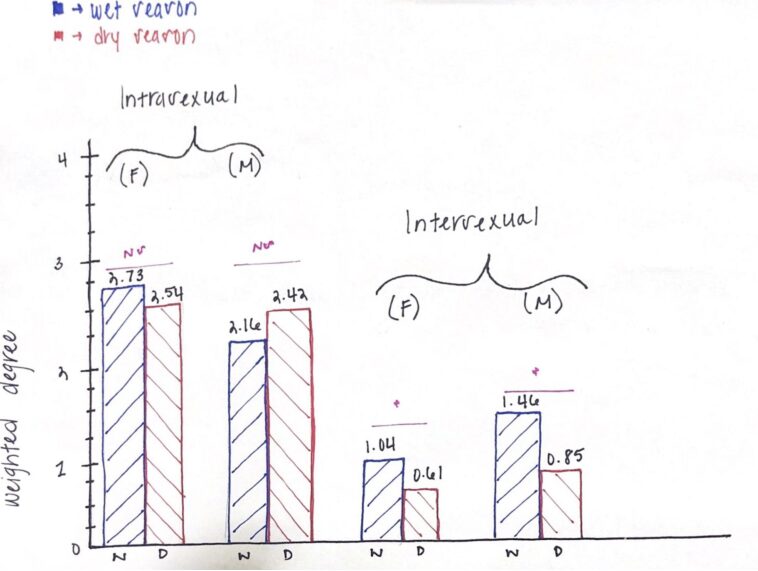
Social ties were characterized by female intrasexual, male intrasexual, female intersexual, and male intersexual connections. In the weighted degree, a measure of overall social connectedness in individuals, significant evidence suggests that intersexual connections for both females and males were increased in the wet seasons compared to the dry seasons, indicating that individuals were more social with the other sex during the wet seasons. This could be connected to the mating habits and peaked contraception within the wet seasons as well. There was no statistically significant evidence leading the researchers to believe that the seasonality affected intrasexual connections for both sexes. In addition to social connections being greater in the wet season, data suggests that the mean of overall groups sizes was significantly higher in the wet season as well.
The seasonal comparisons as well as stability observed over the entire period of field work provided enough evidence for researchers to conclude that giraffes do in fact live in nonrandom, structured societies based on fission-fusion dynamics. With this knowledge, we can continue to research the relationships between wild giraffe as well as the social dynamics of other species.
Prehn, Steffen G., et al. “Seasonal Variation and Stability across Years in a Social Network of Wild Giraffe.” Animal Behaviour, vol. 157, 2019, pp. 95–104., doi:10.1016/j.anbehav.2019.08.018.
