
By Zachary LaRocca-Stravalle ’21
Say you were standing in a grass field and told to get from point A to point B. Perhaps at point B there is a $50 reward — because why not amp up the stakes. Before you can go out and find point B, you are asked to put on a blind fold. With no vision, you must find point B to get your $50 reward, however you decide to get there. Once you’ve found it, you are asked to do it again. Another $50! Hopefully the second time you can get there faster, perhaps get there in one straight shot — although humans are notoriously bad at walking in straight lines blind folded (MythBusters did an episode on this). Now say there is a beacon that emits a faint buzzing noise and is always located a few meters from point B; you’ve learned to associate this. So, if you hear a buzz that means you are near your 50 bucks. What’s the significance of the beacon? It may be helpful if point B is placed somewhere else in the field. Now, how much better can you navigate the field with this beacon?
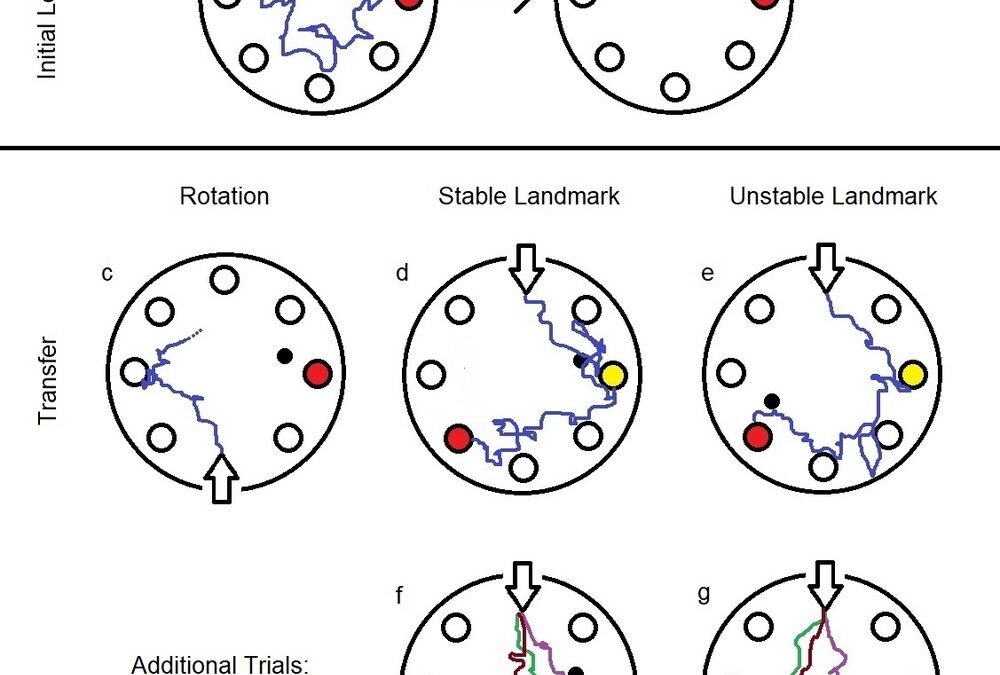
What you were asked to do in this hypothetical situation is what scientists did with elephantnose fish. Instead of a grass field, they used a water-filled circular tank with multiple feeders placed at its inner perimeter; only one contains food (not $50). Instead of a beacon emitting sound, they used a metal rod with which the fish could use a human-exclusive sensory ability — electroreception. The researchers asked whether these fish would find food using their electroreception of the metal rod, learning its proximity to the food through successive trials and without visual information, or whether the fish would rely solely on the direction they remembered the food to be instead. These two types of spatial learning have special terms: allothetic and idiothetic, respectively. One might expect that if the food was always located in the same place (and the fish released in the same place), the fish would rely on idiothetic information because the location of the metal rod doesn’t give any useful information. To test this idea, the researchers changed the location of where the fish was released into the tank and kept everything else
the same (rotation experiment). As expected, the fish went in the direction of where they thought the food was, relative to their start position. They ignored the metal rod completely in the first trial.
Clearly, the results suggest that these fish use idiothetic information to seek out food when other sensory systems fail. However, in this particular experimental design, the researchers wanted to establish that the fish won’t use their electroreception — unless they need to. Dun dun dun! So, the researchers next oriented the tank in two different ways: the metal rod remain in the same place but the food moved (stable landmark) and the metal rod stayed by the food but they were in different locations relative to the start position (unstable landmark). In the stable landmark test, the fish went directly to where they remembered the food was. The food had indeed been moved, and during the first few trials, the fish had no sense of where the food was until they had relearned its location idiothetically. In the unstable landmark trial, the fish still went out in the direction they remembered, but unlike the previous test, the fish found the food better in successive trials. They learned to associate the position of metal rod with the food. Drawing from previous research, the researchers suggested that in the unstable landmark test, the fish used an allothetic strategy (using their electroreception on the metal rod) to find the food because the idiothetic strategy didn’t work.
So, how does this help you get your 50 bucks? It doesn’t — because we don’t have $50. It does, however, help us understand how animals utilize sensory modalities in spatial learning! In this case, allothetic electrosensory information helps the elephantnose fish learn about and navigate through its environment.
Jung, S. N., Künzel, S., & Engelmann, J. (2019). Spatial learning through active electroreception in Gnathonemus petersii. Animal Behaviour, 156, 1–10. doi: 10.1016/j.anbehav.2019.06.029
