
By Stephanie Jordan ’20
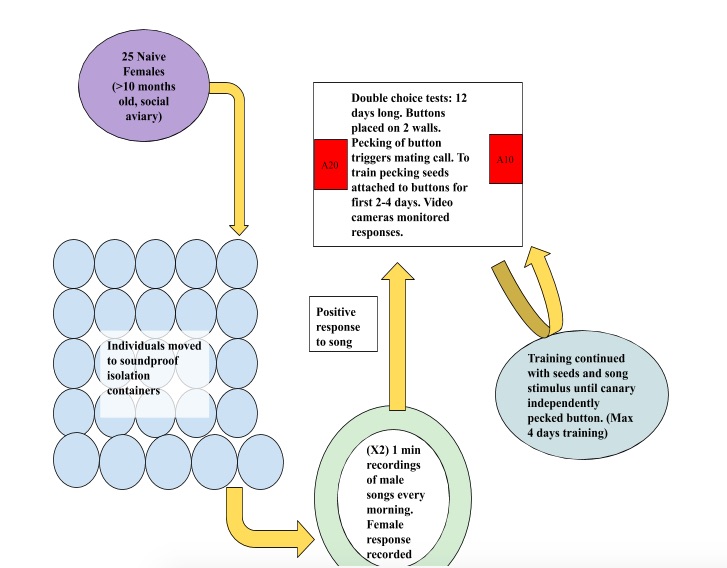
Song and vocal signals are vital forms of communication between birds. Birds use calls to signal mating, conflict, and conversation between each other. The ability for male birds to serenade their intended mate is crucial for that male’s overall fitness. However, given that these mating interactions occur in person, how much does the physical appearance of the bird effect the selection of the female mate? Or is the female able to draw her conclusion as to her desired mate based only on his serenade? To examine this Salvin et. al isolated 25 nïave females and trained them to choose, using operant conditioning, the male song they most preferred.
Female canaries when reacting positively to courting will chirp a specified copulation chirp and bounce in a small dance (Salvin). Females were given an additional way to express affection towards a certain call by teaching them that if a certain button were pressed that desired call would come out. The other button offered a less-attractive call from a less desirable male. In this investigation, socially raised females were placed in soundproof isolation. They had red buttons placed on either end of their cage and were trained, using operant conditioning, to peck the presented buttons with seed rewards. When the buttons are hit, each button respectively triggers one of two different calls. Salvin et. al categorize the two mating calls as A10 and A20. “A” refers to the specific pattern of vocals that correspond to mating, and the 10 and 20 refer to the quality of the male with 20 representing the more desirable male. In a paired t-test there was a significant chance of A20 being selected over A10 (p=0.012). Furthermore, there was a significantly higher likelihood that females would chirp out mating calls as a response to the A20 song being played (p= 0.469).
The relationship between female choice and mating response and the A20 male mating call indicates that there is some evolutionary history in which that specific type of call indicated the fitness of the male. Given the Salvin et. al article, there is no apparent cause for this preference, however calls with a larger auditory range seem to possess greater favor with female canaries.
Salvin et. al’s results support the claim that female canaries are able to recognize fitness in males by their mating song. Further research should be done into other potential indicators of bias or fitness within the canary dataset. One potential confounding factor of the investigation is the color of the button and the same constant location within the bird enclosure. In future investigations the color of the buttons should be varied to ensure that there is not bias upon the color red. Rather, in future studies the buttons should be different colors and the color button that triggers the A20. With buttons being different colors the bird can then track the color of the button outside of the corner of the room. After that a secondary trial should be done where the A20 button stays in the corner of the cage but alternates button colors. Looking into the significance of color and corner will help eliminate confounding factors from the study.
Another further investigation that could be pursued would be a wild-type observational study. Isolating auditory from visual signals in a wild setting would be very indicative in reinforcing the link between female preference and the A20 call. To test this, isolate an area of nature in which female canaries commonly reside. Then play from one side the A20 call and the A10 from the other side. Wait and evaluate if the female canary shows any visible response to either signal. If research were to go a step further, they could also utilize heart monitors, as they did in the laboratory setting, and re-release birds with the monitors. Then, play the calls once again with significant time between each call and see if either spikes the female’s heart rate beyond her normal resting beats per minute. Lastly, to absolutely confirm the importance of audio over physical presence isolate the female canaries where they can see the male but not hear him. Then show the same male and play the A10, then lastly show the same male and play A20. Repeat with several different males with at least 25 different female subjects and track any reflective response. Heart rate, mating chirps, and mating dances should be observed and video recorded as a response to each audio/physical encounter. The use of bird calls for mating has been a long accepted concept of avian society, however the new development that it may be based more heavily on auditory signals alone than physical is something that requires far more research.
Salvin, Pauline, et al. “Consistency of female preference for male song in the domestic canary using two measures: Operant conditioning and vocal response.” Behavioural processes 157 (2018): 238-243
