
By Julia Eckberg ’21
Predator-prey dynamics play a critical role in animal behavior, as the majority of animal species will at some time play either role in an interspecies interaction, even fluctuating between the two depending on the social context. These dynamics, however, are influenced by more than just the individuals involved. The part that the environment plays in shaping predator-prey interactions is substantial, providing the abiotic context in which all of these social scenarios take place. Matchette et al. (2019), published in Animal Behavior, studied how light patterns impacted the effectiveness of prey detection in domesticated fowl chicks, Gallus gallus domesticus.
This group of researchers designed an elegant experiment that allowed them to manipulate light movement in an effort to mimic the dappled light that occurs in nature, which is often created by moving tree leaves or plants. They used two different methods of light manipulation: a disco ball and a computer simulation, which was referred to as “screen dapple”. Matchette et al. predicted that the presence of dynamic light patterns would impede the ability of the chicks to detect and pursue prey items.
But before trials could begin, the chicks had to go through a training phase. During this time, chicks learned to associate a computer generated prey item, what was essentially a dark sphere, with a food reward. This made it so individuals in the experiment would be motivated to find and peck this new “food” in a foraging context. While all of the chicks were trained, only those who were the most effective foragers after training were part of the experimental trials, leaving researchers with a sample size of 18.
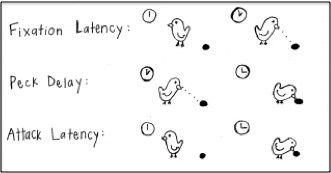
These trained chicks then entered the experimental phase of this study, which took place in an arena with computer generated leaf litter, and the novel challenge of dynamic light added to their foraging experience. To quantify the effectiveness of foraging behavior, researchers measured fixation latency, the time it took for individuals to visually detect the prey item, and attack latency, which was time between the start of the trial and when the individual correctly pecked the prey item. They also calculated peck delay, which was how long it took an individual to successfully peck the prey item after fixation occurred, but this variable was not a focus of the results of their study.
Researchers found that in both dynamic light environments, fixation latency, peck dealy, and attack latency were significantly increased than when chicks were tested under static light conditions. That being said, the use of the computer generated, “screen dapple” version of dynamic light was correlated with attack and fixation latencies that were double that of the trials using the disco ball to produce the light environment. This difference in the magnitude of delay in foraging behavior between the disco ball and “screen dapple” produced light scenarios was likely a result of the predictability of the light movement, as the form of the disco ball made it so light patches were evenly spaced, sized, and moved in the same trajectory. In contrast, the screen dapple was much more unpredictable, as light movements were randomly generated by a computer in order to more accurately mimic dappled light in the natural world.
Matchette et al. (2019) have shown that the dynamic movement of light in environments has a significant, negative impact on the ability of foragers to locate and successfully attack their prey. The ability of the abiotic light environment to impede foraging behavior is important because it has the potential to influence the overall behavior of animals. With light dynamics being capable of dictating foraging success, it would also likely affect which areas predators will forage in and where prey will hide, impacting habitat selection and animal distribution patterns across the world.
Matchette SR., Cuthill IC., Scott-Samuel NE. 2019. Dappled light disrupts prey detection by masking movement. Animal Behavior 155, 89-95.
