
By Roya Best ’22
In many species, morphological coloration is used as a visual signal to provide individuals with information about the signal sender. Specifically, coloration may be used to communicate fitness, dominance, performance, alarms, and other information; mates may be chosen based on these attributes and thus the coloration is a form of sexual selection (Václav et. al, 2007). A study published on May 8, 2019, in Behavioral Ecology and Sociobiology, looks at the Brazilian lizards (Tropidurus semitaeniatus) coloration and corresponding behaviors exhibited when communicating dominance in male-male competitions.
Brazilian lizards have two distinct male morphological colorings: black and yellow. These colors are solely present on the ventral thighs and cloaca of the lizards, while all other parts of the lizards are indistinguishable. Previous studies have found that lizards with darker pigmentation frequently exhibit more aggressive behaviors (Bruinjé et. al, 2019). Bruinjé et. al (2019), therefore, predicted that male Brazilian lizards with black coloration would exhibit more aggressive behaviors than yellow-colored lizards.
Male-male interaction trials were held during the last two months of the Brazilian lizard mating season in a laboratory plastic terrarium. One black male and one yellow male of approximately the same size were paired together for interaction testing. Bruinjé et. al (2019) choose to only pair yellow males that were larger than black males to account for size difference bias. This is due to the phenomenon of size biases,
1
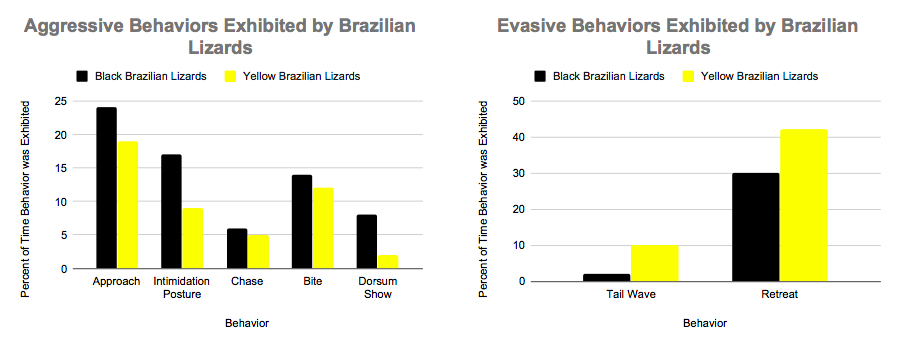
which is when dark pigmentation is associated with larger sized lizards and larger sized lizards have been found to be more dominant. The two lizards were kept in separate, contained areas, and were allowed to interact freely in a common area with a heated rock for 30 minutes. The heated rock attracted the lizards due to the heat deprivation for the previous 24 hours (Bruinjé et. al, 2019). To measure the interactions between the lizards, exhibited agonistic behaviors were then categorized as aggressive or evasive. Aggressive behaviors were defined as an approach, intimidation posture, chase, bite, and dorsum show. A dorsum show is when a lizard shows the colorful parts of its underbody by laying flat while engaging in behavioral interactions with others. Evasive behaviors were defined as a tail wave or retreat. If the lizards exhibited any forms of these behaviors, they were counted, and the frequency was recorded (Figure 1) (Bruinjé et. al, 2019).
The relationship between the coloration of male lizards and agonistic behaviors differed significantly (Pyellow aggressive behaviors< 0.05, Pyellow evasive behaviors<0.001). Out of the 21 trials held, black lizards exhibited approach, intimidation posture, chase, bite, dorsum show, tail wave, and retreat 53, 38, 14, 31, 17, 4, and 67 times respectively. While yellow lizards demonstrated the same behaviors 46, 22, 13, 28, 5, 23, 101 times respectively. Black colored male lizards were found to display more aggressive behaviors and less evasive behaviors than yellow male lizards (Bruinjé et. al, 2019).
Dominance and performance testing also were used to look at the coloration of Brazilian lizards and its implications. The more aggressive an individual lizard was, determined by the agonistic behaviors and coloration, the higher-performing and more dominant the lizard was expected to behave. To test to see if dominance and performance levels were correlated to aggressive behaviors, lizards were incentivized to ran a 2-meter via a feather probe. Fastest sprint speeds determined the performance level of individual lizards, which was a fitness proxy (the fast lizards were considered the fittest) (Bruinjé et. al, 2019).
2
According to the findings of Bruinjé et. al (2019), differences in morphological coloration, black vs. yellow lizards, have been linked to differences in dominant behaviors. Specifically, black lizards exhibit more aggressive behaviors and less evasive behaviors than yellow lizards. These results corresponded to the finding of Bruinjé et. al (2019), where they found that aggressive lizards are more likely to be dominant and fit thus make better mates. Black male lizards were found to be overall more dominant than yellow male lizards, making them more likely to be better mates.
Bruinjé, A. C., Coelho, F. E. A., Paiva, T. M. A., and Costa, G. C. (2019). Aggression, color signaling, and performance of the male color morphs of a Brazilian lizard (Tropidurus semitaeniatus) . Behavioral Ecology and Sociobiology, 73 (72).
Václav, R., Prokop, P., and Fekiac, V. (2007). Expression of breeding coloration in European Green Lizards (Lacerta viridis) : variation with morphology and tick infestation. Canadian Journal of Zoology, 85 (1199-1206).
