
By Patrick Nally ’22
Do you ever get that guilty feeling after leaving your dog by itself because it might be sad orstressed out? Well you should.
Researchers from Italy have found that petting your dog prior to leaving for a short period of time has a positive effect on the dogs’ behavior. Chiara Mariti, Beatrice Carlone, Massimiliano Protti, Silvana Diverio, and Angelo Gazzano have found that physical contact and petting your dog can make your dog calmer during the time spent apart. It has been found that the bond between a dog and its owner is greater than the bonds between a dog and another dog and a dog and its own mother. Physical contact from humans has been known to decrease stress levels in dogs through three factors: behavior, physiology, and endocrine. The experiment by Chiara Mariti et. al studied the effect of human contact and petting and how it affected a dogs’ behavior and physiology after the owner departed the immediate area.
There were guidelines that had to be met for the dogs to be included into the study. The guidelines were as follows: 1. Being more than one-year-old, 2. No behavior problems related to separation (determined by a veterinary behaviorist), 3. Being healthy, 4. Has been with the same family for at least six months, 5. Dog was pet daily by the owner/owners, 6. Dogs are not used to being pet before separation. There were a total of ten dogs used in the study (7 mixed breeds, 1 Chihuahua, 1 Hovawart, and 1 Labrador retriever). The “owner” who also participated in the study was the member of the family the dog had the strongest bond with. There was also a test leader 1 who had no connection with the dog, a test leader 2 who briefly met the dog and was in charge of measuring heart rate, and another unfamiliar face to the dog who helped with saliva samples.
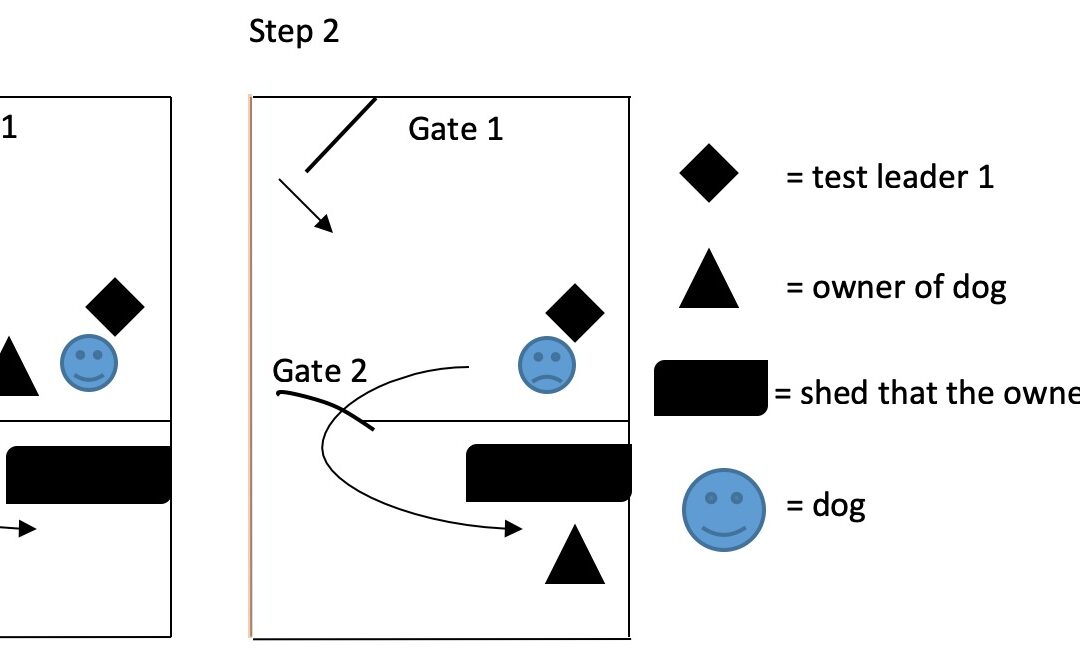
The experiment was run by first having the owners take their dogs on a slow 5-minute walk around the general area of the facility so the dogs could explore. There was then a field set up for which the actual testing took place. The owner and dog entered the area and walked through the first gate to meet test leader 1 and 2. Test leader 2 measured the heart rate and then left through the first gate. There were then two variations of the next step. 1) The owner spent a minute talking to leader 1 without giving any type of attention to the dog or 2) the owner spent a minute conversing with leader 1 while petting the dog. The owner was then separated from the dog by giving the leash to leader 1. The owner then walked through gate 2 and stood behind a shed for 3 minutes while the dogs’ behavior was observed. After the time was up test leader 1 called the owner back out and the owner was given the leash back. The owner and test leader then conversed for an additional minute before Test leader 2 came out to measure the heart rate of the dog again. The dogs’ behavior was recorded during the 3-minute separation in order to look back and observe more closely. Figure 1 depicts the setup of the testing area.
It was found that dogs that received petting were much more calm for a longer duration than the trials where the dog was not touched or even given any attention. The physical behavior of the dogs was not very different between petting vs no petting. The main observed behavior for both variations were that the dog was always positioned towards where the owner was last seen, which would be leaving gate 2. The level of stress observed in the dogs was greater than the level of stress if the dog were to be left home alone. The main takeaways from the experiment were the dogs weren’t overly stressed while waiting for the owner and being petted by the owner before leaving made the dog more relaxed. If you learn anything from this – make sure you pet your dog before you leave no matter how long you are gone, it will make them more relaxed and happier!
Mariti, C., Carlone, B., Protti, M., Diverio, S., Gazzano, A., 2018. Effects of petting a brief separation from the owner on dog behavior and physiology: A pilot study. Canine Research. Journal of Veterinary Behavior. 27. 41-46.
