
By Julia Unangst ’20
Lack of social experience wreaks havoc on the development of wasps’ ability to recognize individual faces.
Have you ever walked down a busy street and recognize someone you haven’t seen in ages? You might be unsure whether to acknowledge the person or not; your thoughts quite baffled by this seemingly incidental recognition. Perhaps you nod or smile hesitantly as you pass the person your brain so dutifully recognized.
We are not the only species that can recognize and remember the faces of others. Golden paper wasps (Polistes fuscatus) can also recognize faces of individuals within their colonies. In fact, they excel at learning and remembering the varying facial patterns of unique individuals, just like we do. This behavior is not part of their lives accidentally; it has an important role within the wasps’ complex social lives as it provides a mediator during social interactions.
But, how do methods of communication develop in species besides our own? Previous research has shown that when animals are socially isolated from others, they become feeble communicators with little to no social skills. Yet not all forms of communication require this social experience. For example, females of many species have been shown to identify signals of male quality and use these signals in mate choice, even if they have never even seen a male before! Elizabeth A. Tibbetts and her colleagues from the Department of Ecology and Evolutionary Biology at the University of Michigan, Ann Arbor, addressed these conflicting arguments by seeing what would happen to social recognition skills if paper wasps were raised in complete isolation.
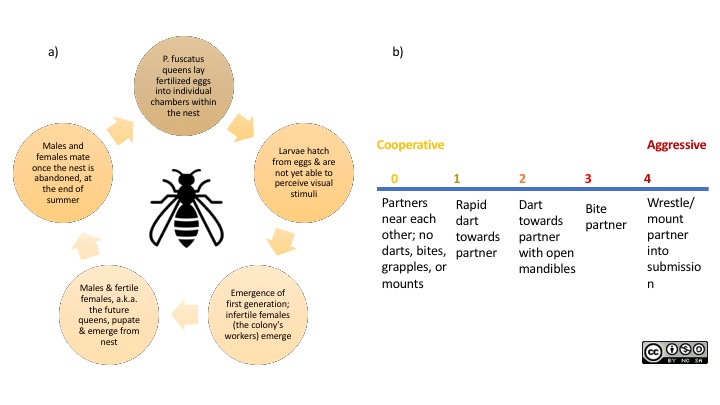
The experiment began by collecting paper wasps and their corresponding nests from the neighboring areas of Ann Arbor, Michigan. Since wasp larvae cannot perceive complex visual stimuli, experimental manipulation occurred after the larvae emerged from their pupae (figure 1a; see emergence of first generation). Once emerged, these now adult wasps were painted with a mark on their thorax, and returned to either their pre-natal nest with other individuals or placed into isolation.
After spending six days in their respective treatments, the wasps were given their first assignment: facial recognition training. Wasps were tasked with learning how to tell apart images of two different P. fuscatus individuals. During training, wasps were familiarized with the two images: image A – the incorrect image displayed as the wasp received an electric shock and image B – the correct image that was shown with no electric shock. Learning was tested by placing these trained wasps into a T-shaped maze where they were allowed to walk toward two different sides. One side had the incorrect image and the other had the correct image. If the wasps learned to discriminate between the two images during training, then they would pick the side of the maze with the correct image more often than not.
Their second assignment was to test their facial recognition skills in a social setting. Wasps raised with or without social isolation were paired with unfamiliar individuals and had to fight to establish dominance. These interactions were videotaped, and their behavior was scored via an aggression index (Figure 1b). A few days later, the pairs were reunited, and if they could remember one another, more cooperative behavior would be observed compared to the first encounter.
But this was not the case.
Wasps that had experienced six days of isolation shortly after emergence were not able to recognize their partner when they were reunited, with high ranks of aggression observed in both the first and second fights. The isolated wasps simply could not recognize the faces of those they had already met indicting that they never learned how to do so. Yet, those that spent six days in a social environment were able to complete both the image learning and social interaction assignments with ease.
Growing up in a social environment is crucial to the development of facial recognition within these paper wasps. Like ourselves, wasps rely on this recognition to communicate clearly & effectively during social interactions. It may be a bit of a stretch to directly connect our own behavior to that of a wasp, but nevertheless, we cannot be blind to our own behaviors. Although we may never be quite sure what exactly wasps are thinking about when they see a face they recognize, but what we do know is that we have only gotten a glimpse of how complex the social lives of other species besides our own truly are.
Tibbetts, E.A., Desjardins, E., Kou, N., and L. Wellman. Social isolation prevents the development of individual face recognition in paper wasps. (2019) Animal Behaviour 159, 71-77. Doi: 10.1016/j.anbehav.2019.04.009.
