
By Scott Upton ’22
Female spiders must mate frequently in order to increase fitness, but usually only one spider makes it out alive. Females often cannibalize their spider counterparts simply because they are hungry or to establish dominance. However, in the case of the female Larinia jeskovi (orb-weaving spider), cannibalism is essential in order to increase fitness as well as further reproductive success.
Writing in Females of a cannibalistic spider control mutilation of their genitalia by males, Pierick Mouginot et al. provide support for as to why female cannibalism occurs in Larinia jeskovi.
Orb-weaving spiders live in a society where the females often have more than one mate, so the male spiders have adapted the ability to manipulate the females abilities to mate and reproduce with other males. The authors elaborated on how male spiders are now able to produce manipulated semen as well as damage female genitals in order to prevent them from mating with a rival male spider. Too many penetrations from a male can mutilate a female’s reproductive organs, therefore the females developed a way in which they can decrease the number of insertions, cannibalism. The researchers theorized that cannibalism is less likely to occur if the female receives signals from other male spiders prior to mating.
A study submitted by Pierick Mouginot and Gabriele Uhl on December 11, 2018 found that cannibalism was not correlated with premating male availability in the surrounding area, but it was correlated with male traits, which contradicted their original thoughts. The researchers suspected that the presence of male traits confounded the premating male availability treatment due to the fact that females were able to receive signals from neighboring males.
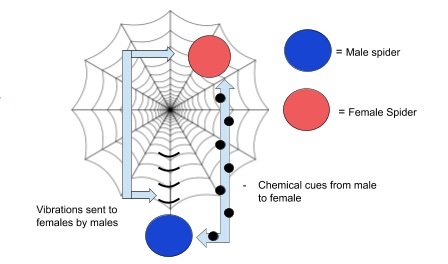
The study began in August 2016 in the Biebrza National Park, Poland, where 66 subadult females and males were captured. The researchers divided the females into three groups prior to mating which included 24 hours of living without a male, living in the area of a male, and living in the presence of a male. The trials began when a male was placed on each female web. The researchers observed how males and females interacted on each web for 5 minutes and recorded vibratory signals and chemical cues issued by the male, this is represented in figure 1. The females and cannibalized males were then saved and preserved for measurements. Using a stereomicroscope, Mouginot and Uhl were able to examine the body size and genitalia of each male and female who mated.
The authors found that only 14.9% of the females who cannibalized their partners were mutilated, whereas 88.9% of females who did not attack their partners were mutilated. They found that a male was able to average one insertion before being attacked by the female, which kept her genitalia in tact. They also determined that premating male availability did not play a significant role in physical contact nor cannibalism between partners. On the other hand, premating male availability trials revealed that male traits, such as size, lead to conflicting values. Larger males were cannibalized less and were able to accomplish more insertions.
This study suggests that female Larinia jeskovi can control if their genitalia gets mutilated or not. The females often limit the males to one insertion which allows sperm to transfer and not damage the females genitalia. Mouginot and Uhl were able to demonstrate female empowerment by showcasing that cannibalism can prevail over the males ability to manipulate the females.
Pierick Mouginot, Gabriele Uhl, Females of a cannibalistic spider control mutilation of their genitalia by males, Behavioral Ecology, arz127, https://doi.org/10.1093/beheco/arz127
Uhl, Gabriele. “This Spider Destroys Female Genitalia to Prevent Future Mating.” National Geographic, 5 Nov. 2015
