
By Kate Alexy ’22
Imagine sharing a living space with over 100,000 individuals! Valley carpenter bees (Xylocopa varipuncta) live this way, creating several dozen nests in decaying stumps or logs with entrances only centimeters apart! So how do they know which one is their nest?
Many animals locate their nests through different forms of communication such as visual, auditory, and olfactory cues to aid recognition in a variety of environmental conditions. Research done on this species of bee has suggested that nest recognition is facilitated by multiple sensory modalities, meaning these bees use different cues to distinguish their nest from others.
Bees have developed mechanisms to integrate visually distant positional information with information acquired in the immediate proximity of the nest entrance. These mechanisms are important in quickly locating the correct nest in order to limit the chance of predation while searching for an opening as well as helping them avoid entering a neighbor’s nest and creating conflict.
A recent study investigated the importance of both visual and olfactory cues in the nest recognition ability of female carpenter bees. The purpose of this study was to distinguish between the effects of proximal and distal visual landmarks in a process called “visual homing” as well as the effect of the presence and absence of scent cues in olfactory homing. Visual homing is the ability of a bee to correctly identify its correct nest or “home” based on visual cues. The researchers tested the influence of far and close range visual features on nest
localization, predicting how alternative cues would affect how bees distinguish between nests. The study also examines if there are particular visual or olfactory cues the bees rely on more than others to navigate the log and find their specific nest. For example, if bees heavily rely on far-away (distal) cues before they even reach the nest, it is likely that rotating the log would increase search times and errors.
The researchers manipulated these long- and short-range visual cues associated with nest entrances in order to assess the importance of visual and olfactory sensory modalities in nest recognition. They observed four logs over the course of the study, each containing 5-20 active nests. To measure cue effect on navigation, they specifically looked at the speed and accuracy of nest localization, measuring the amount of time it would take for a female bee to correctly enter her nest and the number of errors she made before settling into the correct nest.
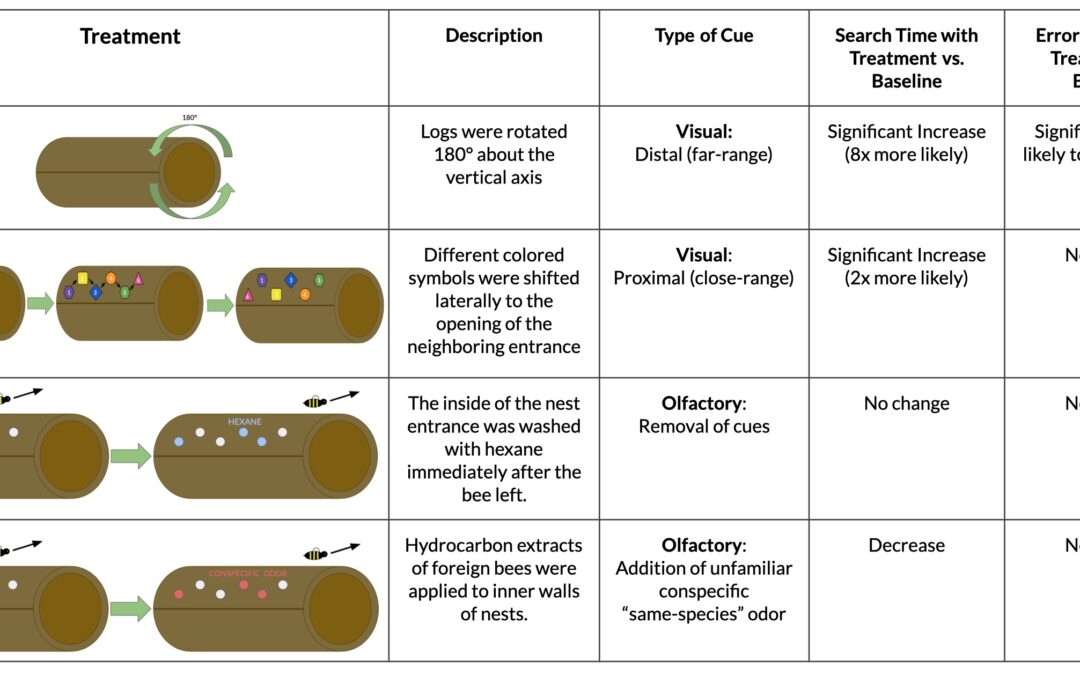
Baseline speed and accuracy measurements were compared to four manipulation trials which included two visual and two olfactory manipulations, respectively. These specific manipulations allowed for the exploration of the relevant sensory cues that the carpenter bee uses to function in high-density nesting sites. The four manipulations were as follows: 1) Rotating a log 180° about its vertical axis, 2) Laterally shifting colored symbols to the edge of a neighboring nest entrance, 3) Rinsing entrances with hexane to remove olfactory cues, and
4) Applying foreign bee chemical cues to the nest (Figure 1).
Both visual treatments (log rotation and symbol shift) significantly increased search time of individuals relative to baseline while the removal of odors had no significant effect. Surprisingly, the addition of foreign odors actually decreased search time. Overall, these results suggest that both visual and olfactory cues play a role in nest localization, but the bees rely more heavily upon visual cues. In other words, visual cues may be sufficient in the absence of olfactory information. Furthermore, the far-range visual cue had the largest effect, as the log rotation resulted in bees taking eight times longer than baseline to locate their correct nest! Carpenter bees therefore pick out their nest from afar and already know which one is theirs as they are flying toward it!
Ostwald, M. M., Shaffer, Z., Pratt, S. C., & Fewell, J. H. (2019). Multimodal cues facilitate nest recognition in carpenter bee aggregations. Animal Behaviour, 155, 45–51.
