
By Victoria Holman ’21
Insects may be very low on the list when you think of social creatures, but in fact some species, such as ants, have very highly organised social structures. Each individual worker ant has to work together to raise young and to forage for food so that they optimize the fitness of the entire colony. In order for a colony of ants to cooperate, they need to be able to communicate information effectively between themselves. Communication can occur in a range of modalities that include auditory, chemical and visual signals.
Ants utilise pheromones, these are chemical signals that can transmit information to organisms of the same species (conspecifics). Often organisms will have multiple modalities of communication that they utilise in everyday life but their reliance on a particular information source is likely to change depending on the environment.
When foraging, ants have been seen to prioritise personal information that they have gathered visually from past experiences over social information sourced from pheromones. But does this change? It has been suggested that ants follow a “copy when uncertain” method, which means they rely on social signals when their personal memory or visual acuity is unavailable.
In 1988, Beugnon and Fourcassi noted that information reliance in the ant species Formica pratensis changed depending on the hour of the day. During daylight hours ants would rely on visual memories over pheromone trails and upon nightfall the preference reversed. This was an observational study and involved no experimental manipulation, but it was interesting in that it showed that ants rely on chemical signals when visual signals are unreliable.
It wasn’t until Jones and colleagues published an article in the journal of Animal Behaviour on July 17 that this theory was tested experimentally, in the species Lasius niger. Varying light intensities were tested to see their effect on an ants preference to utilise either a visual or a chemical signal. They imitated the light intensity of a moderate cloudy day, dusk and darkness in all the trials.
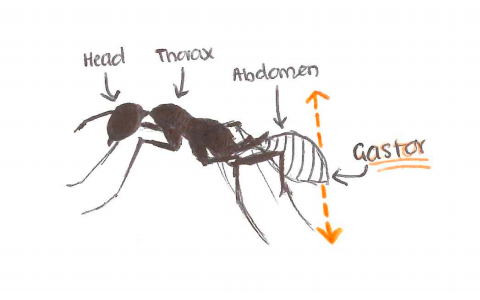
In the first trial, ants were set up in T- maze which extended from their nest in which they were allowed to locate and feed on a sucrose solution placed at either end of the T. They recorded the amount of pheromones deposited by the ants, on their journeys from the food source to the nest. Jones et al. measured pheromone deposition by counting the curving and dipping behaviour of their gastor, part of the lower abdomen, which indicated transfer of pheromones onto the surface of the maze.
In the second trial, the ants were able to forage and create a visual memory of the location of the sucrose solution. Before the ants were released back into the maze, pheromones gathered from the first trial were acquired and added into the T-maze. The pheromone trail indicated the sucrose location to be at the opposite end to what the ants visual memory had retained. This caused a signaling conflict in the ants, between their visual memory and what the pheromones depicted. This allowed Jones et al. to see which information source they favoured in each lighting conditioning. Would they rely on the pheromone trail or their memory of visual cues?
They discovered that in variations of light levels, ants showed differential preference for reliance on visual or chemical signals. When foraging in low light levels (night or dusk) there was an increased reliance on pheromone signalling and a decrease in reliance on their visual memory. The research also showed that there was an increase in the production of the pheromone in the darker light levels. This they thought occurred as a way to provide information to other ants when visual signals were no longer beneficial.
The L. niger was found to use a method of “copy when uncertain” to acquire the most information from their environment when visual cues were low. Animals who use strategic methods to source information optimise their fitness and survival. This is why the examination of how an organism’s preferences for information changes through the use of an ecologically relevant manipulation, such as light intensity, is a powerful method to study information use and delivery.
Beugnon, G., and V. Fourcassie. “How Do Red Wood Ants Orient during Diurnal and Nocturnal Foraging in a Three Dimensional System? II. Field Experiments.” Insectes Sociaux, vol. 35, no. 1, 1988, pp. 106–124., doi:10.1007/bf02224142.
Jones, Sam, et al. “Copy When Uncertain: Lower Light Levels Increase Trail Pheromone Depositing and Reliance on Pheromone Trails in Ants.” Animal Behaviour, vol. 156, 2019, pp. 87–95., doi:10.1016/j.anbehav.2019.08.007.
