
Anyone who has been keeping up with the news knows heat waves are becoming more extreme and intense all over the world. This year (2021) alone there have been heat waves around the globe, from Russia to the Pacific Northwest of the United States. However, information about the effects of heat waves on non-human animals rarely makes headlines.
Heat waves can affect non-human animals just as much as they affect us, and these effects can alter multiple parts of an animal’s biology, from the physiology to the behavior. Yet behavioral responses to heat waves are less researched compared to physiological responses. The few studies that have looked at behavioral responses to heat waves have found conflicting results. Some species exhibit beneficial responses to heat waves while others display detrimental responses. To address these mixed results, a study published in the Journal of Behavioral Ecology in September 2020 looked at the behavioral responses of two species of antlions to simulated heat waves.
The authors decided to use antlions as their model organism because past research has observed changes in antlion activity based on temperature. Antlions are insects that live in sandy areas, and they use a fitting strategy to capture their prey, ants. The antlions create funnel-shaped depressions in the surface and then burrow into the sand below the trap, waiting for an unknowing ant to stumble into it. Previous research documented that some antlions will bury themselves deeper in the sand at high temperatures to try to escape the heat. However, this could have a negative effect on antlions’ hunting behavior.
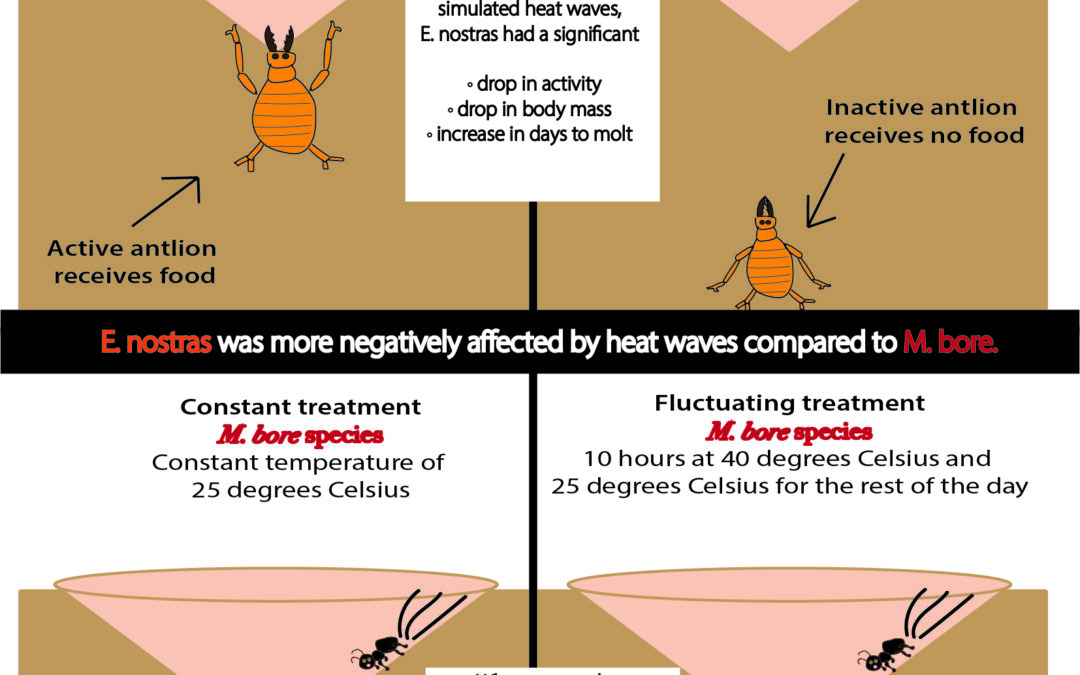
Because of this possibility, Miler and colleagues wanted to test how heat waves affect the hunting activity, mortality, body mass, and time to molt of two antlion species from different microhabitats. Additionally, they wanted to know how species — Euroleon nostras and Myrmeleon bore — differ in their responses and how insects in two different developmental stages (instars) are affected by heat waves. To address these questions, the scientists set up a lab experiment in which antlions were placed in plastic cups filled with sand. They divided antlions into two groups. One group (fluctuating treatment) was exposed to 40 degrees Celsius for 10 hours a day and then to 25 degrees Celsius for the rest of the day. The other group (constant treatment) was kept at a stable temperature of 25 degrees Celsius. The scientists ran this experiment for seven days. Each day, antlions were assessed for their activity level, and only active antlions were fed.
The results of this experiment differed between species. E. nostras was more negatively affected by heat waves compared to M. bore. E. nostras had a significant drop in activity, required significantly more days to molt, and its body mass was significantly lower after it was exposed to a simulated heat wave compared to constant temperature. On the other hand, heat waves had no significant effect on M. bore’s activity and days to molt. However, body mass was significantly lower for one of the instars of M. bore when it was exposed to heat waves. Additionally, E. nostras had a higher mortality rate than M. bore.
What do these results tell us? These findings suggest that not all animals are equally affected by heat waves, even when the species are closely related. The authors of this study suggest the contrast in responses between the two antlion species might be due to differences in the species’ microhabitats. M. bore live in sunlit areas while E. nostras live in shaded areas. Therefore, M. bore is probably more tolerant of high temperatures compared to E. nostras.
Climate scientists predict heat waves will become more frequent in the future, and that makes studies like this one vital. If we want to identify the species most susceptible to heat waves, we need to continue analyzing the behavioral as well as the physiological responses of different animals. Further work should look at the long-term effects of heat waves on different animal behaviors. Another area for future work is exploring how changes in prey behavior could affect predators. Even when predators are not negatively affected by heat waves directly, they could be indirectly affected by changes in prey behavior.
Works Cited
Miler, K., Stec, D., & Czarnoleski, M. (2020). Heat wave effects on the behavior and life-history traits of sedentary antlions. Behavioral Ecology, 31(6), 1326–1333. https://doi.org/10.1093/beheco/araa085
