
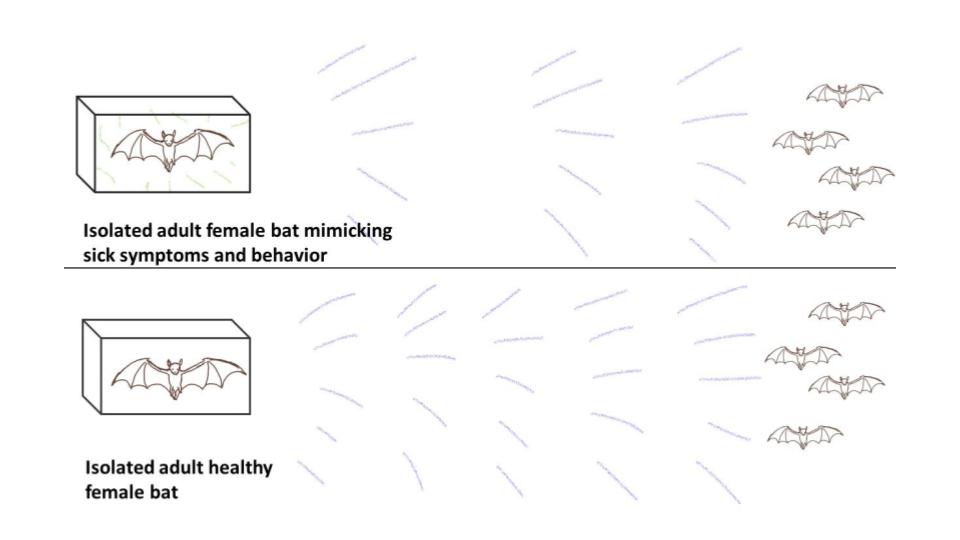
Think back to a time when you were sick. Do you call people more often to help you because you can’t do things on your own? Or do you isolate yourself to keep others from getting sick? Many animals, although they are not thinking these exact questions, are in some way in this situation too when they are sick. Individuals living in groups produce contact calls, or short communication sounds (think of a chicken’s cluck), to maintain contact with their group mates (Stockmaier et al. 2020). When an individual is sick, are they expected to make less contact calls possibly to decrease contact with group mates or are they making more contact calls to maybe gain benefits from their group mates? Biologist Sebastian Stockmaier at the University of Texas at Austin and colleagues at the Smithsonian Tropical Research Institute aim to answer this question within common vampire bats (Desmodus rotundus).
In common vampire bats, contact calls are produced at varying harmonies and durations and are used to find and maintain relationships with partners. In order to find out whether sick individuals produce more or less contact calls and whether they change anything about these contact calls, biologists, Stockmaier and colleagues, set up an experiment. Eighteen vampire bats were injected with a lipopolysaccharide (LPS), a substance meant to mimic a bacterial injection, so that bats would copy the common symptoms and behavior of a sick bat while actually being healthy. Biologists injected the same bats 5 days later with phosphate-buffered saline (PBS), a substance which has no effect on the immune system of the bat so that in this second trial the bats will be healthy and make contact calls as usual. By recording the contact calls of isolated adult female vampire bats four to six hours after each injection, this team of biologists were able to measure the duration, strength, frequency, and total number of calls made by the bats. When comparing bats from the two trials they found that bats who were injected with the substance to resemble a sick bat produced less contact call than bats who were injected with the substance to resemble a healthy bat. They also found that there was no change in duration, strength, and pitch frequency between the sick and healthy bats.
Stockmaier and colleagues found that these results coincide with an often seen behavior in bats, where sick individuals are seen to engage less with other individuals. Reducing contact calling may be a way for sick bats to reduce physical contact with others. Think back to the question proposed in the beginning of this reading, “will animals, specifically common vampire bats, call for their group mates more or less often when sick”. This study done by Stockmaier and colleagues suggests sick bats will call for group mates less than usual to reduce contact, but does not answer why reducing contact when sick is favored. However, the team does note that there are some possible explanations as to why sick bats may contact call less. They point to one of the simplest explanations which suggests that bats may be tired and inactive, as sick animals often are, so they don’t have the energy that is needed to produce the calls and would rather reroute the energy they do have into more important things. However, further research into the behavior of common vampire bats needs to be done in order to be certain. Stockmaier and colleagues point out some interesting ways in which changing the type of sickness that was mimicked may have an effect on duration, strength, frequency, or number of calls. They use rabies as an example, where infected bats may actually produce more contact calls than healthy bats because rabies is a viral disease that favors behaviors that spread the disease.
References:
Stockmaier, S., Bolnick, D.I., Page, R.A., Josic, D., Carter, G.G. (2020). Immune-challenged vampire bats produce fewer contact calls. Biology Letters, 16: 20200272. http://dx.doi.org/10.1098/rsbl.2020.0272
