
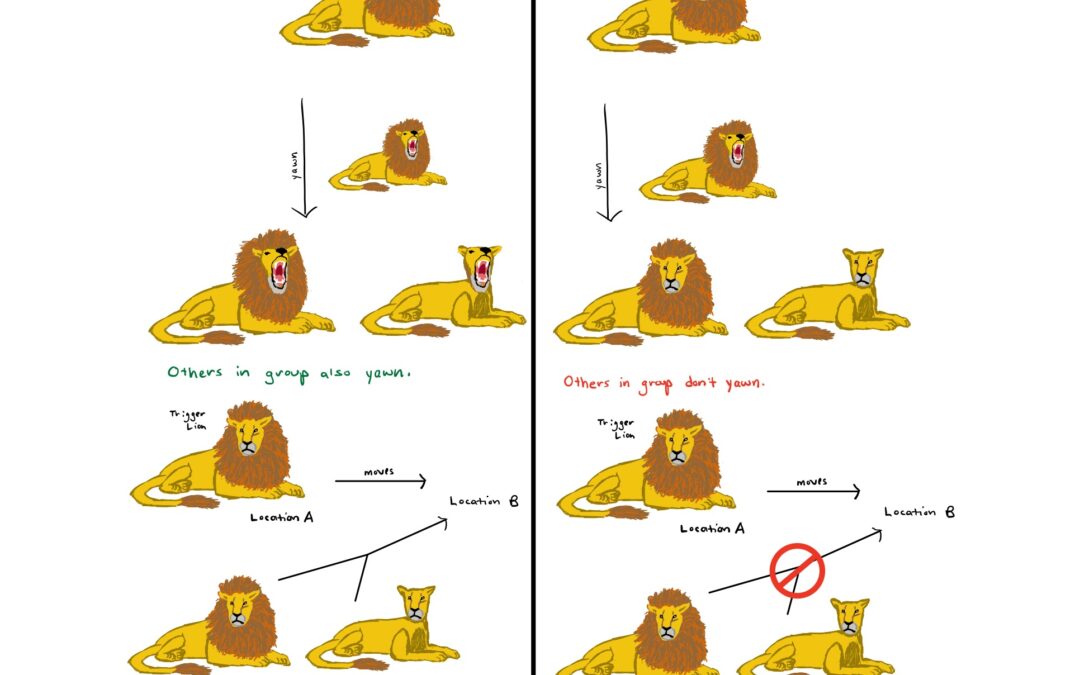
Imagine yourself sitting in an early morning lecture or meeting. It’s barely daylight outside, you are still groggy because you just rolled out of bed 20 minutes ago. Everyone is struggling to stay awake. The mouth of the individual sitting adjacent to you is gaping open as they deeply inhale and fill their lungs with fresh oxygen. It is impossible not to take notice of their yawn, and suddenly you have the urge to do the same. It is almost as if their yawn is contagious.
Yawning is not an action exclusive to humans, but rather a repetitive behavior observed in many species of mammals, birds, reptiles, and fish. Multiple hypotheses have been proposed to explain the purpose of this behavior. These hypotheses have been divided into two domains; the physiological domain and the social communicative domain. Studies of different species have come to varying conclusions about the reason for yawning, demonstrating that there is no one correct hypothesis that explains this behavior among all organisms.
While the reason for the behavior varies from species to species, studies have consistently found that yawning is contagious in most species. The explanation for yawn contagion is thought to be the chameleon effect, which “predicts that the perception of a behaviour leads to unconscious imitation by the observer that in turn provokes an alignment, or convergence, of behaviours” (Casetta et al. 2021).
Like most vertebrates, lions (Panthera leo) also exhibit yawning behavior. Casetta et al. set out to determine the possible physiological causes of yawning in lions, as well as potential social communicative purposes of contagious yawning and if it has implications on group cohesion and motor synchrony. These researchers were the first to delve into this particular behavior in wild lions and explore whether the behavior aligns more closely with the drowsiness or arousal hypothesis. The drowsiness hypothesis states that more yawning occurs during rest periods, whereas the arousal hypothesis states that anxiety inducing events trigger yawning.
The researchers collected their data on 19 lions located near their research camp in the Greater Makalali Private Game Reserve in South Africa. The lions were of varying ages and sexes. Video recordings of the animals were taken in the day and night time and were scoured for yawning behaviors. The researchers defined a yawn as a lion with a wide open mouth, tongue out, teeth exposed, lips retracted, inhaling deeply. The yawn ended when exhalation and mouth closing occurred faster than opening and inhalation. The frequency and duration of the yawns were recorded. Through their analysis, Casetta et al. determined there was no difference in yawn frequency or duration that was attributable to age, sex, or time of day.
The behaviour was also classified as occurring in relaxing context (lying down, switching between awake and asleep, and interaction with other group members), arousal context (feeding), or moving context (moving from one location to another). It was found that lions yawned more frequently in the relaxing context, which supports the drowsiness hypothesis as opposed to the arousal hypothesis.
To explore whether yawning was contagious amongst the lion groups, Casetta et al. categorized yawns as seen (observers eyes were open, head turned toward initial yawner, and no obstacles in visual path) or unseen (observers head was turned away from initial yawner or something was blocking visual pathway). Yawn contagion was observed in the lions and occurred less than a minute after the initial yawn about 75% of the time.
Casetta et al. also looked at whether or not motor convergence occurred after yawn contagion. To do this they documented the presence of three situations. The first being after not seeing a yawn, an observer completed the same movement as the trigger individual. The second situation was if after observing a yawn, the observer also yawned and matched the movement of the initial yawner. Finally, in the third situation the observer saw a yawn, did not also yawn, but still matched the movement of the initial yawner. As it turns out, motor convergence was 11 times more likely to occur following the presence of yawn contagion.
The results of this study suggest that yawn contagion does exist in wild lions, and that yawn contagion promotes motor convergence. Motor convergence has been found to improve the strength of bonds between group members, and consequently improves the cohesion and stability of the entire group. In many social species, group cohesion is essential for success in activities that increase the fitness of individuals within the population. Cooperative behaviors observed in lions include hunting, defending territory, and raising offspring.
The findings of Casetta et al. provide great insight into the cohesive nature and success of lion societies. However, with this being the first study on yawn contagion and its relation to motor convergence, there is certainly more work to be done. Looking forward, it is pertinent that this relationship is explored in other species as well the correlation between other contagious behaviors and motor convergence.
Casetta, G., Nolfo, A. P., & Palagi, E. (2021). Yawn contagion promotes motor synchrony in wild lions, Panthera leo. Animal Behaviour, 174, 149–159. https://doi.org/10.1016/j.anbehav.2021.02.010
