
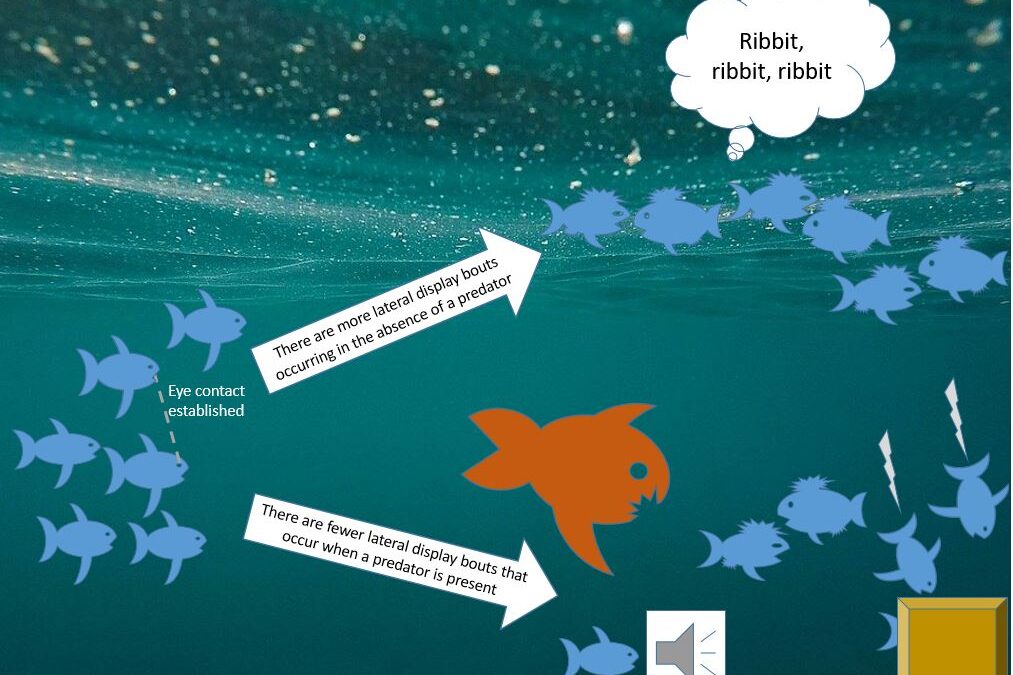
Communication is a big part of life for humans and animals alike. Think about how the red traffic light keeps you from driving into traffic or how frustrating ordering food can be without proper communication. Like us, animals also need to communicate with their own species (conspecifics) about food and the presence/location of a threat. Proper communication can act as a green or red light to modify various behavioral patterns. Therefore, individuals who learn how to communicate and receive signals efficiently have a better chance of avoiding harm. Let’s take a look at the vocal fish for instance. Vocal fish signal acoustically during territorial, agonistic and courtship behavior. One challenge to acoustical signaling is that sound production increases predation risk due to eavesdropping predators and as such, these fish learn how to respond accordingly in the presence of a predator (Maiditsch & Ladich, 2021).
There is limited information on how predators influence acoustic signaling. Some studies have shown that the silver perch (Bardiella chrysoura), the ongspine squirrelfish (Holocentrus rufus) and the Gulf toadfish (Opsanus beta) reduce their calling behavior in the presence of predators. The biggest issue with these studies, however, is that they failed to include behavioral observations that could help clarify if the reduction in calling behavior leads to increased visual signaling. To answer this question, Maiditsch and Ladich (2021) designed an experiment to identify how vocal fish modify their visual and acoustic signaling in the presence of predators in a way that minimizes predation risk and conspicuousness. These researchers chose the croaking gourami (Trichopsis vittata) as a model species.
Hanging out with friends, driving and watching movies is a big part of our daily lives. All of these aspects are also a big part of the animal world even though the hangouts may look a bit different and may even be slightly more aggressive. For instance, the croaking gourami have competitions to prove ‘whose boss’ from day to day as part of their main interactions. These competitions involve lateral and frontal display phases as a part of their agonistic behavior and signaling. Both of these phases include organized sequences (bouts) where the fish would pause and swim to the water surface for air breathing. The first phase, the lateral phase, consists of visual and acoustic displays. The visual displays include the erection of unpaired fins and head to toe circling while the acoustic displays involve croaking sounds. The loser of a lateral phase is one who gives up and flees from the bout. The escalation of the lateral displays moves the bouts towards the second phase known as frontal displays. In frontal displays, the fish protrude their mouths but do not produce any sounds.
Two scientists, Maiditsch and Ladich (2021) wanted to test how these competitions change in the presence of a threat. In the experiment, they separated two tanks that contained the female croaking gouramis and introduced a predator in only one of the tanks. They then recorded the acoustic and display behavior of the gourami during the lateral phase of bouts. These bouts began as soon as the gouramis visually spotted each other within each of the tanks. The researchers found that the display bouts were significantly shorter and fewer in the tanks that contained the predators. Also, the total number of croaking sounds produced during each lateral display was twice as high in the no predator tanks compared to the tanks that contained the predator. As humans, when we see a threat like a vehicle coming fast towards us our first instinct is to panic and run. This is not so different for the croaking gourami since they hid and even got quieter when faced with the threat (predator). Even though animals cannot speak human language, their methods of communicating allow for self and group preservation.
References
Maiditsch, I. P., & Ladich, F. (2021). Acoustic and visual adaptations to predation risk: A predator affects communication in vocal female fish. Current Zoology, zoab049. https://academic.oup.com/cz/advance-article/doi/10.1093/cz/zoab049/6306409?login=true
