
When you imagine natural predators to western honey bees (Apis mellifera), a few animals—such as bears, birds, and skunks—may come to mind but for the eastern honey bee (Apis cerana), their competition is much more fierce—the asian giant hornet (Vespa soror and Vespa mandarinia). Armed with strong bee-decapitating mandibles, a venomous stinger, and thick, sting-resistant armor, these hornets are able to kill thousands of bees each and completely take over a beehive with less than 50 individuals.
These giant hornets use their strong mandibles not only as bee-massacring machines, but also as a way to widen entrance to gain access to the inside of the hive. Eastern honey bees are not without their own set of defences, however, with the most famous example being the ‘bee ball,’ where dozens to hundreds of bees swarm an individual hornet and use a combination of temperature and elevated CO2 levels to take down this juggernautal predator within a matter of minutes.
While in Vietnam, Heather Mattila and colleagues may have discovered a new method of defence used by A. cerana from listening to local beekeepers. These beekeepers noted that following an attack from a scouting V. soror, the dominant giant hornet species in the region, the bees gathered animal feces and molded small spots around the entrance to their hive. This behavior, aptly called ‘fecal spotting’, notes not only the first instance of honey bees foraging for non-plant material, but quite possibly the first instance of tool-use as well.
Mattila et al. (2020) used a series of observational experiments to look into how fecal spots developed and the effect they have on the behavior of V. soror. They found that within 24 hours after the first attack from V. soror, the hives would gain anywhere from 300 to 600 spots, adding additional spots for the next several days. They also found V. soror workers spent 77-81% less time at the entrance of heavily or moderately spotted hives compared to lightly spotted hives.
Most significantly, hornets spent 94% less time chewing on the entrances of moderately-to-heavily spotted hives and those hives also experienced 40-73% less attacks from multiple hornets. This suggests that fecal spotting is a critically important strategy for preventing hornet attacks in the first place as opposed to the ‘bee-balling’ strategy which is better suited for situations where hornets are actively attacking the hive.
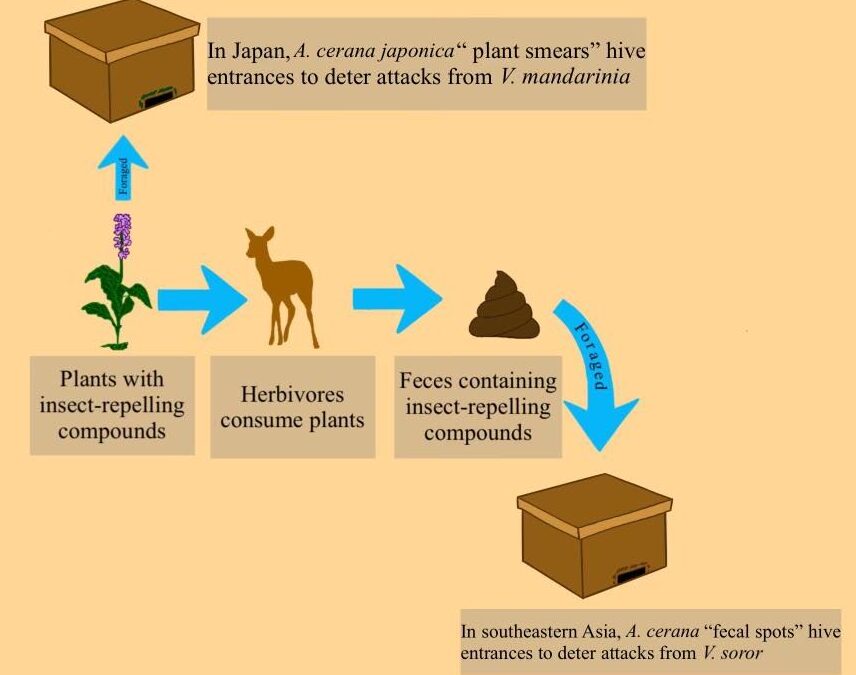
It is amazing how something as simple as forming fecal spots around the hive can have such a profound effect on the severity of giant hornet attacks, but this defence is not entirely unique. The japanese subspecies of eastern honey bees (Apis cerana japonica) has a similar defence, called ‘plant smearing’ where they smear plant material (containing odorous insect-repelling compounds) around the entrance to their hive to fend off V. mandarinia (Fujiwara et al., 2016).
This effectiveness of smearing insect-repellant plants but this begs the question, does the animal feces used by A. cerana also contain insect-repelling compounds or does feces repel V. soror through other means?
Mattila and colleagues put forth several explanations for why fecal spotting is so effective at hindering the hornet’s attacks. One possibility is that the insect-repelling compounds are still present in the fecal matter of herbivores and the honey bees gather feces specifically containing these compounds to spread them around the entrance to their hive ( Figure 1). Alternatively, natural feces avoidance behavior, highly prevalent in animals due to association with parasite and disease risks, may explain why these hornets avoid more poop-covered hives.
Regardless of the exact mechanisms behind fecal spotting, this extraordinary—and dirty—behavior shows how against all odds, nature still finds ways to fight against impossible opponents.
Literature Cited
