
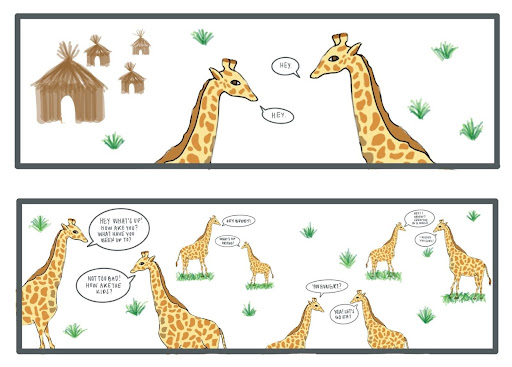
Social behavior in animals can be influenced by the environment, which includes their natural habitat. It has been found that social behavior can be influenced by human evasion, habitat fragmentation, high predation, poaching, and changes in food supply. Giraffes are megaherbivores that roam vast areas and require larger habitats because of their size. It has been suggested that environmental and human disturbances greatly impact animals with larger habitats. Social interaction among members of the same group is important for the survival and reproductive success of the group. Adult female giraffes have stronger family-based relationships and form long-term associations with members of their groups. Researchers at Pennsylvania State University wanted to study the effects of human disruptions among the adult female Masai giraffe population in Tanzania. Adult female giraffes tend to form long-lasting and strong relationships, which made them a good candidate for this study.
Over the span of six years, researchers collected photographic data of the adult female giraffe population located throughout the Tarangire Ecosystem of northern Tanzania. Their collection area stretched over two national parks, ranches, bomas, and towns. Bomas are units of land occupied by humans with homes constructed of natural materials. Towns are areas of land densely populated by humans and mainly consist of concrete structures. Towns can also be surrounded by farmlands that may be inhabited by groups of poachers. The parks observed in this study were fenced whereas local bomas and towns were not. Unfenced areas allow for giraffes to roam freely across the space, meaning that the animals and their environment are vulnerable to human invasion. Typically giraffes are not bothered by human interaction such as tourist vehicles, but do not tolerate being approached by humans on foot. The researchers defined social groups as the presence of two individuals in the same group. High rates of association between two individuals indicated a greater likelihood that those individuals would be in the same group. Repeated disruptions of the environment may lead to decreases in individual social associations among adult female giraffe communities and decrease the overall fitness of the group. The researchers predicted that adult female giraffes would display weaker social relationships and smaller group sizes, the signs of a disrupted social environment, if they lived in close proximity to human settlements.
Communities of giraffes living in closer proximity to bomas exhibited weaker relationships among all group members. These giraffes also formed more exclusive relationships and with fewer females. No adult females were observed near towns so researchers concluded that proximity to towns was not a factor that influenced giraffe social structure. Natural social behaviors of the Masai giraffe population faced some consequences as a result of proximity to human settlements. Giraffes form different social groups within the greater population of giraffes in the Taragine Ecosystem. Specifically, human interaction with the giraffe population had an effect on the patterning of social associations between adult female giraffes. Female giraffes associated more frequently within social groups than between social groups, thus demonstrating distinct communities within a population of giraffes that share the same space. Giraffes that were repeatedly disturbed by humans had smaller group sizes and more exclusive social associations. This reveals that disturbances can disrupt social structure and that the closer in proximity a population of giraffes is to human settlements the more unstable the community.
Overall proximity to human settlements can have negative effects on the fitness of communities. Changes in social structure can prevent necessary interactions among the entire giraffe population. Observations of this study reveal that adult female Masai giraffes form exclusive relationships from larger and overlapping social communities and are affected by the presence of and interaction with human settlements. Giraffe population has rapidly declined throughout most of the African continent, along with elephants and rhinoceros likely due to poaching, habitat elimination, and human invasion of their natural environment. The distinction between human interaction and natural environmental effects on social behavior in animals is still not well understood. Further research is necessary to determine how individual and collective fitness is influenced by social structure.
Bond ML, König B, Lee DE, Ozgul A, Farine DR. Proximity to humans affects local social structure in a giraffe metapopulation, J Animal Ecol. 2021;90:212-221. https://doi.org/10.1111/1365-2656.13247
