
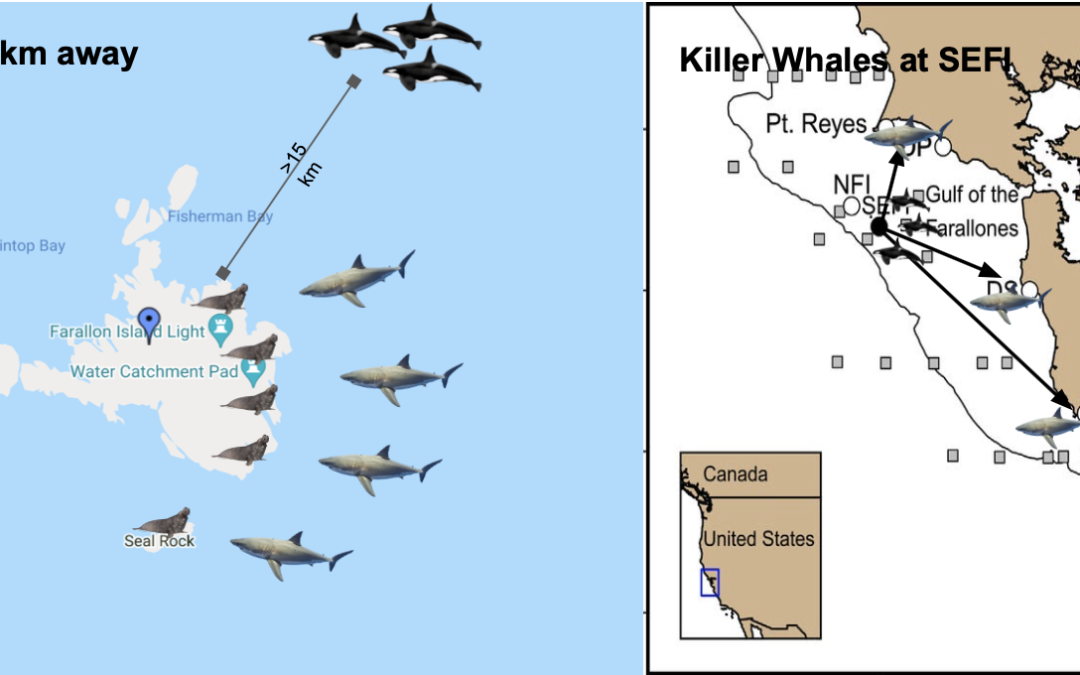
Great White sharks (Carcharodon carcharias) are known to be one of the fiercest predators roaming the depths of our oceans. If you have ever watched National Geographic’s Shark Week then you probably have seen them leaping out of the water to catch a seal or biting on the cages with people in them showing no fear. But would you think that the Great White would shy away from any other animal in the sea? They have been shying away from encounters with killer whales near a popular shark feeding ground, Southeast Farallon Island.
Researchers at the Monterey Bay Aquarium and Stanford University reported in 2019 that the presence of killer whales off the shores of common White Shark feeding areas pushed the sharks to find other areas to feed. This may come as a surprise, that an apex predator is scared of another predator, but there have been reports of pods of orcas attacking a Great White.
To study the interactions between the two apex predators and responses to each other the research team set up an observational study off of Southeast Farallon Island, Año Nuevo Island, and other pinniped rookeries off of the west coast of North America known to be spots where the white sharks and orcas would encounter each other. They hypothesized that the feeding of Great Whites at Southeast Farallon Island would decrease when the killer whales were present around the island. They also hypothesized that the daily shark predations on seals and the date at which they occurred would vary based on the distance of killer whales from the island, closer the killer whales were the less sharks that were around. Thus leading to a variation on the seasonal average of predation of seals by white sharks, less predation when the sharks aren’t around.
The researchers conducted the study over the span of 26 years (1987-2013). In this span they began by taking a census of the elephant seal population, which was usually in the range of 1000-1600. Then they set up “shark watch” observing the sharks’ predation, recording what the prey was when they could distinguish it. They conducted the shark watch from September 1 until November 30 each year. Sharks were also tagged to enhance their observations of sharks in the area and the migration patterns across the ocean.
They also spotted killer whales from the shark surveys, whale surveys from the island, “opportunistic island-based observations”, and wildlife viewing tour boats. The estimated distance from killer whale pods to the shore was recorded. These surveys were carried out year round, however they were ramped up in the September 1 to November 30 window to observe the interactions or change in behavior between the sharks and killer whales.
The data showed that the apex predators showed up off of the coasts with the presence of ample prey. The killer whales peak in appearances in May in correlation with the migration of juvenile gray whales and the spring molt of elephant seals. There is a second peak that occurs from October through November when the white sharks are there and elephant seals are molting again in the fall. This must be due to the cost versus the benefits of a shark or killer whale spending time where food is readily available in ample amounts during specific times of the year. These predators need to find a high quality and nutritious food in order to sustain their body in the oceans dealing with migrations and the constant currents. The data supports this claim with the statistic that the shark predations on seals were correlated with the seal population, the more seals the more shark predations.
More of the data shows the overlapping time period and the way the sharks behave when killer whales are in close proximity. The data they collected showed a steep decline in shark predations off the coast of Southeast Farallon Island when killer whales were within 3 kilometers of the shore. Despite the need for ample energy, sharks seemed to shy away from Southeast Farallon Island when the killer whales were within 3 kilometers. This is important because the sharks seem to see some cost of hunting near the island when killer whales are around. The researchers suggest that despite no witnessed killer whale attacks on sharks, there may have been instances leading to the sharks avoiding the killer whales. The researchers came up with one concrete example of the sharks disappearing when the killer whales arrived. They had 17 white sharks present using the acoustics from the tags in each shark. When they saw 2 pods of killer whales move into the area the researchers no longer could pick up any of the acoustics from the shark tags.
The researchers suggest the avoidance behaviors of white sharks could turn into a long term effect on elephant seal populations and the white sharks. They suggest that the lack of shark predation on the seals there could become overpopulation problems because the killer whales cannot replace the predation of white sharks. The researchers also claim that the white shark population could take a hit due to the effects of their avoidance behavior. They bring in the research of others that pre-migration feeding correlates to performance on the migration. A lack of performance in the migration could cause the shark to go astray or not make it through the migration affecting the population of sharks.
Sources
Jorgensen, S.J., Anderson, S., Ferretti, F. et al. Killer whales redistribute white shark foraging pressure on seals. Sci Rep 9, 6153 (2019). https://doi.org/10.1038/s41598-019-39356-2
