
Imagine yourself sitting at a table with a group of friends deciding somewhere to eat. Eventually you decide to get in the car, drive to McDonald’s, order your desired meal, grab your food from the drive-thru window and park your car to disperse and finally eat your delicious chicken nuggets and fries. This is not so different from the communication resident killer whales use while foraging for food. Marla M. Holt, M. Bradley Hanson, Candice K. Emmons and their team of researchers identified the acoustic cues resident killer whales use while looking for their next meal.
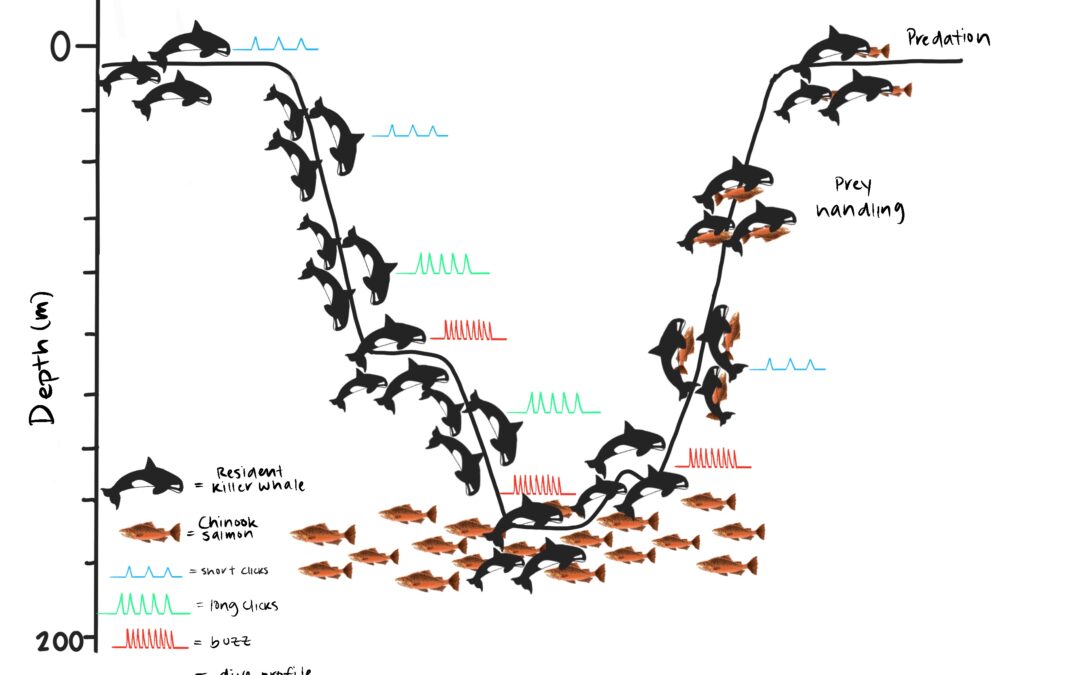
When you think of communication, you probably think of language, texting, emails, phone calls, etc, but this is not how animals communicate. You must be thinking, if animals don’t speak with words, how do they communicate? Killer whales along with other odontocetes such as toothed whales – including dolphins and porpoises – use echolocation. Echolocation are ultrasonic sounds, or in this case clicks, that move through underwater objects then return in echoes for the whales to interpret. When searching for prey, these resident killer whales use three variations of clicks: slow repetition clicks while searching for prey, fast repetition clicks while homing in on prey, and rapid clicks or buzzes immediately prior to capturing prey.
There are three types of killer whales: resident, transient and offshore whales. Marla M. Holt, M. Bradley Hanson, Candice K. Emmons and their team researched resident killer whales which specialize on Chinook salmon prey in the San Juan Islands off the shore of the state of Washington. Wild animals are incredibly hard to study without disturbing their natural habitat, making for a long research project. This investigation began in 2010 and went through 2012 in the months of June and September, and was just recently published in 2019. In order to collect data they used digital acoustic recording tags which were suction cupped to the killer whales. These special tags record pressure, temperature, three-dimensional acceleration and three-dimensional magnetism. It’s like having a little sticker on your back that tracks your temperature and movements.
Killer whales can dive to magnificent depths of the ocean. As a part of this study, they connected the diving patterns to foraging strategies with clicking. At the shallow waters around just three meters, resident killer whales use slow click trains while searching for their prey. During these slow click trains, the killer whales dive down to one hundred and sixty meters below the surface. At a point while diving down, the train clicks shift from slow to fast clicks. Once the clicks shift from slow to fast, the whales slow their descent and reach their maximum depth. This is when the action happens. A buzz signal is sent when it is time to close in and capture the prey. Once they have grabbed their meal, they bring the prey back up above the Chinook salmon habitat where they handle the prey and share their food. Finally, once they have returned to a shallower depth, they eat their meal. In a way, the slow clicks are you and your friends deciding where to eat, the fast clicks are you driving to McDonald’s and the buzzing is when you order your meal before you pick it up to eat.
The objective of this study was successfully unveiled. This team was able to understand and identify the sounds and acoustic cues for different phases of foraging. Their study was made even more incredible as they were one of the first to provide acoustic indicators of foraging in endangered populations that are challenged with a decrease in prey and interrupting noises in their critical habitat. Unfortunately, human fishing and vessels have been disturbing both the amount of prey for killer whales and the echolocation they use to communicate, making it more and more difficult for the killer whales to forage. Luckily, this study lays the foundation for further investigation of the use of killer whale sounds and foraging behavior, including how humans have impacted this behavior.
These clicks and buzzes are primarily used for foraging and not for socialization. Killer whales do seem to have another form of communication that uses calls and whistles in order to communicate in shallow waters. Just as humans have many different tones for communication, these whales have their own complex language, which we are just now beginning to uncover.
Holt, M. M., Hanson, M. B., Emmons, C. K., Haas, D. K., Giles, D. A., & Hogan, J. T. (2019, November 22). Sounds associated with foraging and prey capture in individual fish-eating killer whales, Orcinus orcaa). Scitation. Retrieved October 14, 2021, from https://asa.scitation.org/doi/10.1121/1.5133388.
