
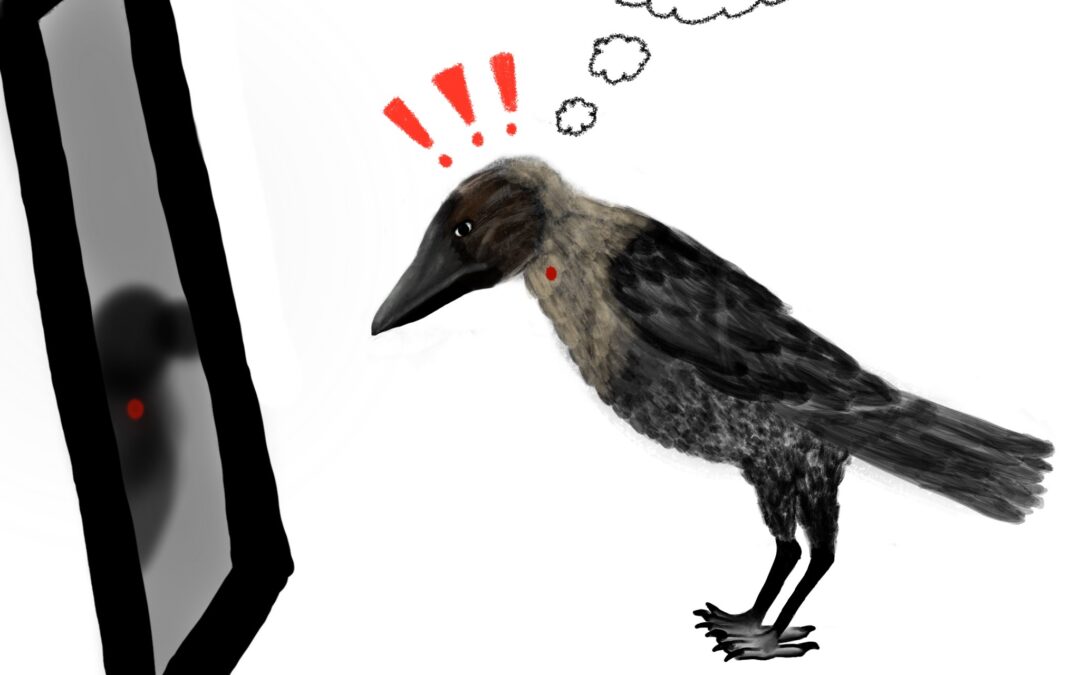
Indian house crows have the ability to recognize themselves in a mirror at a level predominantly associated with primates. Self-recognition is a cognitive ability that was previously thought to be unique to humans. However, self-recognition in other mammals and non-mammals has recently been reported. These new findings have sparked an interest in the study of a variety of animals’ ability to recognize themselves. It has been found that there is high variability in cognitive abilities between species and individuals within those species when it comes to self-recognition. Birds show high variability in self-recognition. Some species of birds are successful at self-recognition and others are not. The researchers at the Department of Zoology at the University of Delhi wanted to study self-recognition in the Indian house crow. The chose the Indian house crow for their experiment because crows are a highly social and a highly cooperative species known for their impressive cognitive abilities.
The mirror-mark test is used to determine if an individual has the cognitive ability of self-recognition. This test uses a mark that is placed on the body of an animal in a way that the animal can only see it from a mirror image. This mark is used to evoke self-exploration and action towards the mark. Self-directed actions are what scientists deem as evidence of self-recognition in animals. Self-directed actions provide evidence that the individual sees the strange mark on the reflection in the mirror and is able to realize that the reflection is itself. From there the individual uses the reflection to aid in the removal of the mark. The researchers at the Department of Zoology in the University of Delhi used a mark test on Indian house crows to assess this species capability of self-recognition. The researchers tested six crows by marking them with a red dot and a black dot and allowing them access to a mirror. All the birds went through trials with the black dot and trials with the red dot. The black mark was used as the control because it was not distinguishable in color from the crows’ feathers. The use of the black dot was to ensure that the results were due to the crows’ seeing the mark and not other factors like being able to feel the mark on their body.
Indian house crows exhibited explicit directed responses towards the colored mark on their body according to the results of the study. These directed responses confirm that Indian house crows are able to recognise themselves when looking in a mirror. The researchers observed higher removal rates of the colored mark than the black mark. This indicates that the crows were able to recognize that the colored mark was on their own body when looking in the mirror. Out of the six crows tested, two did not exhibit any directed response to the colored mark. Although not all the crows exhibited a direct response, it is reasonable to conclude that crows possess the ability of self-recognition. Individual variation in cognitive ability can be attributed to the results of this experiment. Not all animals of the same species have the same cognitive abilities; therefore, variation is expected in species when it comes to self-recognition.
By studying self-recognition in crows, evidence has been gathered of high levels of evolutionary convergence between birds and mammals. Self-recognition was previously attributed to higher cognitive abilities that were thought to only be in humans and certain primates. Crows belong to a phylogenetic group of birds called Corvids. This group has larger brains compared to other birds. Additionally, they possess a much larger forebrain (cerebrum). In humans, the forebrain is directly associated with self-recognition. It is thought that like humans, the forebrain in crows is responsible for self-recognition. Neural connections and the organization of information flow of birds and mammals are similar. Both bird and mammal forebrains evolved in a similar manner and are able to generate comparable executive functions. The evidence of self-recognition in crows through the mirror-mark test implies that independent but similar evolution of brain function occurred between birds and mammals. It is possible that birds and primates faced similar selection pressures that caused similar evolution in brain function resulting in similar behavioral responses.
Buniyaadi A., Taufique S.K., & Kumar V. 2019 Self-recognition in corvids: evidence from the mirror-mark test in Indian house crows (Corvus splendens). Journal of Ornithology 161, 341-350. (doi: 10.1007/s10336-019-01730-2)
