
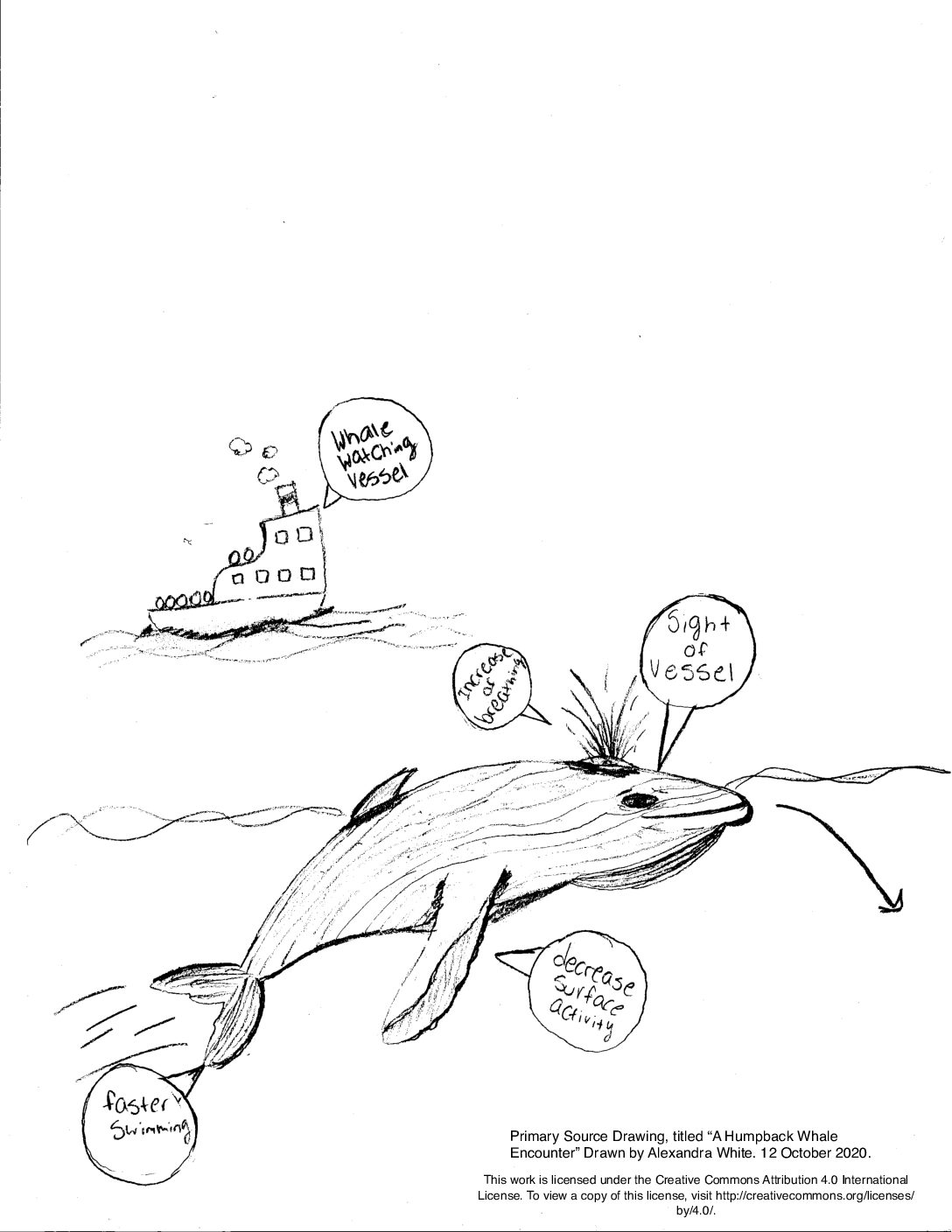
Whale watching tours have been a public gripping experience for many years, especially in unique locations, like Juneau, Alaska. Whale watching even brings in millions of dollars worth of revenue to the city. Yet, there is an increased risk on the humpback whale population because of the increasing large amounts of whale watching boats and tours. The study, completed by Schuler et al (2019), grapples with the issue of the long term health issues of the humpback whale population specifically in Juneau, Alaska. The study set out to observe the whales and their changes in behavior due to the whale watching tours and the group hypothesized there would be a negative impact on the whales due to the boat tours.
Schuler et al (2019) studied the humpback whale population (Megaptera novaeangliae) specifically in Juneau, Alaska. The study lasted a total of 147 days spread among two points on the coast, Point Retreat and Point Lena. The researchers observed the whales from the months of June through October then from May to September. Among this time the researchers wanted to observe four behavior states that the whales would display. The first was feeding or the amount of eating on the surface along with the changes in direction while feeding. The second was resting and the third was the amount of surface activity. The last was the amount of traveling the whales did during the presence of vessels. These changes were observed in the presence of boats and without any boats. In order to observe the behavior changes and transitions, they also used the breath rate and respiration rate of the humpback whales. For whales, a breath rate would mean the time difference between two blows out of the blowhole on the top of the whale. The respiration rate was observed by counting the number of blows within a sighting. With these four behavior states in mind, they observed their changes in behavior with the presence of whale watching boats. In order to complete the findings, the study also observed the presence of boats, the number of boats, and the percent of time spent with the whale watching boats could affect the behavioral changes.
The study showed that in the presence of whale watching boats, the humpback whales were more likely to choose a different path, increase their swimming speed, and experience an increase in breath rate during the exposure to vessels. Along with the presence of whale watching boats, the amount of time whales spent with the boats increased their respiration rate. In the case of behavior changes during time with vessels, the whales experienced more feeding during the presence of vessels and more moving in the absence of the vessels. The whales did not alter their feeding or traveling even if a vessel was present. In the study, the only significant change in behavior pattern was the change of surface active behaviors. These humpback whales were more likely to change their behavior from surface active behaviors to either traveling or stop surface activity in response to the boat watching tours.
The study concluded that there were short term effects on the presence of whale watching boats on the humpback whale population. The changes in speed and direction could be a response to try and move away from an unknown predator. The noise of the vessels could play into the increased respiration rate due to the loud sudden changes of noise a whale could hear and experience. In the case of changes of behavior, the researchers bring up that whales may not change their feeding patterns in the presence of vessels possibly due to the need to gain energy by feeding. The decrease in surface activity could show a negative response to the whale watching boats.
The study done by Schuler et al (2019) does not study the effects of these behavioral changes on the long term health effects of the whales. They do speculate that with a constant disturbance of daily life patterns such as feeding and traveling whales may experience a decrease in nutrition. Also with prolonged faster speed and changes in breathing rate could affect the whales long term in terms of physical fitness. In conclusion, whales are shown to have negative effects in the presence of whale watching tours. In the end, are we really watching whales or are whales just changing in order to survive?
Schuler, Alicia. Piwets, Sarah. Clemente, Jacopa. Steckler, David. Mueter, Franz. Pearson, Heidi. Humpback Whale Movements and Behavior Response to Whale-Watching Vessels in Juneau, AK. Frontiers in Marine Science. Volume 6. 9 November 2019. Pages 1-13. https://www.frontiersin.org/articles/10.3389/fmars.2019.00710/full
