
By Zachary LaRocca-Stravalle ’22
Imagine yourself taking a stroll through rural New Mexico: open, grassy fields, patches of juniper trees among the cane cholla and prickly pear, and blue skies over the distant Sangre de Cristo Mountains. A scenic view. Now you are in downtown Boston: crowds wait for the crosswalk signal, cars honk every thirty seconds, and street performers attract the attention of tourists at a bustling Quincy Market. Are either one of these places more appealing? How about for an animal? Indeed, these two environments present very different landscapes and ecosystems, and while humans may enjoy living in either, many animals struggle. Unsurprisingly, urbanization poses threats to many animal species that cannot adapt to the rapid alteration in environment. Those that can, however, often develop different physical and behavioral characteristics from their non-urban counterparts to cope with this change. This is the case for the Eurasian coot, and researchers in Poland took advantage of this bird’s resilience. They were interested in not only how behaviors differed between urban and rural coots, but also how their behavior changed since they populated the urban environment. Essentially, are there phenotypic differences between old and new urban coot populations? And how would this be tested? Instead of spending decades collecting data on one urban population, the researchers cleverly collected data in two different cities where the respective coot populations were established at different times. In Warsaw, coots where first observed in the 1960s and in Łódź, the late 1990s — coots in Warsaw had a thirty year head start.
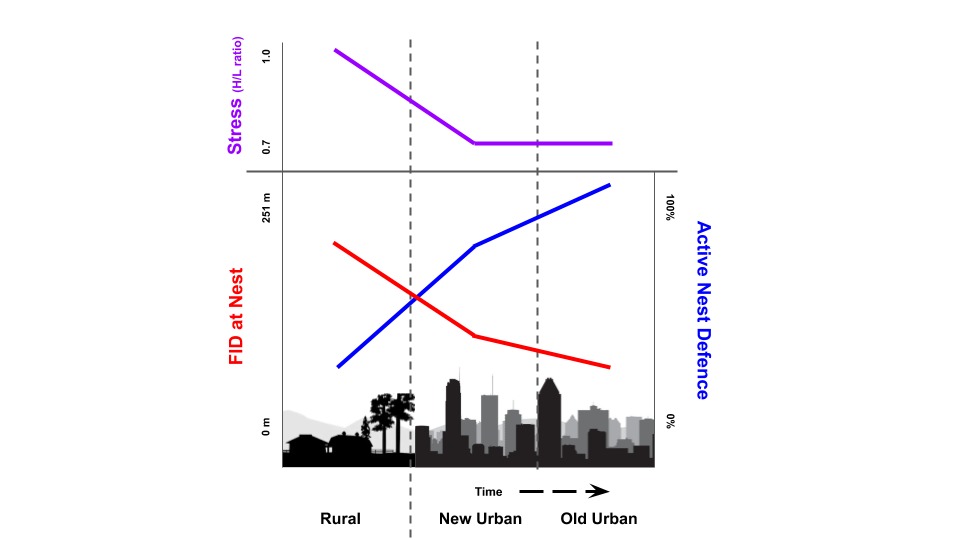
The researchers tested two behavioral traits and stress responses in three coot populations: rural coots, the Łódź coots (new urban) and the Warsaw coots (old urban). To test behavior, they wanted to see how close a human could get to the nest before the adult(s) fled, and whether or not the inhabitants tried to defend it (e.g. threatening posture or alarm calls). First, they found that birds in the urban areas had a lower flight initiation distance (FID) — that is, the observer could get closer to the nest before the bird fled — than birds living in the rural environment. This is perhaps not surprising, considering the differences in daily human interaction. Within the urban populations themselves, FID was lower in the old urban population — the reasons of which will be explained below. Second, active nest defense was found to be inverse to FID; more defensive (and aggressive) behavior occurred in the urban populations, with the old urban coots showing greater defense of their nests. In addition to measuring these behaviors, the researchers also looked at stress levels. You might think that constant noise, unrelenting lights and the risk of getting hit by a car, among other things, would be stressful for a poor coot. But that’s not the case here. In fact, stress went down in urban populations and was similar for both new and old urbanites.
So…why? What are the reasons behind these trends? Actually, this study raises the many complex, interconnected processes that affect an animal’s success in the urban environment. Let’s break it down! First, there are three potential forces at play: microevolution, phenotype sorting (or frequency-dependent selection), and phenotypic plasticity. A lot of words, I know. Because there were differences in defensive and aggressive behaviors between the old and new urban populations, it is suggested that microevolutionary forces were at play here. In other words, the more generations spent in the city, the more defensive and aggressive the birds got — evolution, but on a small scale. Phenotype sorting and/or phenotypic plasticity, in contrast, were likely present in the first generation of coots to enter the city long ago. Here’s why: phenotype sorting would suggest that bolder coots came to the city because, well, they were bold enough to do it. Their defensive and aggressive traits may have already been present. Phenotypic plasticity, on the other hand, would suggest that the coots that came to the city learned how to behave in a manner that benefited their survival (i.e. being defensive and aggressive). It could be either/or, or both!
The FID data suggests that phenotypic plasticity (in the form of habituation) was responsible for such change. The more contact with humans the more comfortable the birds got. However, not only did the birds get more comfortable around humans, they also initiated the contact, no doubt in search of food. This then suggest phenotypic plasticity beyond habituation. Finally, stress levels! Because we only see a difference in stress levels between the rural and urban coots, not between the old and new urban coots, phenotype sorting seems to be at play. Coots that were able to resist stress levels initially could inhabit an otherwise stressful environment, and those that couldn’t, didn’t.
There are indeed many proposed explanations to why (and how) animals make their way to the city, and the Eurasian coot is just one example of such an animal — able to adapt to the ever changing landscape of the environment. So, next time you find yourself in a crowd of people, waiting for the crosswalk signal, look around for any animals and appreciate their resilience — and how different those city slickers might be from their rural counterparts.
Minias, P., Jedlikowski, J., & Włodarczyk, R. (2018). Development of urban behaviour is associated with time since urbanization in a reed-nesting waterbird. Urban Ecosystems, 21(6), 1021–1028. doi: 10.1007/s11252-018-0781-7
