
By Roya Best ’22
A yawn, also known as an oscitation, is defined as a reflex that is the simultaneous inhaling of air and the stretching of one’s eardrums as one’s mouth opens, followed by an exhale of breath. A yawn is slow, followed by an instance of frozen action while the mouth is open, then a rather quick close of the mouth. While research has never fully understood the purpose of yawning, in mammals they believe it to be related to brain activation and cooling of the brain after inactivity. To most other mammalian species, such as dogs and chimpanzees, yawning is considered normal and is even a form of communication. However, there is little research on an elephant’s yawn. Why is it that there is a gap in the literature about the expectations of yawning in certain mammals, the difference between species’ “yawns,” and specifically for elephants, why is there so little research? In 2017, Zoë T. Rossman and colleagues decided to look deeper into elephants’ behavior to try and answer some of these questions. In an initial study, six Asian elephants and thirteen African elephants were observed through video surveillance in the San Diego Zoo Safari Park by Rossman et. al. Their observations confirmed that elephants could exhibit yawning behaviors. From there, Rossman et. al researched the effects that yawns had on elephants’ brain activity in relation to sleep and rest.
Rossman et. al observed nine elephants (four adult females, one sub-adult female, two sub-adult males, and two adult males) under 24-hour video surveillance in the Knysna Elephant Park, on the Western Cape of South Africa. Observations and data were collected during the cooler season (June-September) and the warmer season (December), for a total of 273 hours of daytime footage and 72 hours of nighttime footage. Elephant’s behavior differed between day (8:45 am to 4:45 pm) and night (6:00 pm to 6:30 am). In-person daytime observations occurred in 2-hour time blocks twice a day, and nighttime behavior was solely observed from the infrared camera. During the day, elephants walked around and interacted with human observers; while at night, laying down and feeding were the two most common behaviors. Feeding typically occurred throughout the day until 12:00 am, and laying down occurred throughout the night.
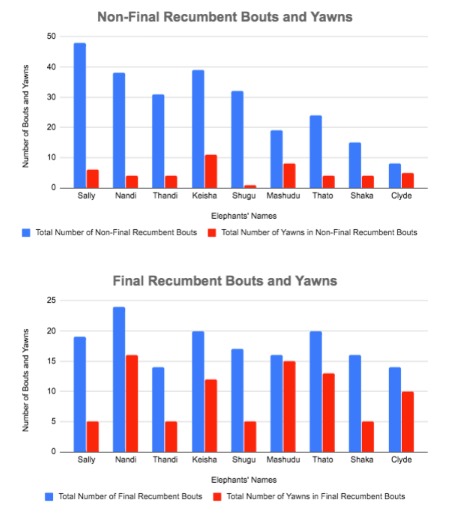
After analyzing hours of footage, Rossman and her team found evidence of yawning behavior related to brain activation. While during the day, only one yawn was accounted for, at night there were 133 yawns observed. Yawns were found to occur during a recumbent bout, which is defined as elephants transition from an inactive laying down position to an active standing position. These bouts lasted for one to three hours and frequently occurred more than once a night. The last bout of the night was known as the “final bout,” all other bouts that occurred throughout the night were known as “non-final bouts.” Both non-final and final recumbent bouts were found to occur in all elephants. Non-final recumbent bouts occur between 14 and 24 times (varying elephant to elephant). Final recumbent bouts were found to occur between 8 and 48 times (varying elephant to elephant). Non-final bouts were found to be less common in the majority of the elephants observed and typically lasted about half an hour shorter than final bouts. When yawns occurred during bouts, they took place 1 to 4 times a night and occurred in all elephants despite age or gender. Rossman et. al found that yawns occurred more often in final bouts than in non-final bouts. They inferred that this could be due to the purpose of yawning and how it relates to activating the brain after long periods of inactivity.
Additional analysis of previously observed elephant yawns by Rossman et. al, were used to determine if contagious yawning occurred in elephants. Contagious yawning is when one individual starts a yawn then another individual begins to yawn as well, due to the sight of the first individual’s yawn, and their yawns overlap. In this study, Rossman et. al observed 72 hours of night footage and recorded 6 contagious yawns, 5 of which were from recumbencies that were associated with the final bout of the night. These observations support Rossman et. al’s theory that yawns typically occur after recumbencies (periods of inactivity in the brain). The literature on animal behavior has found that contagious yawning in humans and other mammals have been linked to empathy and other social cues. Rossman and her team theorized that if contagious yawning did occur in elephants, there could be implications for the functionality of yawning, specifically as a social function.
In mammals, yawning has been recorded as a way to communicate and express emotions and behaviors, such as feelings of fatigue and boredom. Many studies are conducted to explore the biological and psychological meaning behind yawns in certain mammals, however, the research on elephants’ yawns is quite sparse and little is known about their purpose. Rossman and her colleague’s contributions to the literature have confirmed that elephants do yawn, and shown that there are patterns in which they occur. The next step for future research would be to explore the functionality and social implications these yawns have in elephants. This research could be compared to the functionality of other animals’ yawns and could help us better understand how animals interact socially within an environment.
Anderson, J. R., Myowa–Yamakoshi, M., and Matsuzawa, T. (2004). Contagious yawning in chimpanzees. The Royal Society Publishing, 271 (6).
Baenninger, R. (1997). On Yawning and its Functions. Psychonomic Bulletin & Review, 4 (2).
Romero, T., Konno, A., and Hasegawa, T. (2013). Familiarity Bias and Physiological Responses in Contagious Yawning by Dogs Support Link to Empathy. Plos One, 8 (8).
Rossman, Z. T., Hart, B. L., Greco, B. J., Young, D., Padfield, C., Weidner, L., Gates, J., and Hart, L. A. (2017). When Yawning Occurs in Elephants. Frontiers in Veterinary Science, 4 (22).
