
By Ava-Rose Beech ’21
Researchers find that large concentrations of oil in the oceans are doing more than just polluting the waters, but actually altering group dynamics and social behaviors of fish.
In April of 2010, people all over the world were directly affected, and devastated, by the infamous Deepwater Horizon oil spill in the Gulf of Mexico. The tragic event was followed by circulating aerial photos of the catastrophic damage as well as images of birds, fish, turtles, and many other aquatic animals washed ashore and floating dead in the sea due to the vast amounts of oil in the Gulf of Mexico. Oil pollution in the oceans is one of the greatest dangers to aquatic organisms and delicate ecosystems. And it isn’t just large scale events, such as Deepwater Horizon, that are causing oil concentrations to rise in the oceans. Oil pollution is also building slowly on a daily basis due to the increasing amount of plastics breaking down in the ocean, and other forms of oil dumping and pollution from industries. The issue of oil polluting oceans may immediately bring to mind the kinds of images described above– birds and fish covered in oil or washed up dead on shores. However, recent studies suggest that oil pollution is also affecting the behavioral ecology of these aquatic organisms.
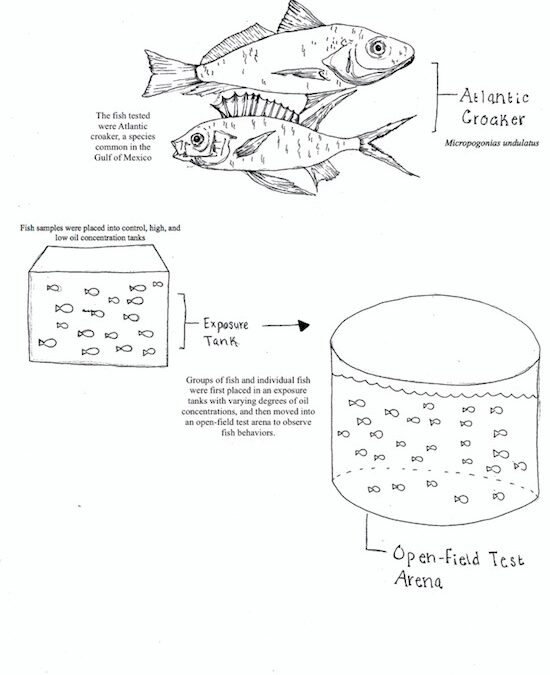
Researchers have begun thinking about the subtler facets of oil pollution, and the ways these pollutants change the behaviors of animals affected by oil pollution. One particular study looked at Atlantic croakers, a species of fish that live in high densities in and around the Gulf of Mexico. Scientists were particularly interested in finding out if there was a correlation between high levels of oil in seawater, and the social behaviors of the Atlantic croakers being studied. Specifically, these experiments studied shoaling behaviors in the fish in order to determine if oil concentrations in the water altered group social dynamics of the fish. Fish that swim, live, and function in a group dynamic are engaging in ‘shoaling behavior’. The ability to maintain social groups is incredibly important for the ecology and biological health of these kinds of fish populations. Species such as the Atlantic croakers depend upon shoaling for foraging, mating, and protection from predators. Additionally, studies have found that swimming in a school even
lowers the energetic cost to the fish of moving as the combined movement of the fish enables each individual to move through currents more easily. Notably, it has been previously observed that shoals that have more social fish tend to function better as a group, therefore elevating the fitness of the group as a whole.
Considering the importance of group cohesion for these fish, these scientists conducted experiments to examine how rising levels of oil in the oceans may be altering the sociality and group dynamics of shoals. How exactly did they do this? The researchers filtered water straight from the Gulf of Mexico into the experimental lab! These experiments also used oil sourced from a Massachusetts pipeline in order to facilitate an environment similar to that of the Deepwater Horizons spill. The researchers set up the experiment to observe shoals of Atlantic croakers placed in three different different environments: control, low oil exposure, and high-oil exposure. The findings of these experiments? It turns out that the shoals that were in environments mirroring oil polluted waters were overall less cohesive, and had altered social dynamics. The study notes that in sample groups that were exposed to oil, the fish kept greater distances between each other, moved slower, and generally did not function as well as a group. What is more, the researchers repeated the same experiment, but only exposed one fish within the group to oil concentrations, and the findings were similar. Group dynamics and social behaviors were still affected when only one fish had been exposed to oil pollutants. The findings of these experiments offer great insight and potential into an increasingly important topic. It is vital to understand the subtleties and unseen ways in which human pollution and waste is impacting and altering ecosystem function. These multidimensional and delicate systems are altered by our accumulating waste, pollution, and irresponsible treatment of the oceans. The disrupted social dynamics of fish exemplified in this study demonstrate the detrimental impact that degrading the environment is having on animal behaviors, and the ways in which these impacts impair the overall health of the ecosystems being affected.
Armstrong, Tiffany, et al. “Oil Exposure Alters Social Group Cohesion in Fish.” Nature News, Nature Publishing Group, 18 Sept. 2019,
Pallardy, Richard. “Deepwater Horizon Oil Spill.” Encyclopædia Britannica, Encyclopædia Britannica, Inc., 29 May 2019, www.britannica.com/event/Deepwater-Horizon-oil-spill.
