
By Natalie Cady ’22
Much beneath the depths of our ocean surfaces remains a mystery, spiraling curiosity of the social interactions among marine animals. Anthropogenic impacts including, but not limited to, pollution, entanglement, and direct harvesting have threatened elasmobranch species, cartilaginous fish, for years, potentially causing changes in their social behaviors. Though not much is known regarding elasmobranch behavior, social interactions among mammals have been proven important to successful cooperative foraging, predator avoidance, and social learning. Manta ray social preferences and social networks are among the many mysteries of our oceans, inspiring researchers to dive deep into the waters of the Dampier Strait region of Raja Ampat, West Papua.
Manta rays have often been considered as solitary creatures, though they are known to have a highly developed central nucleus and large brains relative to body size, two characteristics that have been linked to social intelligence and the formation of hierarchical social structures. Previous research had provided evidence that manta rays participate in “collective foraging, following, breaching, copying, play, and curiosity towards humans”, all examples of group-based behavior, though the genuinity of their social preferences remained unknown, until now.
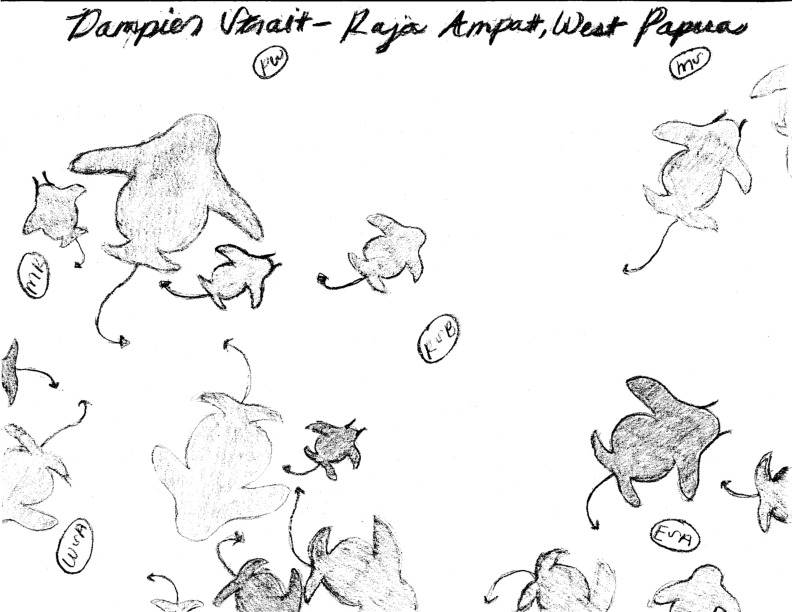
Within a 20km2 area of the Dampier Strait region, the research team observed 512 sampling occasions and 3411 individual manta ray at multiple locations. Such locations included three cleaning stations, Manta Sandy (MS), Manta Ridge (MR), and Rob’s Secret Bommie (RSB), two feeding stations, East Study Area (ESA) and West Study Area (WSA), as well as Pulau Wai (PW), an area used for both feeding and cleaning. Individual manta ray were accurately identified by their unique, lifelong spot patterns. Researchers were able to determine both the sex and maturity of each individual manta ray. Sex was determined by the presence or absence of claspers, as the presence indicated that the individual was male and the absence indicated female. Maturity was evaluated for females using evidence from pregnancies and mating scars while clasper size and calcification were used for males.
Associations were determined by observing individual manta ray around one another, but they did not necessarily have to be directly interacting. Social preferences were then quantified by the use of generalized affiliation indices (GAIs), which statistically removed non-social factors when estimating the strength of social preferences. Phenotype assortment was also taken into consideration for the differences in sex, maturity, and color morph among the population.
Preferred associations among reef manta ray were concluded by the result of higher critical values for GAIs than were expected. The most significant trends observed included females appearing at cleaning stations more while males were spotted more frequently at the feeding stations, individuals with the same site preferences typically expressed stronger connections, and males tended to avoid one another. Additionally,
data concluded that manta rays that preferred the Manta Sandy site were significantly more isolated from the population. The results from the GAI comparisons and the multiple social trends observed throughout the data collection allowed the researchers to conclude that reef manta rays are socially intelligent creatures that have formed complex heterogeneously structured societies.
The results were not only important to the overall understanding and knowledge of elasmobranch genuine social preferences, but also for the protection of the many populations threatened by human impact. While scientific research is beneficial for further our knowledge of animal behavior and ecology, it is also very important in preserving our wildlife. Since social behavior is highly linked to spatial ecology, further research will allow for the minimization of future anthropogenic impacts on elasmobranch populations.
Perryman RJY, Venables SK, Tapilatu RF, Marshall AD, Franks DW, Culum Brown. Social preferences and network structure in a population of reef manta rays [Internet]. Macquarie University. Springer Fachmedien Wiesbaden, Springer; 2019
