
By Ben Sedgwick ’21
Declawed cats may be a danger to themselves as well as cat owners.
When bringing in a new cat into a household, many owners are quick to declaw their cat. However, while not understanding the negative effects it may have on the cat, many owners will proceed with an onychectomy operation, also known as declawing. While this may save some carpeting and furniture, and reduce transmission of diseases, the negative impacts of fully declawing cats may outweigh the benefits of owning a clawless cat. While illegal in most developed countries, the United States and Canada still permit declawing in cats. To better understand the effects of onychectomy on cats, researchers conducted a study analyzing behavior differences between declawed and non-declawed cats. The goal of their research was to present correlations between declawing and the negative effects on cats.
Domesticated cats (Felis catus) are great additions for families, however, declawing will raise potential behavior and health risks. Martell-Moran et. al focused a study on adverse behavior and pain in declawed cats. They conducted a retrospective cohort study analyzing declawed and non-declawed cats. They examined 176 owned cats, and 98 shelter cats, half of the total cats declawed, and the other half as non-declawed as a control group (Martell-Moran et. al 2018). Radiographs had been conducted on the limbs from the declawed cats. These radiographs assess the presence of the P3 bone, which should be completely absent in a well-conducted onychectomy, however, it may still be present allowing for potential nail growth (Martell-Moran et. al 2018). To assess pain in each cat, they a palpation exam and used a table from another study to categorize differing degrees of pain (Hellyer et. al 2007). For analysis of behavioral changes, researchers reviewed the previous two years of medical history from each cat and noted “problematic behavior,” such as inappropriate elimination and biting with minimal provocation and aggression (Martell-Moran et. al 2018). Using Odds Ratios, the researchers quantified the strength of association between declawing and negative impact on the studied cats.
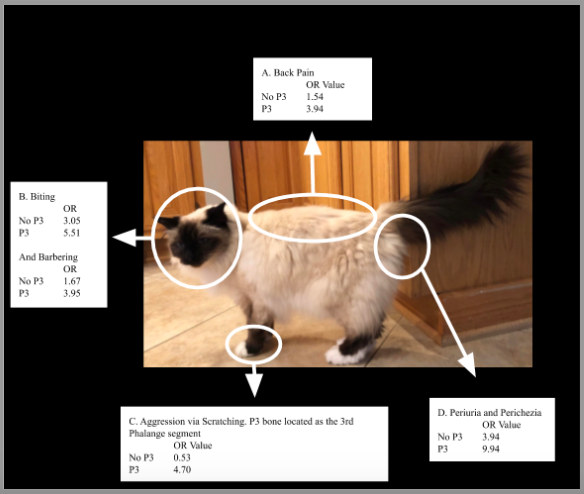
Findings from analyzing both groups of cats suggest that declawing will have negative effects. Also, the presence of P3 segments in the claws will significantly increase the occurrence of pain and problematic behavior in declawed cats (Martell-Moran et. al 2018). The study found clear associations between declawing and the increase of problematic behavior as well as the presence of more health issues. The Odds Ratio values greater than 1 correlated with back pain, periuria, biting, and barbering, suggesting increased occurrences in those events (Figure 1). These behaviors are due to animals experiencing uncomfortable levels of stress. Hence, coping with pain from declawing results in increased occurrences of stress-coping behaviors. For well-conducted onychectomy, cats with the P3 bones intact were found to be aggressive significantly more often, while the absence of the P3 bones suggests a low chance of aggressive behavior. This trend is similar throughout behavior occurrence, as the presence of the P3 segment in claws increases the problematic behavior tendencies.
Onychectomy on cats results in only increases negative behavior and pain in cats. The findings from this study will give more insight to aspiring cat owners, and inform them of the negative impacts of declawing. While the principle behind onychectomy strives for a reduction of transmitting zoonotic diseases, previous studies highly recommend cat training before carrying out declaw surgery (Martell-Moran et. al 2018). Although there is little published work to inform the public about long-term health effects of declawing cats, this study pushes towards questioning the practice of declawing cats in North America.
Martell-Moran NK, Solano M, Townsend HG. Pain and adverse behavior in declawed cats. Journal of feline medicine and surgery. 2018;20(4):280-8. https://journals.sagepub.com/doi/abs/10.1177/1098612X17705044
Hellyer P, Rodan I, Brunt J, Downing R, Hagedorn JE, Robertson SA, AAHA/AAFP Pain Management Guidelines Task Force Members. AAHA/AAFP pain management guidelines for dogs and cats. Journal of Feline Medicine & Surgery. 2007;9(6):466-80. https://www.sciencedirect.com/science/article/pii/S1098612X07001519
