
By Morgan Engmann ’20
In the science of animal behavior, it is usually assumed that animals act in such a way that will maximize their fitness. Not your typical going-to-the-gym fitness, but fitness in that the animal survives to produce offspring that can then produce more offspring. A recent study looked at how crows make decisions that will affect this fitness, specifically that of when or how they signal (caw) to other crows when they have found food. It would make sense that when a crow finds food, they would not produce any signals in order to keep all of the food for themselves, however this is not what is seen in nature. Rather, it seems that many factors go into this decision, such as predation risk and how much food is present. There are costs and benefits that need to be weighed for each choice that the crow makes, and this research attempts to tease this apart.
This study aimed to answer 3 questions: (1) What different calls do crows produce when they have found food? (2) Does size of a food source have an effect on what calls are used? (3) How do other crows respond when hearing each specific kind of call? To answer the first question, researchers placed piles of peanuts on the ground and observed the activity, call frequency in Hertz (or how high pitched the call was), call length, and how many times the call is made pre-, during, and post-food placement. Several interesting observations were made about the calls produced during these phases. When food was present, calls were the shortest, and during the post phase calls were longer. It is unclear yet as to whether or not these shorter calls act to bring other birds to the area as areas with food were seen to have more birds around, or if the other birds move to the food area on their own without using the short calls as a signal. Calls during the post phase were also a higher frequency than those made during the pre phase. These findings show that crows change their calls depending on whether or not food is present, meaning they are using the food as a cue to signal to others (Figure 1).
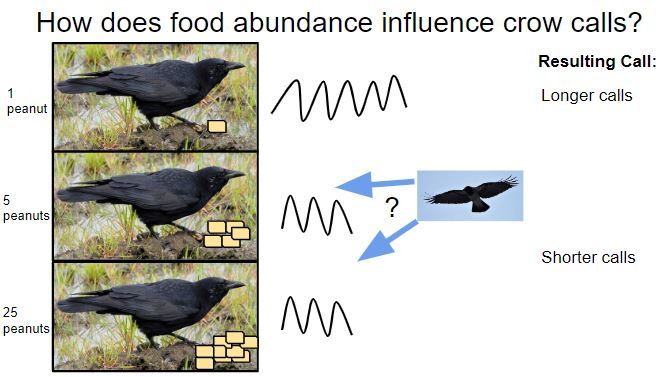
The second question was addressed by changing the amounts of food placed at the sites. The researchers used groups of 1, 5, and 25 peanuts and recorded the behavior and calls of the crows. As expected, more crows arrived at sites with more food, however they did not stay long. The average length of calls was significantly longer in the 1 peanut group and shorter in the 5 and 25 groups, but frequency and call rate did not differ between the groups. Therefore, crows change their calls depending on the abundance of food, meaning they are likely assessing their situation and how much food is present to determine what they will signal to others.
But what do these different calls mean? The researchers placed a speaker near where they would deposit food in order to play different types of calls and observe how the crows respond. When a short call was played, behavior did not significantly change during the pre-food phase. However when food was presented, the crows changed their calls to better match that of those coming from the speaker by making them more high pitched and increasing their call rate significantly. Crows exposed to medium calls made more calls of their own, performed more dominance displays, and mimicked the medium calls in that their calls were significantly longer. The speaker treatment also involved using a “scold” call, and crows responded by vocalizing more, taking flight more often, and shortening their calls compared to before hearing the speaker.
Although their results were somewhat confusing, the researchers were able to make several conclusions. Medium calls are likely used for territorial defense and aggression as other bird species have been known to use mimicry in aggressive behaviors to challenge one another. This is seen in this experiment as the crows mimicked medium calls, therefore they likely have the same purpose as seen in other birds. Because the crows only used longer territorial defense calls when there was 1 peanut present likely means that defending a territory comes with little cost when there is little food present. But why not use these calls when more food is present? Perhaps if these medium calls were used around large food piles not only would predators and competitors be deterred from the territory, but there could be unwanted side effects. For example, it could be that these calls also signal to others the location of the food which causes competition, or perhaps the crow is too distracted defending its territory with the calls to eat. This may decrease how much food the crow eats which would decrease fitness, therefore the crows use shorter calls when food is abundant. Another hypothesis is that the shorter calls used when food was abundant was a call for other crows to join as the number of peanuts exceeded the amount that a single crow could monopolize. Having more crows around the food pile could ward off other predators that may come to steal the food or hunt the birds while the single crow is distracted. However, this hypothesis was not supported by the speaker experiment which did not show any change in the number of crows present in response to the short calls.
Much more research needs to be done in order to understand how birds communicate with one another. The preliminary data here show that food does have an effect on communication and that there seems to be a trade off between territory defense and gathering food. It will be interesting to understand in the future how these animals use their voices, each other, and their territoriality in order to maximize individual fitness.
Article: Pendergraff L., Marzluff J. 2019. Fussing over food: factors affecting the vocalizations American crows utter around food. Animal Behaviour, 150: 39-57.
