
By Patrick Nally ’22
Cheetahs are known as a top predator across the world. However, cheetahs are very prone to attacks while handling their own prey from other predators such as lions and spotted hyenas. Cheetahs are considered mesocarnivores, which are animals that primarily eat meat for their diet (50-70%), while still eating other items such as plants and fruits. Knowing this information, cheetahs need to decrease the amount of time spent eating the prey and possibly increase the amount of time being vigilant to prevent kleptoparatism and attacks from larger predators. Kleptoparatism is when an animal takes food or prey away from the animal that actually caught it, basically a form of stealing. Anne Hilborn et al. wanted to find out how cheetahs behaved once they had taken down an animal of prey. There are two main strategies to handling the prey: 1) a predator maximizes the amount of food consumed before the food is taken by another predator, 2) if an animal chooses to eat quickly then the animal is spending much more time with its head lowered, which also means that the animal is more prone to attacks from predators due to lack of vigilance.
Hilborn et al. used a data set that had been collected for over 35 years in the Serengeti National Park and Ngorongoro Conservation Area in Tanzania to see how cheetahs differed in their tactics of handling their prey depending on size of their group. Cheetahs are no stranger to having their kills stolen from larger predators or having their cubs killed also by larger predators. There are three main steps to how cheetahs handle their prey: 1) the actual hunting, 2) taking a pause after the kill in order to recover physically or potentially look for predators, and 3) eating the prey they had killed. Cheetahs were seen hunting in the following social groups: a mother with her cubs, a single female, a single male, and a group of males. For female cheetahs it is costlier for her fitness to lose a cub rather than the kill she had just made.
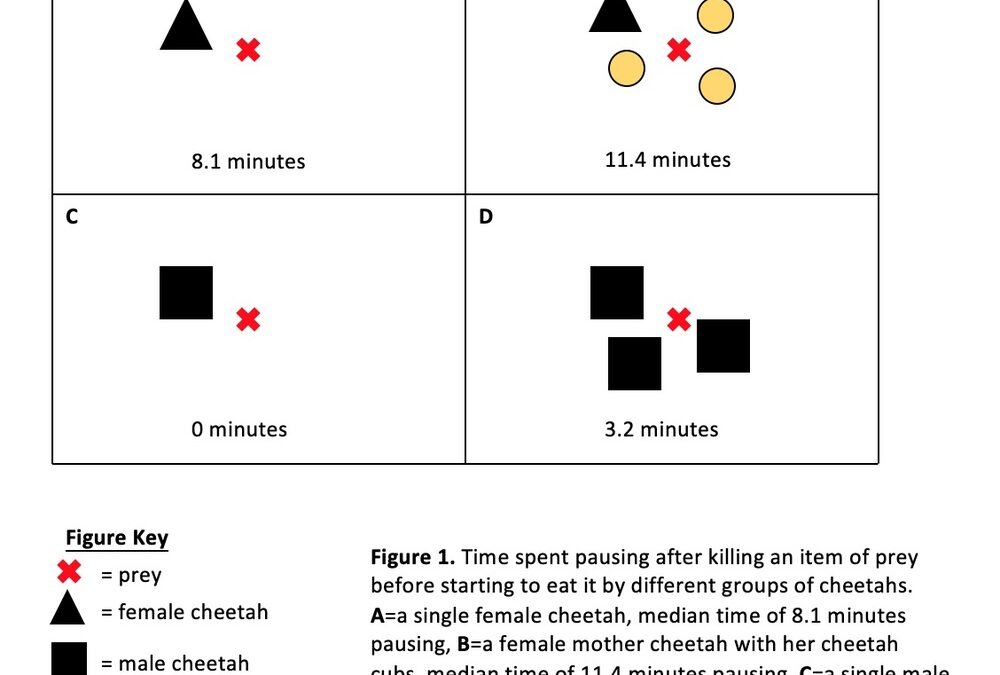
After analyzing the data collected over the past 35 years Hilborn et al. found that mother cheetahs with cubs spent more time handling the prey than any other social grouping. In terms of pausing after the kill female cheetahs with cubs took the longest (median time (mt)=11.4 minutes), then single females (mt=8.1 minutes), then single males (mt=3.2 minutes), and male groups took the shortest amount of time (mt=0 minutes) (Figure 1). The reason for male groups having a median of 0 minutes is because males would start eating even before the prey had died. In terms of time spent eating mother cheetahs with cubs spent more time eating than all other social groupings (single male, male group, and single female). The data also showed that mothers with cubs spent more time being vigilant than the other social groupings as well.
Overall single female cheetahs and male cheetahs (single and groups) are more worried about their prey being stolen by another animal so they choose to eat very fast to maximize their nutrient intake. Alternatively, the mother cheetahs biggest risk is their cubs being killed so she spent more time being vigilant and looking out for larger predators rather than eating the food as fast as they can. In order to prevent kleptoparatism single females, single males, and male groups use a much shorter handling time because that is their only main risk. Female cheetahs with cubs are more worried about another predator and the safety of the cubs rather than the prey being taken so the mother will spend more time being vigilant, giving the cubs more time to eat the prey.
I will just end it with the fact that mothers know the right from wrong and will protect her children at whatever costs.
Hilborn, A., Pettorelli, N., Caro, T. et al. Behav Ecol Sociobiol (2018) 72: 74.
