
By Scott Upton ’22
Animals often form collective groups simply for protection over predators because there is safety in numbers. Austruca mjoebergi (male fiddler crabs) have been known to gather in groups for reasons other than survival. The male crabs often form “leks”, which are essentially large clusters of crabs, in order to try and maximize their reproductive success. Writing in Male spacing and female choice in a fiddler crab, Daniela M. Perez et. al provides support and examples to explain why male fiddler crabs live in clusters, and how clusters affect reproductive success.
Male fiddler crabs primarily live in clusters in order to defend themselves against predators, and increase fitness through reproductive success. It has been displayed in other animals that females favor males who live in clusters simply because she can choose to mate from several males rather than searching for males who are independent. It is also more beneficial for less appealing males to live in clusters because they are often able to intercept females from mating with more appealing males in the same cluster. On the other hand, problems such as male competition increases when clustering occurs, and individual territories are left undefended when a cluster approaches a female. The researchers hypothesized that if female crabs favor clustered males, then male aggregation is the result of female preference. They also hypothesized that if females show no preference for clustered male crabs, then aggregations can be attributed to separate plausible explanations.
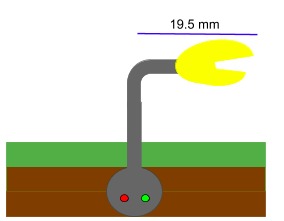
The study began in September 2015 in East Point Reserve, Australia where a population of Austruca mjoebergi w ere studied. The researchers attempted to put female preference to the test by building robotic crabs that were systematically built to mimic a wave that male crabs perform in order to win over a female (Figure 1). They were able to build an 80×80 centimeter mangrove arena that was 70 centimeters off the ground in order to create a viable environment for the crabs. The females were introduced to the robotic males who were arranged both spatially and in a cluster. Each robotic male was run by a motor hidden underground, with a yellow robotic claw protruding from the ground (Figure 1). The researchers created two experiments in which they surrounded the lone female with robotic males, and each experiment showcased spaced out males and clusters of males. Each female was allocated an unlimited amount of time to choose a robotic male, and when she did, a score was recorded when a she came within 5 centimeters of either a spaced or clustered male.
Authors Perez and Backwell found that females preferred to approach spaced males in comparison to clustered males in both experiments. Throughout the experiments, the spaced robots were visited 85 times compared to the 46 times visiting clustered robots. The most common explanation about clustering in males (female preference) does not apply to the Austruca mjoebergi. T he authors explained how clustering in fiddler crabs has more disadvantages than advantages when it comes to mating success. Less appealing males are directly compared to desirable males resulting in failure, and there is intense mating competition between male fiddler crabs. However it is still common to see males cluster, and that is because of waving. Female crabs prefer a male who can create a leading wave, in other words start a wave that other males in the cluster follow. A plausible reason as to why individual males cluster is to showcase to females that they are leaders and not followers, and that is the greatest preference in female fiddler crabs.
This study suggests that male fiddler crabs discard the disadvantages of being in a cluster in order to prove to females that they are leaders. The individual males often fail since the female can only choose one to mate with, but that isn’t stopping the male fiddler crab from trying to lead the wave. Perez and Backwell were able to demonstrate the power and importance of leadership in life through the eyes of a fiddler crab.
Sean, B. “How To Care For A Fiddler Crab.” The Aquarium Adviser, 17 Sept. 2019, theaquariumadviser.com/fiddler-crab-care/.
Daniela M Perez, Patricia R Y Backwell, Male spacing and female choice in a fiddler crab, Behavioral Ecology, Volume 30, Issue 6, November/December 2019, Pages 1769–1774, https://doi.org/10.1093/beheco/arz147
