
By Kate Alexy ’21
The ability to forage and find food is attractive to female budgerigars looking for mates. After chicks hatch the females are busy incubating, brooding, and feeding their young while the males are responsible for providing food for the females. It is therefore advantageous to find a partner with the skills to solve foraging problems. A recent study found that initially less-preferred males became preferred after the females observed they could solve extractive foraging problems. Talk about a gold digger!
Previous research suggests that sexual selection may be contributing to the evolution of cognitive abilities in both humans and non-human animals. Variation in cognitive abilities often affects reproductive success. In budgerigars, mating with a “smart” partner will result in more food brought back to the nest, therefore increasing the chances of offspring survival. While there are many morphological traits that influence sexual selection, these researchers wanted to see how direct observation of different cognitive abilities among males would affect female mate preference. Specifically, they examined whether female budgerigars alter their preference for males after observing the males’ ability to open problem-solving devices called “problem boxes” to get access to food.
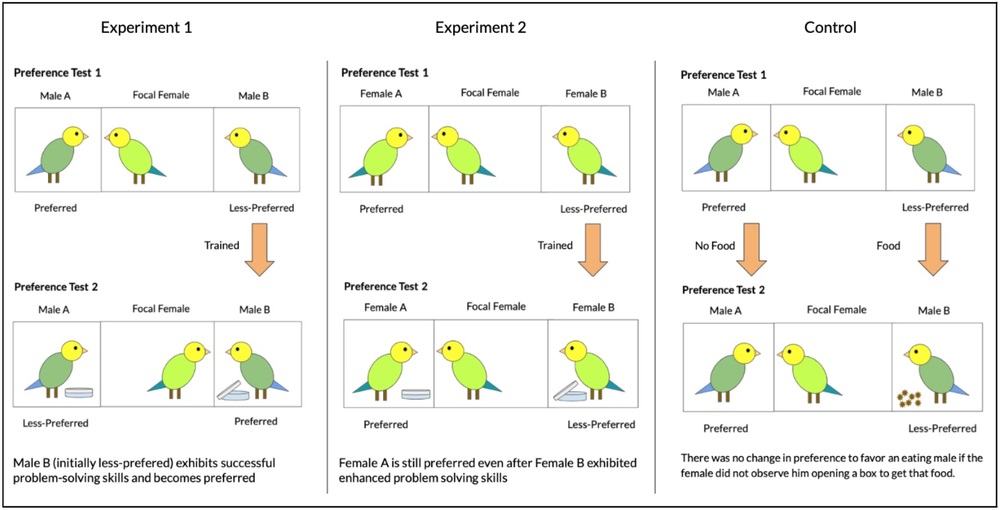
Two experiments were carried out to see just how important foraging ability was in determining the attractiveness of a male budgerigar. In the first experiment, a female was exposed to two males: a visibly skilled male problem solver that was able to open two different problem boxes and a male that could not. To assess initial preference, a female was placed in a two-choice cage with one pair of males. The male which she spent the most time near was identified as the preferred male and the other the less-preferred male. After this first preference test, the less-preferred males were trained to solve two foraging puzzles (opening a petri dish and opening a three-step box) while the preferred males did not receive such training. Females were then able to observe as all less-preferred males, but none of the preferred males, successfully opened both problem boxes. A second preference test was then conducted to see how the problem-solving success of the non-preferred males and failure of the preferred males influenced attractiveness. Not only did the females significantly increase their time spent near the less-preferred males, but the time allocated to the less-preferred males was significantly higher than that allocated to the originally preferred males!
Budgerigars are very social birds, so how do we know this change in behavior was determined by sexual preference, and not simply due to a social preference to be near skilled individuals? To rule out the possibility of problem-solving preference being strictly social, a second identical experiment was conducted but the focal female chose between two females rather than two males. Female preference did not change after observing skilled and unskilled female foragers, suggesting that selection for cognitive ability has a clear sexual component.
Sexual selection is affecting the evolution of cognitive traits across animal species. This research demonstrates that direct observation of behavior indicating the presence of cognitive skills is crucial to choosing a mate. Only when females directly observed males opening a box, did they shift their preference to the previously less-preferred males. Furthermore, there was no significant morphological difference between male foragers, suggesting that superior cognitive abilities can be selected for directly by mate choice. It’s crazy to think that learning a particular task may be the only thing needed to increase one’s attractivness to the opposite sex.
Chen, J., Zou, Y., Sun, Y.-H., & Cate, C. T. (2019). Problem-solving males become more attractive to female budgerigars. Science, 363(6423), 166–167.
