
By Bella Stevens ’23
With a world changing rapidly and becoming more and more urbanized, there are a lot of species we should be concerned about. Coyotes are not one of them. Coyotes have been a part of American history for almost a million years, and so far have survived everything we’ve thrown at them. From blanket poisoning used in the 1950s that killed 6.5 million coyotes in the American West, to recent Wildlife Service killings of 60,000 to 80,000 coyotes a year on behalf of the livestock industry, this adaptable species has managed to thrive1. Today, coyotes have colonized major cities in the U.S. where they don’t have to worry about trapping, poisoning or shooting. But what behaviors have helped coyotes adapt to city living? If we can understand how coyotes are changing their behavior, whether it’s mainly through learning or genetic selection, wildlife management can create techniques to reduce coyote-human conflict.
Recently, Stewart W. Breck and colleagues conducted an experiment to compare bold and exploratory behavior in urban coyotes of Denver, Colorado and rural coyotes of central Utah. They conducted two tests: Flight Initiation Distance (FID) and the novel object test. FID measures the distance at which an animal begins to flee from an approaching threat, and the novel object test measures the willingness to take risks and approach new objects. In the FID experiment, radio collared individuals in a study area were approached by a person and the distance at which the coyote fled from the human was recorded along with their behavioral reaction. The actual flight distance did not differ greatly between rural and urban coyotes but their behaviors did. Behavior ranged from a low level response where the coyote would move a short distance away, stop and look back at the human, to a high level response of fleeing the area rapidly, without looking back. 81% of the rural coyotes fled without looking back. In urban coyotes, 41% reacted at a low level response-stopping at a short distance to look back at the human. But this couldn’t be the only method of interpreting behavior. The habituation of urban coyotes to humans could be mistaken for boldness. So how do we know that urban coyotes really are bold?
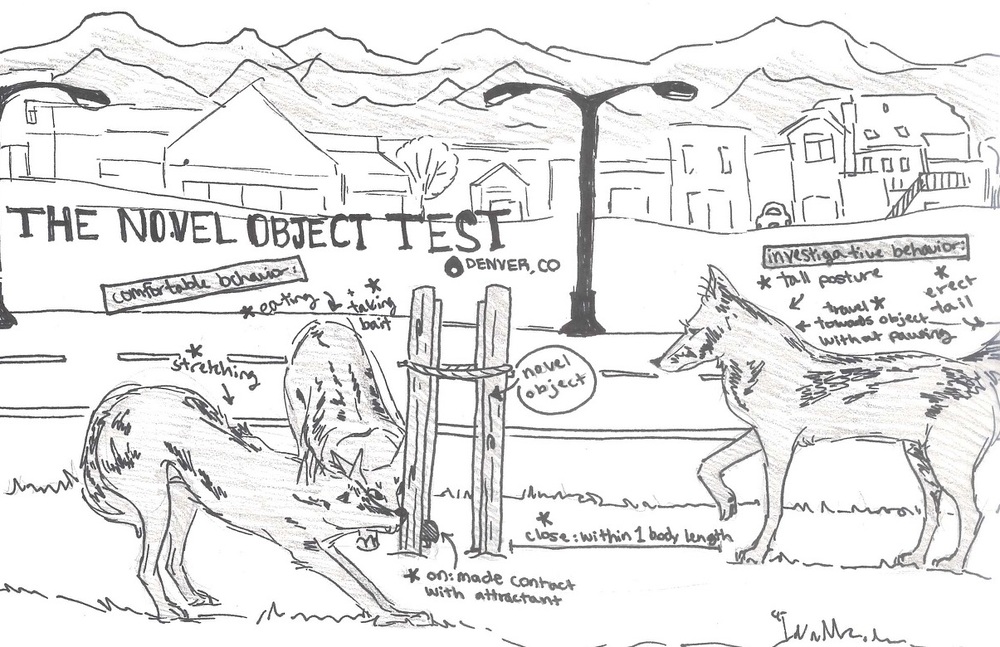
The novel object test showed that urban coyotes were bolder and more willing to explore a new object. Multiple sites were used in the urban and rural study areas, half being a control with an attractant and half containing a novel object along with the attractant. The attractant was a meat bait and the novel object was four wooden stakes with rope surrounding the attractant. Through video analysis, they measured the number of visits to a site, the distance to the attractant and the behavioral reaction. Urban coyotes spent more time at closer distances in the baseline sites and spent more time in the treatment sites than rural coyotes. Urban coyotes were also more investigative for both baseline and novel object treatment and even displayed comfort behavior in baseline sites. Only one rural coyote showed any comfort behavior in baseline, and no coyotes, rural or urban, showed comfort behavior with the novel object present.
More research is needed to understand the mechanisms behind these behavioral differences, but it’s clear that this urban population of coyotes was bolder and more exploratory. The experiment also saw significant variation in individual behavior, and a lack of repeatability, suggesting that coyote behavior is quite changeable. This finding points to learning as being a possible mechanism behind behavioral change in coyotes. It’s also important to consider the differences between how coyotes are treated in urban areas and rural areas. In cities, coyotes are sometimes fed and there seems to be either a disregard or fear towards them. This is unlike rural areas where coyotes are regularly trapped and killed by hunters and wildlife management, and experience predation by mountain lions in areas like Utah, where this experiment studied rural coyotes. Even if you view coyotes as pests, or something to be feared, you’ve got to appreciate their ability to adapt and survive. Throughout history and in today’s world, coyotes have
proven to be greatly resilient. These canines have shown time and time again that they aren’t going anywhere.
Breck, S.W., Poessel, S., Mahoney, P. et al. The intrepid urban coyote: a comparison of bold and exploratory behavior in coyotes from urban and rural environments. Sci Rep 9, 2104 (2019)
Flores, Dan. Coyote America: Author Dan Flores Speaks About North America’s Native Song Dog. Project Coyote. 2016. http://www.projectcoyote.org/coyote-america-author-dan-flores/
