
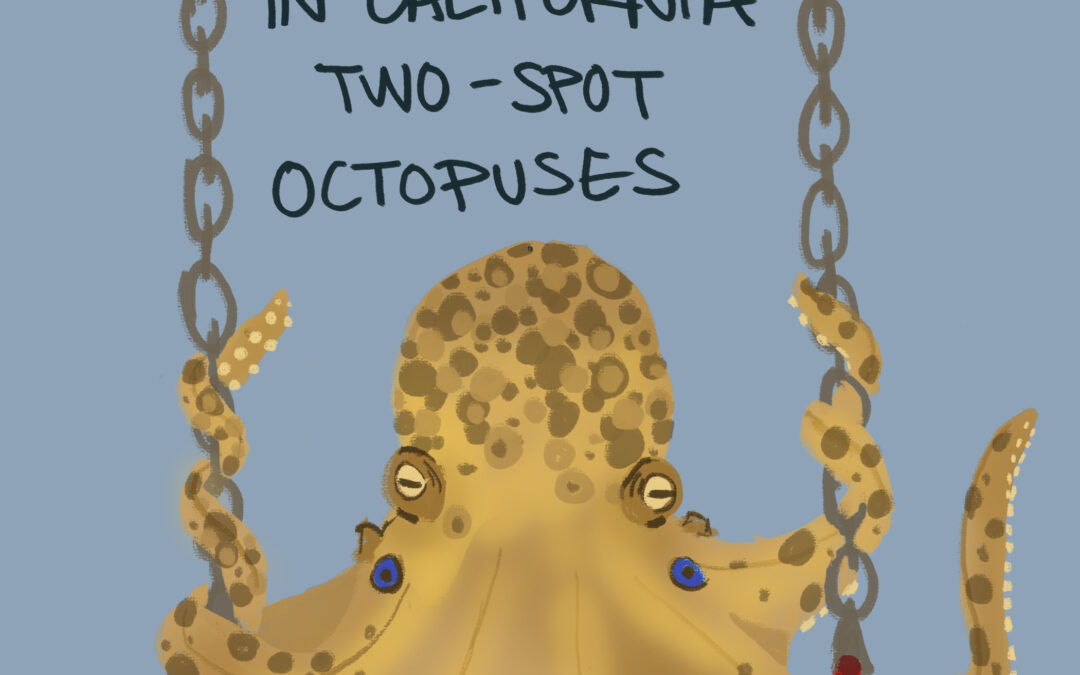
Known for their intelligence, eight arms, and ability to change colors to match their surroundings, octopuses have been the subject of scientific study for many years. These amazing creatures have proved that they are able to solve puzzles which demonstrate that they have high cognition and are capable of advanced learning. However, some of the behaviors that they exhibit are strange and done for seemingly no reason.What could be the purpose of these behaviors? Scientists suspect that these behaviors may be a form of play. To investigate this, scientists Katarina Jarmoluk and Galit Pelled seek to create an experiment that will allow them to conclude whether octopuses are actually playing, or just doing something else.
Play is a behavior that we usually associate with domesticated animals: dogs, cats, rabbits. And we often characterize this behavior as animals “having fun”. Unfortunately, that is not a specific enough criteria for scientists to use to study play behavior. So, Jarmoluk and Pelled created five criteria that could help them investigate whether octopuses are exhibiting play behavior. The criteria they came up with were: “1) there is no immediate function to the behavior in the context in which it is performed; 2) the behavior is voluntary, spontaneous, or autotelic (done for its own sake); 3) there is a structural or temporal difference from other typical behavior; 4) the behavior is repeated but not stereotyped; and 5) the animal is healthy and free of stress and competition”. This criteria allows the researchers to identify and differentiate play behaviors from other kinds of octopus behaviors.
Once their scientific question and research criteria were created, they began setting up their experiment. They chose to run this test on California Two-Spot Octopuses (Octopus bimaculoides). Because this species is often kept as pets and used in bio-medical experiments, they wanted to investigate more about normal octopus behaviors. If they understand which behaviors are normal for the octopuses, they can compare these to behaviors of individuals in experiments to draw conclusions about an animal’s mental health during experimental trials.
Nine octopuses were collected on the Californian coast and sent to Michigan State University where they were housed separately in 40 gallon tanks. The octopuses were provided with materials to construct dens from shells, rocks, and gravel. To prevent the octopuses from getting bored, they were also provided with legos, live food, and shells. Enrichment items are important for preventing boredom. Other researchers have observed that captive octopuses will grow bored without proper stimulation. Imagine how you would feel if you were stuck in an empty room for several days! Not fun! This observed correlation between octopus boredom and lack of stimulation is what led scientists to investigate when/if octopuses exhibit play behavior.
Once the octopuses had adjusted to their new environment, the researchers began attempting to train the octopuses to unscrew a lid from a test tube to access a food reward. To do this, they first presented the octopuses with a lid-less test tube that contained a piece of shrimp. This teaches the octopuses that food can be found inside these tubes, therefore these tubes are an article of interest. Then the researchers put the lid on very loose so the octopuses had to take the lid off to get to the food. Then the researchers screwed the lid on a little tighter and gave it back to the octopuses. Then they screwed the lid on even tighter, until the octopuses had to unscrew a fully tightened lid to access the food. Out of the 9 octopuses in the study, only three of the octopuses were able to unscrew the lid from the test tube. Then those three octopuses began to play with the blue, plastic test tube lids! They would grab the lid, pull it into their bodies then release it to be taken away by the current in the tank. Then when the lid floated back by them, they would reach up and pull it back into their bodies, before releasing it again.
These results provide significant evidence that California Two-Spot Octopuses do engage in play behavior. Though further research will be needed to prove why they exhibit these behaviors, Jarmoluk and Pelled theorize that this could demonstrate that play behaviors “satisfy intellectual and emotional needs” of an octopus. They also observed that all three octopuses who engaged in play behavior ate the food reward before playing, which could signify that play behavior is only exhibited once nutritional needs have been met. While there is still research to be done about why/how/when octopuses play, this recent research has provided a good benchmark and outline for continuing this investigation into the importance of octopus playtime!
Sources:
Evidence of play behavior in captive California Two-Spot Octopuses, Octopus bimaculoides, Katarina Jarmoluk, Galit Pelled, bioRxiv 2024.08.23.609397; doi: https://doi.org/10.1101/2024.08.23.609397, Now published in PLOS One doi: 10.1371/journal.pone.0326379
Figure: Play Behavior in California Two-Spot Octopuses created by Cameron McCaleb is licensed under CC BY_ND 4.0
