
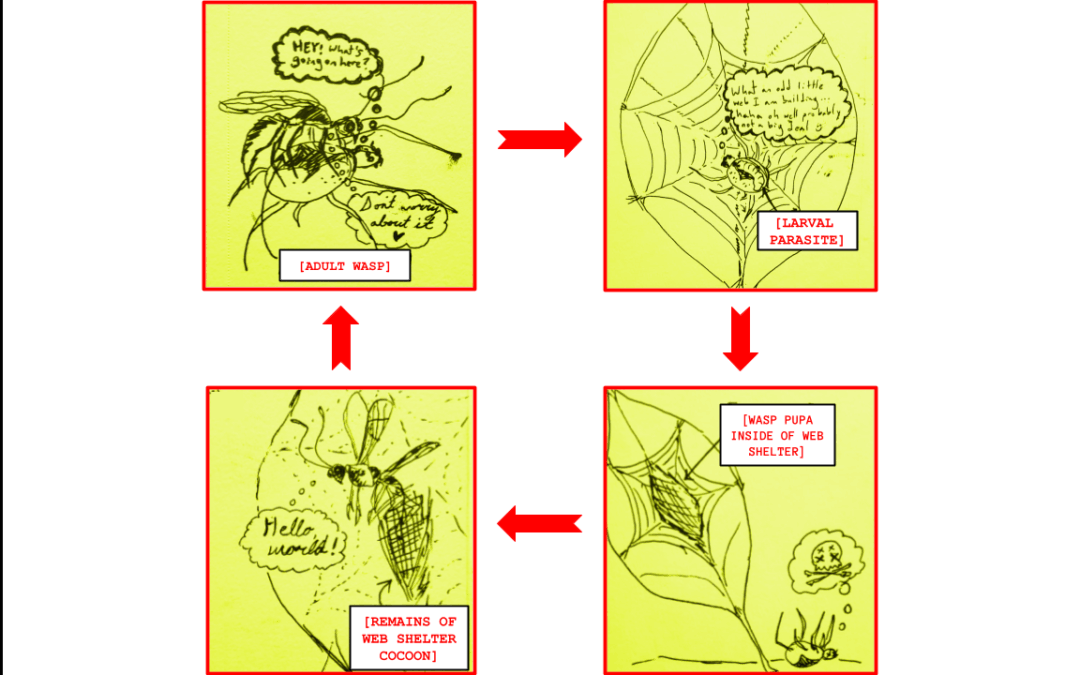
Unless you are spectacularly lucky – or scrupulously hypochondriac – you have probably had an experience with a parasite. It’s likely, too, that you’ve changed your behavior in response to that parasite, whether that’s swatting a mosquito on your arm or staying home so as not to give your coworkers lice. But what if your behavior changed in ways that were actually helpful to the parasite? What if, in fact, your behavior formed an integral part of the parasite’s reproduction? Shivery as that idea may make you feel, it’s a fact of life for many insects across the world, many of whom display fascinating and complex responses to parasitic infection – responses which speak to the subtlety of those parasites’ ability to manipulate their hosts.
One such parasite is a diminutive, drably colored group of insects in the genus Ichneumon – known more commonly as Darwin’s wasp. To give just a taste of the reactions inspired by their life cycle: the wasps are so named from a quote taken from Charles Darwin’s letters, in which he expressed to a friend his doubt “that a beneficent & omnipotent God would have designedly created the Ichneumonidæ with the express intention of their feeding within the living bodies of caterpillars.”
And it’s not just caterpillars! The wasps (found on every continent except Antarctica) parasitize a wide variety of insects, and induce a range of different behavioral modifications in different hosts. One of the hosts in question? Web-building spiders, upon whom an adult wasp will deposit a larva – which will then remain attached to the abdomen, feeding and eventually completely consuming its host. Before the larva does so, however, it causes the spider to change its web-building behavior in a variety of ways which ultimately create a web designed less to catch insects and support the spider building it – and more to shelter and protect the parasitic larva as it pupates.
But what happens when spiders are already creating webs that suit the needs of their larval parasites? Or, put another way: are the ways that parasitized spiders change their webs always beneficial to the wasp larva? One recent study conducted in Espírito Santo State, Brazil, looked at just that question. The researchers set up experimental trials to determine a. the impacts of parasitism by one species of Darwin wasp (Zatypota alborhombarta) on the web design of the tangle web spider (Cryptachaea migrans) and b. whether those modifications actually helped larva to better survive and ultimately emerge as adult wasps.
When it came to the first question – how does parasitism change the web-building behavior of tangle web spiders? – researchers found a wealth of fascinating alterations. Yet what researchers found on the second front – whether those changes impacted larval survival – surprised them. Whether wasp larvae developed in webs built by parasitized spiders or healthy ones, they survived at the same rates. Why? The authors theorized that it may be due to a feature of this specific host. Tangle web spiders build their webs in dead leaves anchored to vegetation – so it might be the case that these spiders’ webs are already so well anchored that the structure is already stable enough to support a larva’s pupation, regardless of parasitic modification.
A trickier question appears when we look at the wasp. Why, if it seems to pose no benefit to larva, are Darwin wasps still inducing this behavior in their hosts? As with many puzzling phenomena in animal behavior, the answer may lie deep in the evolutionary history of the species involved. The authors of the study suggest that, in causing the spiders to build their strange, corrupted webs, this particular species of Darwin wasps may still be carrying out an ancestral behavior. In some early relationship between an ancestral wasp and its spider (theorize the researchers), that web modification was actually necessary to create webs that would adequately shelter wasp larvae; and though the behavior is no longer relevant to these particular spiders, it still persists in the wasps as a sort of “leftover”. Crucially, inducing these behavioral changes does not pose a high cost to the wasps, meaning that natural selection against the behavior is likely to be low – a fact which provides fairly convincing support to the “leftover” explanation.
Like all interactions between species, lastly, it is important to remember that this relationship is contextual. The authors of the study suggest that the benefits of web modification may vary in different locations, even within the same species. Still, this discovery is a fascinating reminder of the fact that animal behaviors – even ones so bizarre they caused Darwin to question his religion – may be nothing more than an evolutionary leftover.
Works Referenced
Kloss TG, Gonzaga MO, Mendes-Pereira T & Dos Santos De Almeida, S. 2024 Deluded zombies: induced behavioral modification in a cobweb spider does not increase the survival of its parasitoid wasp. Behav Ecol and Sociobiol 78(1), https://doi.org/10.1007/s00265-024-03428-9
Darwin C (1860, 22 May). Letter to Asa Gray, May 22, 1860. [Letter]
