
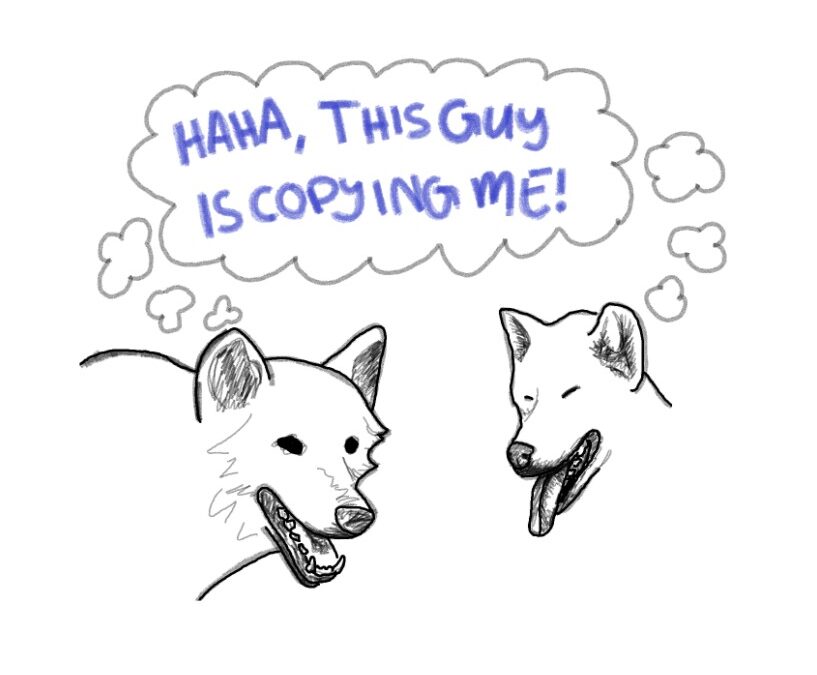
Imagine this: you and a friend are playing around, laughing and shoving each other around a little bit. You push your friend a little too hard, and they stop laughing. Things got a little too rough, but nobody got hurt cause you knew to stop after it stopped being funny. People who have a dog at home may be a pro at noticing the differences between the face that desperately wants you to throw a ball and one possessive of their food. Scientists have studied how facial expressions of domestic dogs help communicate intentions of playing versus real aggression, but Veronica Maglieri et al. expanded her research to investigate wild wolves, hoping to understand if this behavior evolved or is a product of domestication.
Similar to laughing in humans and the play face that monkeys make, the relaxed open mouth smile wolves and other social carnivores make is crucial in communicating clearly and effectively to their playmates. In order to signal back and forth that both want to keep playing, wolves will do something called rapid facial mimicry. This means that within seconds of the first wolf open mouth smiling, the other will mirror that smile back, showing they are still interested in playing. During play, individuals will allow their playmates to counterattack, resulting in returned competitive behaviors. Competitive behaviors are categorized as attempts to bite, jump over, knock down, hold, paw, push, run, or stand over their opponent. Noncompetitive behaviors are more submissive; laying on back, squirming, turning in on oneself, crouching, wiggling, jumping, and looking back on playmate. Researchers hypothesized that since the smile is used to show playfulness, more competitive behaviors would follow the copied smile—similar to human forms of consent. Focusing their attention on wild wolves, they set up secret cameras in 5 different sites around the forests of Tuscany, Italy and waited.
82 videos were recorded in which wolves were playful, and of 60 relaxed open mouth occurrences in which the wolves’ faces were visible, 24 smiles were replicated within 1 second.
Maglieri et al. created an index to categorize the scale of competitive behavior; ranging from 0 (no competitive patterns) to 1 (only competitive patterns). They found that every interaction had at least a little bit of competition, as none scored a 0. In contrast, about 21% of the play sessions scored a 1 on the index. Amongst these highly competitive play sessions was always at least one instance of rapid facial mimicry—that copied smile. In previous studies done with domestic dogs, there was an extremely balanced amount of relaxed open mouth smiles, but the amount of competitiveness was not at such an increased level as the wild wolves. Maglieri et al. believe that the placement and mirroring of the smile just before a competitive action can limit the risk of misunderstanding between playmates.
A difference found between dogs and wolves; 89% of the time, the relaxed open mouth smile with domestic dogs comes before a competitive pattern, but only 47% in the cases involving wolves. This high frequency of smiling combined with generally uncompetitive patterns have led researchers to believe an exaggerated execution of these communicative behaviors has followed domestication, to help both dogs and humans access a situation. As this copying of facial expressions is shared amongst domestic dogs and wild wolves, scientists now understand this phenomenon as ancestral, rather than a result of domestication. Play is an important behavior that leads to a rewarding and positive mood. Synchronizing and communicating actions and motivations is crucial to avoid the escalation of playtime into seriously dangerous conflict. Afterall, we never want to fight with our friends—playing is so much more fun.
Maglieri, Veronica, Alice Galotti, Luca Petroni, Alessio Garzelli, Marco Apollonio, Chiara Benedetta Boni, Nadia Cappai, et al. “Untamed Smile: Rapid Facial Mimicry in Wild Wolves.” Animal Behaviour 227 (September 2025). https://doi.org/10.1016/j.anbehav.2025.123303.
