
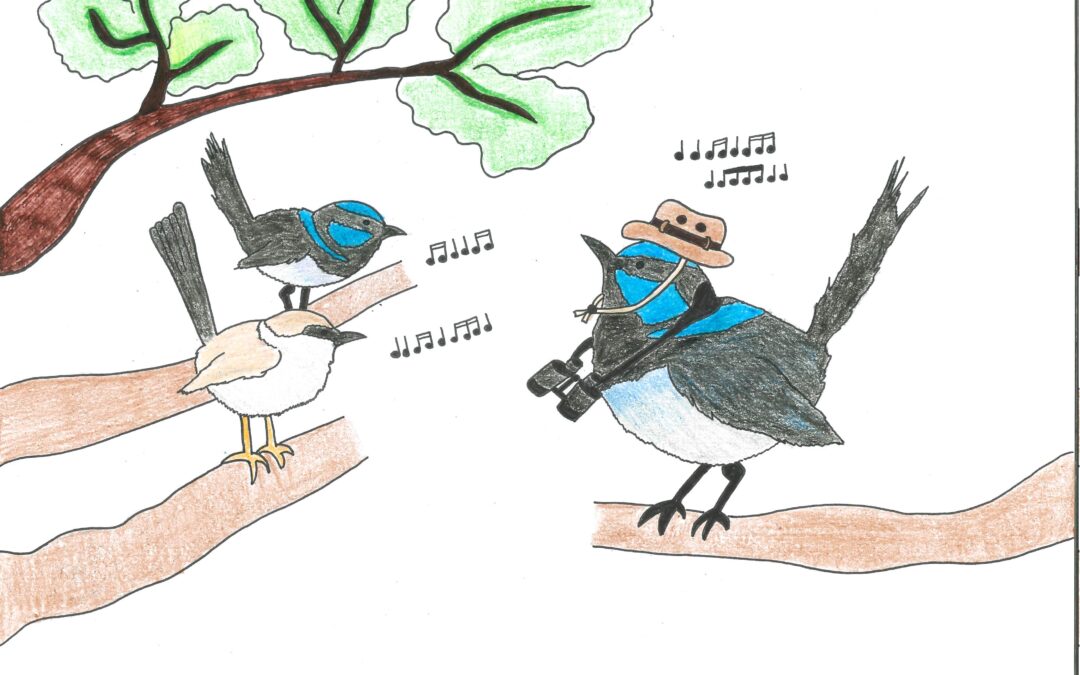
Most of us hear bird songs every day, usually multiple times a day. If you’re anything like me you probably haven’t taken the time to stop and think about what these songs mean… or who they are coming from. It’s hard to think that these songs can serve so many different purposes as they all sound pretty much the same, right? Well to us these songs may sound similar but to birds they serve as a vast system of communication made up of the songs of many individuals. One group of researchers (Colombelli-Négrel et. al., 2025) wanted to know, can bird songs be affected by an individual’s personality? It turns out that the answer is yes. Birds, like us, have different personalities that affect the way that they learn and communicate.
Superb fairy-wrens (Mylurus cyaneus) are a type of bird native to South Australia that produce complex songs of three types including chattering songs and alarm calls. These small birds have big personalities making them the ideal candidates for this experiment. However, as you may imagine, it is a bit more difficult to observe personalities in animals like birds. They can’t exactly tell us about their interests. Luckily this problem has already been solved for us! Bird personality can be measured by quantifying five traits: boldness, exploration, activity, aggressiveness, and sociability. In this experiment, researchers decided to focus on two of these traits, exploration and aggressiveness, and how these personality traits influence the number of elements and syllables per song.
The researchers’ hypothesis was that the more exploratory birds would incorporate more element types in their songs and that the more aggressive birds would have less syllables in their songs. To clarify, elements are the different types of vocalizations and syllables are the elements that are grouped together in between pauses. Fairy-wrens can learn songs from their parents as well as tutors (members of their species that they are not related to). It was assumed that exploratory individuals will travel further distances and encounter more tutors, allowing them to incorporate more diverse elements into their own song. Aggressive individuals are assumed to be less innovative than shyer individuals and may not be as creative when making their songs.
Now, the most important question, how did the researchers carry out this experiment? First, they had to make sure that they knew which bird was which so that they could keep their data straight. Each fairy-wren had colored rubber bands placed around their legs from previous experiments and they were able to use the color-bands as well as the sex to identify individuals. Male and female fairy-wrens look very different during breeding season. The males are black and bright blue whereas the females are brown and grey. One difficulty, however, is that all juveniles have the same coloring as females and it can be hard to tell which sex the juveniles belong to. In these cases, molecular tools were used to determine sex. Once the individuals could be properly identified, the researchers carried out the first phase of their experiment: a measurement of exploration.
Individuals were first placed in a wooden box and allowed five minutes to get comfortable. When their time was up, the door of the box was raised, revealing a metal cage with three wooden perches and 13 sectors (the three perches, four floor quadrants, four walls, the ceiling, and the box door) that the birds could visit. Each individual’s “exploration score” was quantified as the number of times that they visited each sector in the first five minutes. Immediately after this first test concluded, a curtain at the edge of the cage was raised to reveal a mirror. Aggressiveness was quantified as the amount of time that each individual spent in the three sectors closest to the mirror over the first three minutes of the test. Once these tests were completed, the fairy-wrens were released back into their wild habitats and researchers recorded them throughout the breeding season of the same year they had been captured. The recordings were analyzed and broken down into how many element types and syllables were present in each song.
The results of the experiment supported the researchers’ hypothesis! The more exploratory birds had more element types present in their songs and the more aggressive birds had less syllables per song. This study demonstrates how fairy-wrens personalities play a big role in their communication. Whether birds are extroverted or introverted can affect how they learn, what they learn, and who they learn it from. Their personalities are then shared with others through their songs. Not only can fairy-wrens communicate their message to one another, they can also share information about who they are! The next time you hear a bird song you may take the time to think about whether that bird has a personality similar to yours.
Reference: Colombelli-Négrel Diane, Katsis Andrew C., Common Lauren K. and Kleindorfer Sonia. 2025 Personality predicts song complexity in superb fairy-wrens. R. Soc. Open Sci. 12:241497. http://doi.org/10.1098/rsos.241497
