
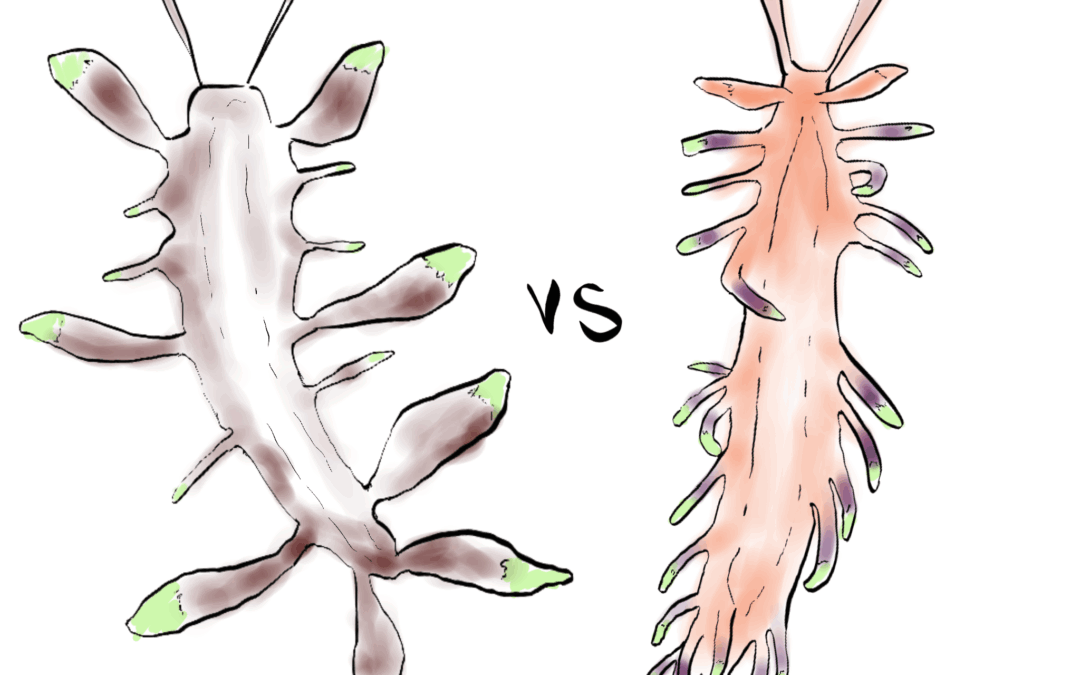
A person who copies someone else might do so because they admire the other person or because they might want to fit in with others. One might want to blend in with a group in order to avoid bullying, the milder human equivalent of predation. A human might not need to worry about getting eaten by others, but it’s a different story in the animal kingdom. Specifically looking underwater, nudibranch sea slugs are quite good at repelling predators, and our friend Cryptochaetosyllis imitatio seems to have taken notice. Let’s see how our friend likes to copy the nudibranch.
While exploring the coral reefs in Japan and Vietnam, researchers stumbled across a tiny marine worm that didn’t quite look like the typical worms they had encountered before. These little guys closely resembled the nudibranch that are often found around that area. Nudibranchs are sea slugs that have varied patterns full of bright colors that warn predators that they probably won’t be super tasty because of toxins. Our newly discovered friend the Cryptochaetosyllis imitatio is a harmless annelid, but would probably not like to be on the menu for the many hungry predators that share the waters with them. The problem it encounters is that of finding protection. How can it possibly lower the likelihood of getting eaten?
The answer lies in the mechanism of Batesian mimicry, in which a harmless creature like our annelid buddy will disguise itself as a dangerous or toxic creature such as the nudibranch. If a predator has eaten a toxic nudibranch and faced the consequences, that predator will most likely have learned its lesson to avoid anything that looks similar in the future. This little worm uses the nudibranch as a muse in order to benefit from the same foul-tasting reputation by evolving the bright and colorful appendages reminiscent of the toxic sea slugs in the surrounding area.
One particularly interesting finding is this worm’s unique anatomy. Unlike many of its polychaete relatives, this intelligent worm is able to maintain its disguise so well because of its ability to hide its bristles (chaetae). These bristles are usually a dead give away that an animal is a worm, so having undetectable traits that would quickly give away its identity to predators is essential for successful mimicry. These worms are able to successfully resemble a nudibranch’s shape and color. This is the first time that this type of mimicry has been found in annelids, so being able to pull off this type of deception is a major feat for these little creatures.
So if these newly discovered Cryptochaetosyllis imitatio is mimicking the nudibranch, how can we tell these different animals apart? Only a few millimeters long, these worms have long and colorful appendages that look like the nudibranch’s cerata, the finger-like projections on the sea slug’s back. Similar coloration and appendages are not enough to make these worms identical to the nudibranch however. There are still structural differences between these worms and the sea slugs found in the Japan and Vietnam coral reefs. Nudibranchs like Hypselodoris festiva found in Japan have thicker bodies and bright and colorful appendages more concentrated in one area rather than along its entire body like our Cryptochaetosyllis imitatio friend. Other sea slugs like Glaucus Atlanticus are more structurally similar in terms of appendage dispersal and overall shape.
These researchers presented us with the idea and possibility that other annelid worms may be able to mimic predator-repellent creatures in order to protect themselves. Although there needs to be more research done on this mimicry in annelids, this previously simple creature has opened a door for larger possibilities for conversation of understanding underwater mimicry.
So if you see a sea slug on your casual swim through the coral reefs of Japan and Vietnam, think twice before categorizing it as such because it might just be a deceptively sea-slug-like annelid worm.
Jimi, N., Britayev, T.A., Sako, M. et al. A new genus and species of nudibranch-mimicking Syllidae (Annelida, Polychaeta). Sci Rep 14, 17123 (2024). https://doi.org/10.1038/s41598-024-66465-4
