
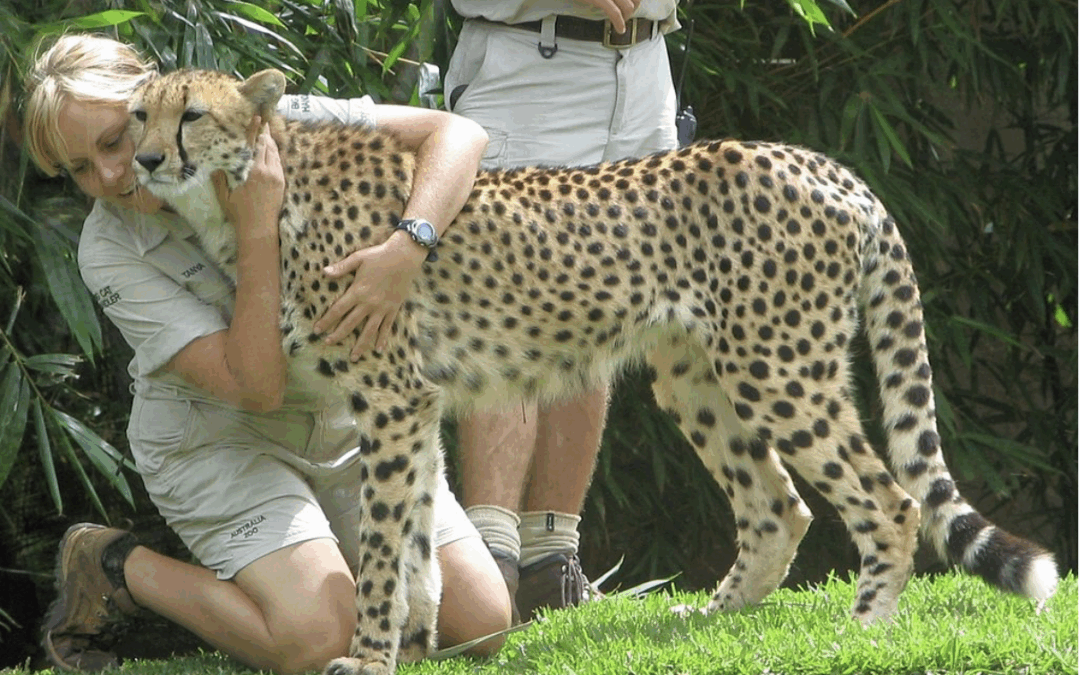
Most people know that housecats can purr. It’s seen all the time in videos displaying happy cats. But there’s one species of larger cats, cheetahs, that with enough human attention at an early age, can purr just like housecats. Researchers have found that cheetahs orphaned at an early age and raised by humans tend to start purring to their humans, not just to other cheetahs.
While cheetahs purr normally, they do not do it towards humans. They instead purr to each other. Cheetahs that are orphaned young, and instead of being raised by their own parents are raised by human caretakers, begin to start purring to humans as well. Interestingly, cheetahs that spent more time with their mother before being orphaned, never begin purring to humans, not even their own caretakers, although they do tend to show more signs of affection. These kinds of cheetahs, in fact, purr much less than the other kind! And unlike their more aloof brethren, cheetahs raised young also presented more activity to their caretakers, anticipating an interaction with them.
A group of researchers discovered this incredible behavior by studying fourteen cheetahs housed at the Cheetah Conservation Fund in Namibia. Of these fourteen, they studied eight which had been separated from their mother before two months of age, and six that had been separated between two and six months old. They observed how these cheetahs responded to being alone with either a human they should be familiar with, or humans they were completely unfamiliar with. The humans in question remained motionless across from the cheetahs, to avoid any gestures or subtle body language communication to affect how the cheetah may act. It was important to see how the animal would act of its own accord to just a presence. Unlike many big cats, cheetah attacks on humans are incredibly rare, so these tests were quite safe for the people in the enclosure with the cheetahs.
Incredibly, while cheetahs orphaned late treated both familiar and unfamiliar people with the same lack of purring, cheetahs orphaned young actually purred more with those they were familiar with, just like housecats! Researchers speculate that because the cheetahs that were orphaned early spent more time with humans while young, they were able to develop a way to distinguish different people from each other. So while they can tell the difference between a stranger and the person that feeds them every day, their late orphaned brethren never developed that sense, and see all humans as the same. If they don’t form an attachment to a human at a very young age, they don’t become just like housecats!
Gallo, A., Schmidt-Küntzel, A., Petersen, L., Moya, M. J., Marker, L., Lemasson, A., & Hausberger, M. (2024). Agenda of Early Life Experience and Its Association with Sensitivity to Human Presence and Familiarity in Wild-Born Orphaned Captive Cheetahs. Animals, 14(22), 3223. https://doi.org/10.3390/ani14223223
“Australia Zoo cheetah and zookeepers” by Benchill is licensed under CC ASA 3.0 shared with attribution.

