
By Mark Lang ’23
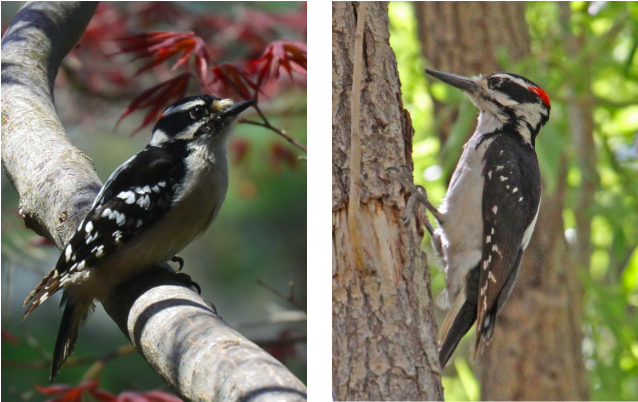
A recent study published in the journal Animal Behavior from Cornell University and Manchester Metropolitan University showed that, in some cases, having the same appearance as another species is not as advantageous as previously believed. Downy and Hairy Woodpeckers, two visually strikingly similar species, were observed at feeders in a series of feeding interactions. While both birds belong to the same genus, evolutionarily they have their last shared common ancestor over 6 million years ago, giving them plenty of time to diversify and acquire different traits. However, the species look nearly identical and often pose a problem to bird watchers: Which species is which?
On average, Hairy Woodpeckers are roughly one and a half times the size and weight of the Downy Woodpeckers, but otherwise they are nearly identical. This difference in size but similarity in appearance got the researchers thinking; do Downy Woodpeckers benefit from looking similar to the Hairy Woodpeckers?
The researchers decided to approach this from two different viewpoints: Either these traits arose in Downy Woodpeckers to reduce hostility from the larger, more aggressive Hairy Woodpeckers (thus deceiving the Hairy Woodpeckers into thinking they were one of their own), or the traits evolved in Downy Woodpeckers so that other birds might assume they are the more dominant Hairy Woodpeckers (thus fooling the other birds that might normally be dominant to them and getting them to leave the Downy Woodpeckers alone or allowing the Downy to displace them from feeders). To test this, the researchers utilized a global group known as Project FeederWatch, in which everyday citizens collect and report data on the behaviors and interactions they observe at their feeders. Thus, the researchers were able to pool a large set of data and look at all possible interactions. They determined dominance based on whether the bird feeding flew off when another one landed on the feeder, and kept track of which birds often displaced which.
The researchers found that when a feeding Downy was approached by a Hairy, it was displaced 96% of the time. The researchers also found that Hairy Woodpeckers antagonized Downy Woodpeckers at a rate nearly three times as great as any other species. Thus, the researchers propose that the Hairy Woodpeckers are well aware of the attempted deceit of the Downy Woodpeckers, and are behaving more aggressively toward them because of it.
Interestingly, even though they were targeted more by Hairy Woodpeckers, Downy Woodpeckers appear to benefit from the shared appearance in interactions with other species. While this data was not deemed significant, the authors found that Downy Woodpeckers tended to displace birds which should have been dominant to them based on size and body weight. Thus, the researchers proposed that the similarity in appearance to the Hairy woodpecker might be a
trait that was selected for, as it allows for better feeding opportunities due to the feeding birds confusing the Downy with a Hairy. Thus, the authors argue that the Downy Woodpeckers did not evolve the similar traits to deceive the model Hairy Woodpeckers, but rather they came about as adaptations that improved their interactions with other species they would normally compete for resources with.
While there are many other species that display similar mimicry, further research is needed to see if this aggressive mimicry is a more common trend than currently perceived. If it is, do the benefits that the mimic species receives from interactions with other species outweigh the costs it incurs from the model species? Or is this an evolutionary one off, with the mimicry just being a vestigial remnant of the shared common ancestor of the Downy and Hairy woodpeckers?
Leighton, G. M., Lees, A. C., & Miller, E. T. (2018). The hairy–downy game revisited: an empirical test of the interspecific social dominance mimicry hypothesis. Animal behaviour, 137, 141-148.
Miller, E. T., Leighton, G. M., Freeman, B. G., Lees, A. C., & Ligon, R. A. (2019). Ecological and geographical overlap drive plumage evolution and mimicry in Woodpeckers. Nature communications, 10(1), 1602.
