
If someone asked you to think of a non-human animal that uses inference to solve problems, you would probably think of an ape or a monkey. Inferential reasoning has been studied in a number of different species of primates, and also in some other intelligent animals, like parrots and pigs. But, what about man’s best friend? In a recent study, Rivas-Blanco et al. investigated if dogs (and wolves) are able to infer the location of a food reward by using an experiment known as the “cups task.” They predicted that wolves would be more successful at this task than dogs due to a loss of problem-solving skills in our canine companions over time through domestication.
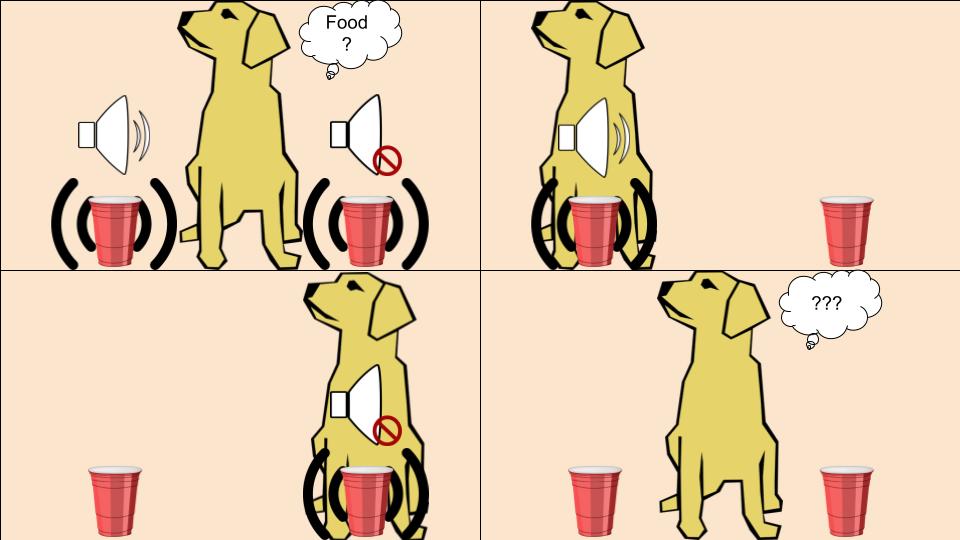
To test this hypothesis, researchers subjected both dogs and wolves to four different conditions. For all four of these conditions, subjects were given the choice between two cups on either side of a table (one with a food reward inside and one that was empty), and they made their choice by touching a target positioned below each of the cups. The cups looked the same on the outside; however, the conditions differed in the auditory information that was presented in each trial. Either 1) both of the cups were shaken in front of the animal in a random order, 2) only the cup with the food reward inside was shaken, 3) only the empty cup was shaken, or 4) none of the cups were shaken. Shaking the cup with the food reward inside made a noise while shaking the empty cup did not; therefore, it was expected that subjects would be able to differentiate between the two cups and choose the one with the food reward inside by using this information.
So, what did the researchers find? Interestingly, they found that dogs and wolves showed about the same results. Both dogs and wolves showed a bias toward choosing the cup with the food reward inside when only that cup was shaken, and a bias toward choosing the empty cup when only that cup was shaken. When both of the cups were shaken, however, they showed a bias toward choosing the most recent cup that had been shaken. These results suggest that dogs and wolves are probably not using inference to differentiate between the two cups, but rather making their choices based on both recency (a bias toward choosing the most recent stimulus) and saliency (a bias toward choosing the most intense stimulus) effects. It is unclear, however, if this is due to the absence of inferential reasoning in dogs and wolves or if other confounding variables possibly affected these results, such as researchers having to use a food reward to reposition animals between trials (thus, possibly rewarding them for incorrect choices). Future research could rethink the current “cups task” experimental design by using an automated set-up, like a touchscreen, which would make it easier to control for these confounding variables. Currently, this set-up idea has been implemented and used to investigate inferential reasoning in other species, and would likely also be successful in reducing confounding factors in tests involving dogs and wolves.
Rivas-Blanco, D., Krause, S., Marshall-Pescini, S., & Range, F. (2025). Inference in wolves and dogs: the cups task revisited. Animal Behaviour, 227. https://www.sciencedirect.com/science/article/pii/S0003347225001952
