
Each summer, many baby puffins, often called fledglings or pufflings, take their first flight out of their nest towards the open ocean but some find themselves stranded near industrial or commercial areas instead. What explains this? Not their inexperience or lack of navigation skills but rather our light sources. This is a problem facing Newfoundland and Iceland as we have seen populations of Atlantic puffins decrease as coastal development increases. In Newfoundland specifically, industrial and commercial locations that are close to breeding colonies of puffins often have stranded fledglings. Researchers Brown et al. hypothesized that this is largely due to the use of artificial light at night (ALAN) which can cause positive phototaxis, also known as light attraction, altering the navigation of these pufflings. Previous studies have concluded that different types of seabirds are likely impacted by ALAN, leading them to end up stranded near human developments, but Atlantic puffins specifically have not been observed until recently.
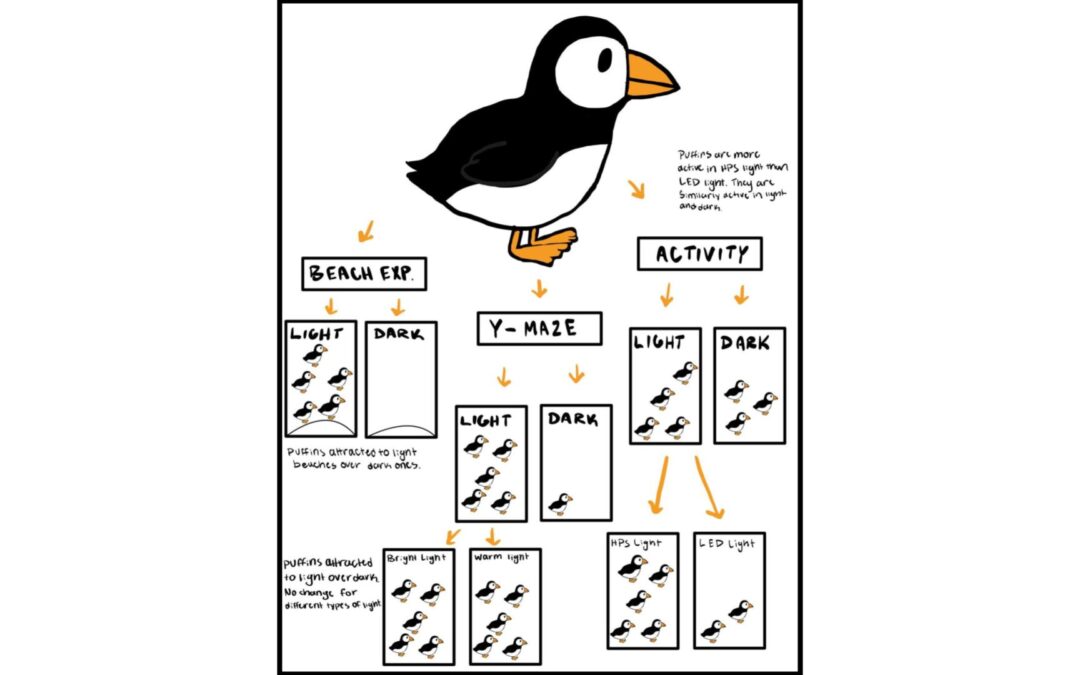
The researchers focused on questions of whether or not artificial light was causing these pufflings to lose their way and if the type of light made a difference. They conducted three experiments: a beach experiment, a Y-maze experiment, and an open field experiment. This strategy allowed them to observe the pufflings in a realistic environment and in a lab environment, producing greater evidence for their hypothesis. First, the researchers went to two beaches in Newfoundland called Long Pond Beach and Ragged Beach closest to the Gull Island puffin colony and directed a bright light at one of them each night, leaving the other dark. They alternated this for eleven nights observing the number of puffins found stranded at each. More pufflings were found stranded at the lit up beaches than at the dark beaches, meaning they were most likely drawn to the artificial light. In addition to this, the pufflings did more swimming and flying in the lit beaches than in the dark beaches, leading the researchers to believe that light influences their activity.
Second, they performed an experiment in their lab, building a maze shaped like a Y where puffins were placed in a box with two tunnels that had different light or darkness for the pufflings to choose from. They chose high-pressure sodium (HPS) light, similar to a typical warm streetlight, more often than darkness and more often than dim light. Other than this, pufflings did not show a preference between different types of light when presented with the choice. This maze showed that they consistently chose light over darkness, again emphasizing their attraction to it. Lastly, the researchers conducted an open field test looking at the activity of these pufflings in different types of light. They placed them in a small box and put different lights on them to see what they would do; would they fly, move, jump, or remain still? They were much more active in darkness and in HPS light than in any type of light emitting diode (LED) light. This lack of activity in LED light somewhat confused the researchers, but they proposed the idea that it might be either calming or alarming for these pufflings, limiting their activity. Further information would be needed to determine which is true.
These findings make us ask, are we the problem? Artificial light in human developments is leading these fledglings astray on their first flights out of the nest. As they become stranded they may not be able to find their way back, decreasing the populations of Atlantic puffins. How can we find a solution? One possible way would have been to use a different type of light that may interfere less with the navigation of the pufflings but as the research showed, the type of light did not make a difference for them. They were attracted to all types of light over darkness. The most simple solution then is to reduce the use of light near the homes of these pufflings, or at the very least shield it from their view so that they can make their first flight successful.
Taylor M. Brown et al., “Navigating the Night: Effects of Artificial Light on the Behaviour of Atlantic Puffin Fledglings,” Animal Behaviour 218 (December 2024): 135–48, https://doi.org/10.1016/j.anbehav.2024.09.008.
