
When thinking of REM sleep, one probably pictures humans twitching or dogs running in
their dreams. Looking at this idea in a new light, a recent study published in Nature shows that
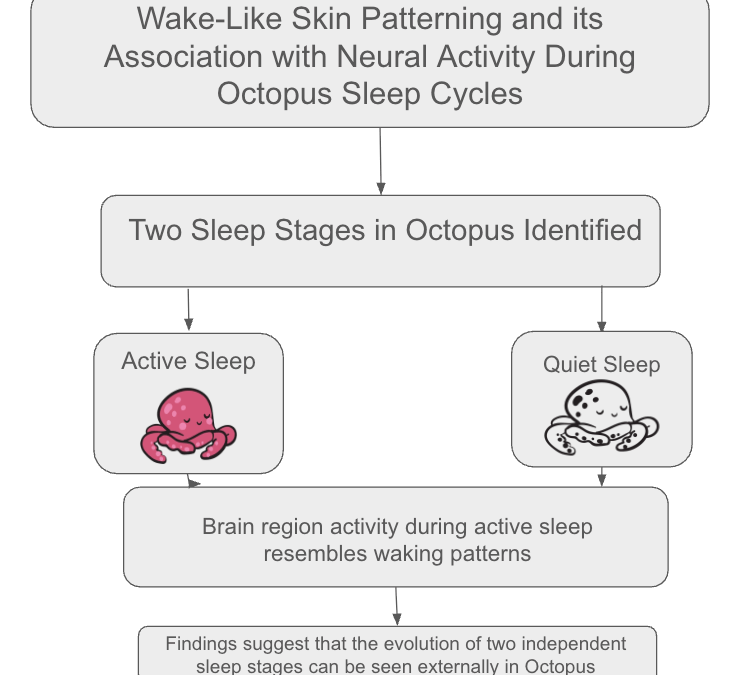
the Octopus species experiences sleep in two different stages: quiet and active. Within these
sleep cycles, Octopus may even experience something comparable to dreams, evidenced by a
colorful flash of skin color, similar to what is seen when they are awake.
Marine scientists at the Okinawa Institute of Science and Technology observe the
nighttime Octopus species, Octopus Laqueus, during their sleeping periods. Researchers
observed their baseline sleeping state or “quiet sleep” to consist of closed eyes and pale skin.
However, almost every hour this quiet state is interrupted by a moment of intense colorful skin
changes, eye and body movements, and quick breathing. This flash of bright skin color that is
often exhibited, mimicking the patterns they display when awake, is an indicator they might be
dreaming. These bursts of what seems to be “active sleep,” the researchers found are not at all
random, yet allow for a view into the dreams experienced by the octopus. These sleep patterns
persisting even under tough conditions suggests that octopuses, much like humans, experience
sleep cycles that are internally regulated.
To look inside the octopus brain, researchers developed a way to record electrical activity
using small electrical detectors. Through this experiment, they discovered that during the octopus’ “active sleep” bursts, brain activity in the regions related to memory looked incredibly similar to those that were taken during the time they were awake.
Together, these findings along with the low state resting potential found in the “quiet sleep” resembles what is known in science to be human “sleep spindles,” ultimately helping store memories when the brain is resting during
sleep. In other words, the octopus brain is in a constant cycle of a calm, low-activity state, and
awake like spurts of neural activity, just as resembled in humans between slow-wave and REM
sleep.
Though, the question still remains as to why the octopus would flash awake like patterns
in its sleep, colors that would normally be used in the behavior of hunting, communication, and
camouflage? The research team suggests one distinct possibility. This is that the color sequences
reflected in the octopus skin shows the reactivity of the waking cycles, similar to how human
brains display segments of memories during REM sleep. Overall, the skin patterns offer
something that no other animal can do: portray a visible layout of the sleeping brain. Because of
this reflection of the brain activity, watching an octopus during its sleep may lend the viewer a
peek into the complexity of their dreams.
Both octopus and humans diverged from physiological similarities more than 550 million
years ago, yet both organisms evolved to sleep independently, a classic case of convergent
evolution. These findings show that complex brains, no matter how different, require similar
processes to rest and recover, and ultimately given the ability to dream.
https://doi.org/10.1038/s41586-023-06203-4
