
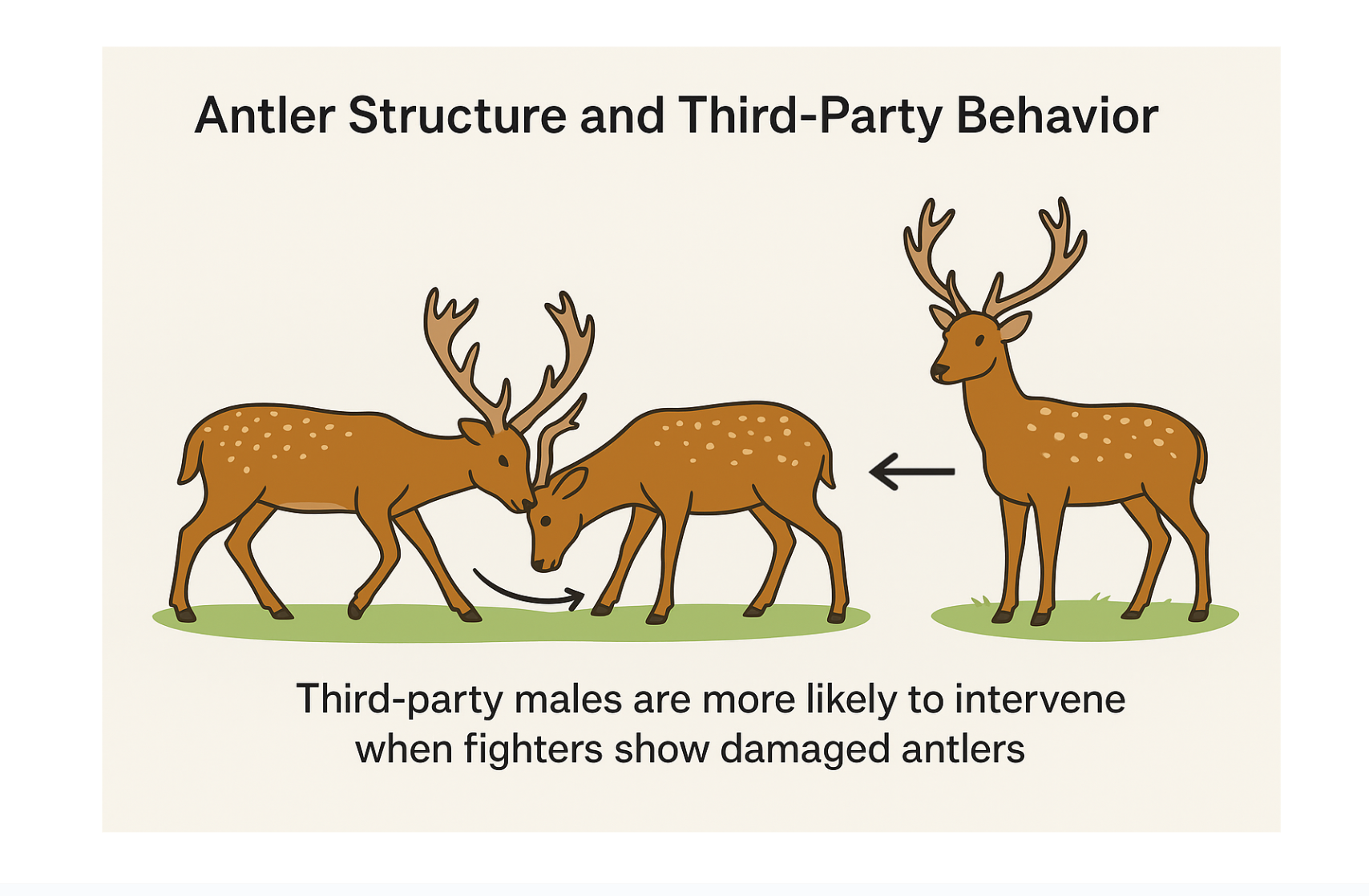
Imagine standing in a misty Irish meadow as two male deer lower their massive antlers and collide with a thud that echoes through the park. Their antlers lock, twist, and they’re locked in a contest of strength and stamina that could decide which male earns the right to mate. But just out of sight, another buck watches closely. He’s not fighting, at least not yet. Suddenly, he charges in, breaking up the duel. But why would a bystander risk stepping into someone else’s battle? A new study by Dómhnall Jennings and Martin Gammell explores this very question. The researchers discovered that decisions made by these “third-party rivals” males, who observe and sometimes disrupt fights, depend on the condition of the fighters’ antlers. Surprisingly, the damage on a deer’s antlers, rather than just their size or symmetry, seems to influence when bystanders jump into the fray.
For male fallow deer, antlers serve a double purpose: They serve as physical tools for combat and they are visual signals of strength, age, and genetic quality. Growing and maintaining antlers is costly, requiring large amounts of energy and nutrients. As a result, large and symmetrical antlers are often a good sign that the male deer is very healthy and a high quality mate. During the annual matting season, males use their antlers to lock and push, engaging in contests that can last minutes or even hours. But not all deer rely solely on brute strength. Many also rely on keen observation, not just of their own opponents, but of others’ fights. These spectators, or “bystanders,” sometimes step in to break up ongoing battles. Previous studies suggested that bystanders intervene to prevent a rival from gaining dominance through a “winner effect”, where repeated victories make a male more confident and more likely to win future fights. Jennings and Gammell wanted to test whether these bystanders use antler characteristics to decide when to intervene.
The researchers conducted their study in Phoenix Park, Dublin, one of Europe’s largest city parks and home to a free-ranging herd of about 700 fallow deer. Over three mating seasons from 1995 to 1997, teams of observers watched the males from dawn to dusk, recording every aggressive interaction they could see. In total, they logged over 1,600 contests involving 61 individual males. Most fights were between two opponents, but roughly 10% involved a third male who either approached or interrupted. Each deer’s antlers were photographed, measured, and later collected after the season when they naturally shed. The scientists assessed three key features: antler size, antler symmetry, and antler damage. Using advanced statistical models, Jennings and Gammell examined how these features predicted how often a male was targeted by third-party rivals.
The findings revealed a fascinating pattern. Males with damaged antlers were significantly more likely to experience third-party interventions. In other words, deer with chipped or broken antlers attracted more interference from other males. At first glance, this seems counterintuitive. Wouldn’t weaker, damaged males be less threatening? But the study suggests a different story. Damage might not signal weakness at all. Instead it might signal experience. Males with battle-worn antlers are likely to have fought many times, marking them as socially dominant and potentially dangerous rivals. Interestingly, antler size and symmetry alone did not predict third-party behavior. They only mattered when combined with damage. For instance, a male with large, symmetrical, but damaged antlers faced the most third-party interference. This implies that rivals weigh multiple visual cues, not just how big or even the antlers are, but what those features say about the deer’s recent fighting history. The researchers concluded that third-party deer might use antler damage as a cue to decide whether to intervene, acting strategically to limit a strong competitor’s rise in dominance.
These results shed light on a subtle layer of deer behavior. It’s not just about brute force, it’s about social intelligence. The study supports the idea that fallow deer make context-dependent decisions, using information from what they see around them. Rather than random aggression, third-party behavior seems tactical: a way to control rival power dynamics within the herd. By recognizing that these visual signals based on their antlers can influence not only two-way fights but also multi-individual decisions, this study expands traditional contest theory. It highlights that animal societies often operate with far more complexity and social awareness than we might expect. Understanding how animals interpret physical and social cues gives scientists insight into the evolution of communication and cooperation. In species like fallow deer, where social hierarchies determine access to mates, even subtle details like a broken tine can shift the balance of power. In the end, Jennings and Gammell’s study shows that antlers are more than ornaments or weapons. They’re storytellers. They record a deer’s history, signaling its strength, and influencing how others behave around it. To a bystander deer, a cracked antler might not say “weakness”. It might say, “This one’s been through battles, and might be worth stopping before he wins another.”
References:
Gammell, Martin P., Jennings, Dómhnall J. 2025. Decision making by third-party rivals is associated with antler structure in the fallow deer. Animal Behaviour. Vol. 228: 1-12 https://doi.org/10.1016/j.anbehav.2025.123305
