
Fruit flies know when they’re being watched! And they show it.
When two male fruit flies face off over a patch of yeast, the outcome might seem trivial with a few seconds of wing flicking, boxing, or lunging. But to Marina Hutchins and Julia Saltz, behavioral ecologists at Rice University, these tiny showdowns reveal something profound about the evolution of social behavior. Even simple animals pay attention to who’s watching.
In their 2025 study, Eavesdropping and audience effect in fighting fruit flies reveal feedback between social information use and production, Hutchins and Saltz discovered that male Drosophila melanogaster both change how they act when observed and learn from watching others. This forms a feedback loop that regulates aggression within fly societies. In short, fruit flies not only fight, they also strategize about when and how to do it.
In animal societies, two main behavior types are related but often are studied separately. These two behaviors are: social eavesdropping – learning by watching others interact and audience effect – changing behavior because someone is watching you. A chimpanzee may call differently if a dominant group member is nearby, and a fish might size up future rivals by observing fights. But what happens when these processes occur together, when animals are both observers and performers in their social networks?
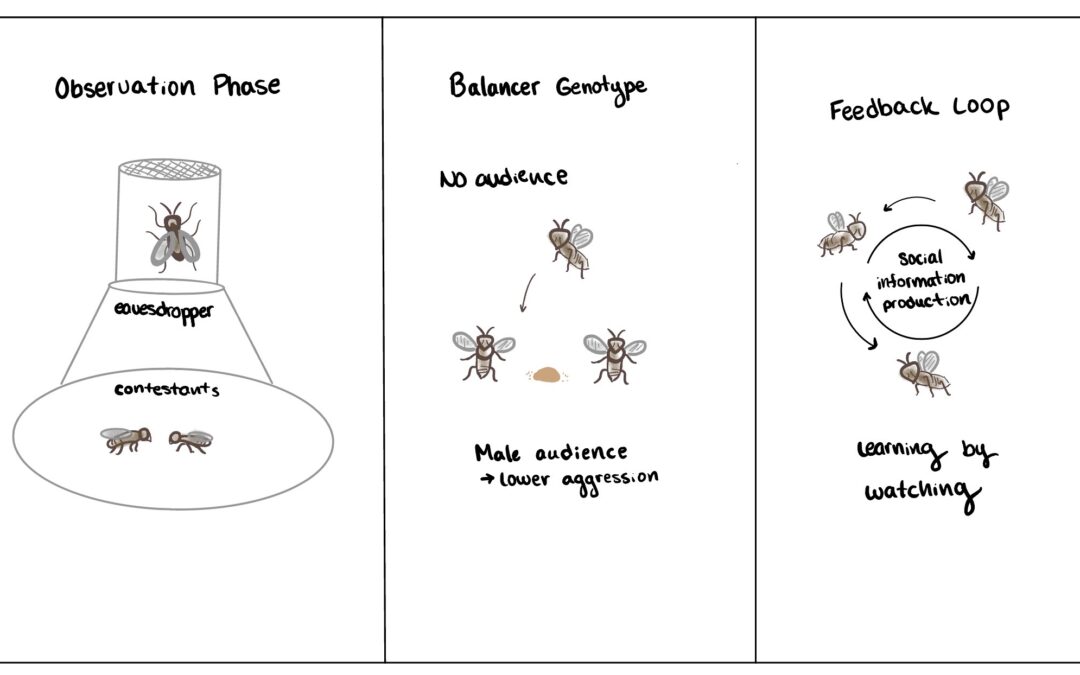
To find out, Hutchins and Saltz designed a clever two phase experiment using fruit flies, a species famous for its well studied aggression patterns. In the first phase, two male fly “contestants” were placed together to fight while being watched by either a male fly, a female fly, or no one at all. In the second phase, the observer fly was allowed to interact with the contestants to see whether the observer used what it had learned.
The setup consisted of a pair of petri dishes with a small mesh “observation tower” for the onlooker which allowed for visual and chemical cues to pass through. All flies were filmed and their aggressive behaviors, like lunging and chasing were carefully recorded.
The Hutchins and Saltz study results were striking. When a male observer was present, the two fighting males became noticeably less aggressive. It was as if they were aware that another potential competitor was watching and decided to keep their tempers in check. But when a female observer watched, aggression levels stayed the same as when no observers were present. This suggested that only same sex audiences trigger this behavioral restraint. “This is one of the first demonstrations of an audience effect in fruit flies,” the authors write, “showing that even insects modulate their social signaling based on who’s paying attention.” In other words, male flies seem to recognize that being seen fighting could affect future interactions, so they act differently depending on the observer’s identity.
Being a bystander also paid off. Male eavesdroppers who had watched a fight later showed less aggression towards the stronger contestant. They appeared to remember which opponent was dominant and avoided unnecessary conflict. Males who had not observed any fight lacked that insight and were more likely to attack indiscriminately.
Females on the other hand, didn’t seem to use the information they gathered. They showed no clear preference for mating with the more or less aggressive male, even after watching a contest. The researchers repeated the experiment to control for genetic differences in male attractiveness, but the results remained unchanged.
The combination of results revealed a feedback loop between social information and its future usability. When males are observed by another male, they tone down their aggression. This changed the information available to the audience. Those observers then used what they’d seen to guide their future behavior, which in turn can influence future interactions among the individuals involved. Overall, being watched and observing both shape social life in the flies’ world.
Hutchins and Saltz found that this feedback operated only in males, and that different fly genotypes varied in how strongly they responded to social information. Some strains were quick to adjust their behavior after watching others, while other strains seemed less socially attuned. This genetic variation hints that the ability to use social information could itself evolve under natural selection conditions.
Why does this matter? Because it shows that social intelligence isn’t limited to large-brained animals. The same cognitive processes that help humans navigate peer pressure or reputation also apply to other species. Noticing who’s watching and adjusting behavior accordingly is also found in the tiny nervous system systems of insects. These mechanisms may help stabilize group behavior by preventing runaway aggression and fostering coexistence. Demonstrating that fruit flies both monitor others and change their actions under observation, Hutchins and Salts add an elegant piece to the puzzle of animal communication. Their work supports a growing view of behavior as a dynamic network of feedback. This is a constant dance between action, observation, and adjustment. So the next time you swat away a fruit fly hovering at your kitchen counter, remember it might be watching you too!
References:
Hutchins, M., & Saltz, J. (2025). Eavesdropping and audience effect in fighting fruit flies reveal feedback between social information use and production. Behavioral Ecology and Sociobiology, 79(18). https://doi.org/10.1007/s00265-024-03503-1
