
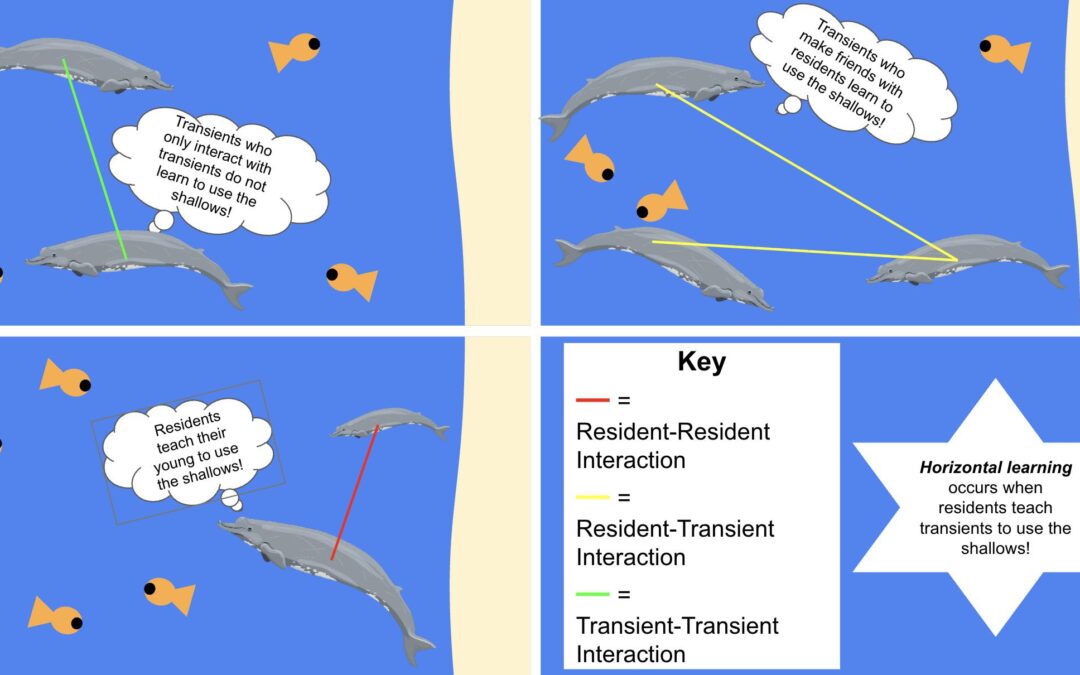
Baird’s beaked whales (Berardius bairdii) usually dive about a mile deep. So why are scientists finding some hanging out in the shallows? These ocean giants are elusive and notoriously difficult to study because they spend much of their lives deep below the ocean’s surface on food-foraging dives. These whales have been recorded as deep as a whopping 3,000 meters for as long as 138 minutes (National Oceanic and Atmospheric Administration, n.d.). That’s almost 2 miles deep for over two hours! This deep-sea lifestyle usually forces scientists to study Baird’s beaked whale far offshore, closer to oceanic trenches they call home. So when a group of whales near the Commander Islands in the Bering Sea were observed mingling in an area with depths of only about 300 meters, researchers knew something unusual was happening.
The largest of the beaked whale family, Baird’s beaked whales are traditionally found in cold, deep waters around 1 kilometer below the surface. Both males and females grow to 35 feet long in adulthood and feed on deepwater fish like mackerel and sardines as well as crustaceans and squid (NOAA, n.d.). Scientific information on these whales is very generalized due to difficulty distinguishing and researching these whales in the wild. But in the late 2000s, scientists working in the Russian Far East observed a group of Baird’s beaked whales regularly visiting a remarkably shallow area of coastal sea. Intrigued by this unusual behavior, this team of researchers began to collect data on these whales’ movements, habitat use, and social interactions (Filatova et al, 2024). While social learning and cultural traditions have been documented in several more easily-studied whale species, this data collected in this study provided the first evidence for such phenomena in Baird’s beaked whales (Lotzof, n.d.).
Scientists found that there were two main groups of whales in and around the area of interest: residents and transients. Residents stuck around for multiple years, while transients were observed for only one year. As the researchers tracked these groups over time, they came to a shocking conclusion – the whales seemed to be forming friendships! In scientific terms, the long-term residents were building social bonds with visiting transients (Filatova et al, 2024). Familiar with the local coastal conditions, the residents appeared to be letting their transient “friends” in on a special secret: passing along information about the coastline and this specific shallow area. Fascinatingly, only the transient whales who had social bonds with the knowledgeable residents were observed in the shallow areas.
The scientists suggested that this sharing of knowledge might be evidence of animal “culture” within Baird’s beaked whales. Animal cultures are socially learned behaviors that are passed on within a distinct group; research on other whale species like humpback (Megaptera novaeangliae) and killer whales (Orcinus orca) previously established evidence of rich cultural traditions such as hunting and vocal variations (Lotzof, n.d.). For Baird’s beaked whales, the repeated use of shallow coastal waters could be this type of tradition, learned and passed with the resident group. Digging deeper, the research group analyzed samples of mtDNA haplotypes from resident and transient whales to check if the behavior had a genetic basis (Filatova et al, 2024). Spoiler alert: it didn’t! The evidence pointed straight to social learning, suggesting that the unusual habit of the whales was a brand-new example of a local cultural tradition.
One explanation for this behavior is that cultural traditions shape how animals use space and resources. If whales that venture outside of their normal habitats find better feeding grounds or safer places to rest, their chances of survival naturally go up. The research group also proposed horizontal learning – in which individuals learn skills from their peers – as the mechanism driving the cultural development. This could help explain how this shallow-water tradition developed amongst the Baird’s beaked whales. This fascinating finding also raises bigger questions for conservation and future research. If protected whales are depending more on learned sites outside of their typical range, protecting these special zones may become vital (Filatova et al, 2024). Additionally, cultural traditions complicate how scientists think about animal behavior. Deeper understanding of animal culture in species like Baird’s beaked whales could reshape how experiments, both in the field and the lab, are designed. In the end, the work of a small group of scientists in the Bering Sea offered a rare window into the social lives of nature’s most elusive whales. It’s a discovery that reminds us that culture isn’t just a human trait; we are only beginning to understand the vibrant social networks flourishing beneath the waves.
Filatova, O.A., Fedutin, I.D., Meschersky, I.G., Mamaev, E.G., Hoyt, E. (2024). Unusual use of shallow habitats may be evidence of a cultural tradition in Baird’s beaked whales. Animal Behavior, 209, 121-128. https://doi.org/10.1016/j.anbehav.2023.12.021
Lotzof, K. (n.d.). Life in the pod: the social lives of whales. Retrieved 14 October 2025 from The Natural History Museum, London, https://www.nhm.ac.uk/discover/social-lives-of-whales.html
National Oceanic and Atmospheric Administration. (n.d.). Baird’s Beaked Whale. Retrieved 14 October 2025 from NOAA Fisheries, https://www.fisheries.noaa.gov/species/bairds-beaked-whale
