
Do you get distracted easily if there is someone near you? When this happens, does it
cause you to mess up or fail at what you are doing? Getting distracted and making mistakes is a
common occurrence that happens to some people. This is an occurrence that can also happen to
animals such as grey squirrels. For grey squirrels, being part of a group during foraging can have
advantages, but it can also have disadvantages. Such as disrupting the foraging speed of animals
with shorter attention spans. Foraging speed and accuracy has been studied in a recent
experiment by Animal Behavior, Teichroeb et al. to determine if squirrels get distracted when
there is a competitor nearby.
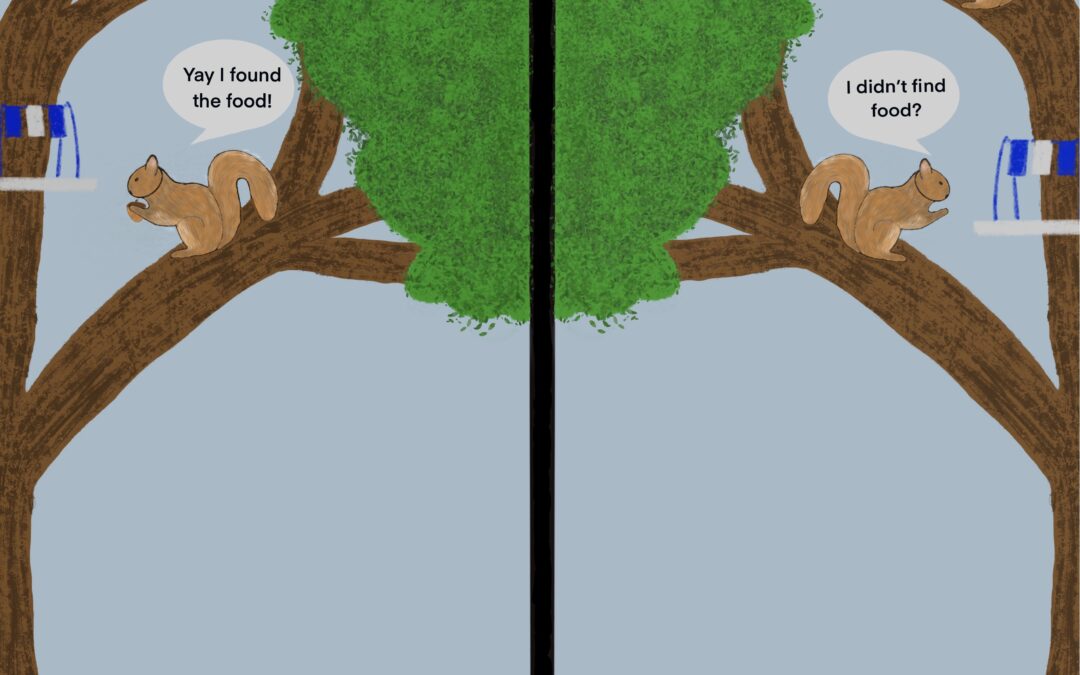
In this study, the scientists observed how Eastern Grey Squirrels could successfully pick
the correct container and rotate it to receive a nut from it as a reward. The containers were part of
a dog toy puzzle that was modified. There were three containers that were connected, the middle
container was painted white while the other two were blue. The nut was always placed in the
white container as a way for the squirrels to learn which container would result in a reward.
During the study, the scientists observed the time it took to complete the puzzle, if
mistakes were made, and if there was a competitor nearby. A stopwatch was used to record the
time it took for the squirrel to get the nut. There was also a camera set up on a tree about 2.5
meters away from the puzzle to record each trial. If there was a competitor around the foraging
squirrel, it was recorded if the distance between them was within 1 meter or 5 meters. The
technique used to track the foraging time was to start the time when the squirrel first touched the
puzzle and was stopped once the nut fell out of the container. The scientists counted a mistake as
the squirrel tried to rotate one of the blue containers instead of the white one, which was the one
holding the reward. All the data was collected over the span of 11 days, which resulted in a total
of 140 trials.
Based on the data collected, the scientists found that in the end all the squirrels
could successfully rotate the containers and receive the reward. The speed of performing the task
and the amount of mistakes made were negatively affected if there was a competitor within 1
meter. If there was a competitor within 5 meters, there was no impact on the foraging speed and
the amount of mistakes made. The number of mistakes being made with the presence of a
competitor improved overtime, leading to there being fewer mistakes by the later trials. The
squirrels getting used to a presence near them caused this improvement.
Eastern grey squirrels, according to the scientists’ conclusion, are sensitive to others
around them while foraging, resulting in distraction. This can negatively affect the squirrel
overall because their food intake could be decreased from losing feeding opportunities. In this
study and others, it was found that repeated exposure to distractions can improve the squirrel’s
responses. The scientists suggest a future study where each squirrel would be tagged in order to
track if individuals have different attention span abilities and learning abilities.
Teichroeb, J. A., Ghorbani, H., Fallah, K., & Vasey, E. N. (2024). Distracted foragers:
competitors impair foraging efficiency, accuracy and speed for eastern grey squirrels. Animal
Behaviour, 215, 241–250. https://doi.org/10.1016/j.anbehav.2024.06.017
