
A trait commonly associated with crickets is their songs. If one goes outside on summer evenings, crickets can often be heard singing in grassy areas. However, even when there is no singing, crickets might still be all around you. Anyone who has recently lived in or visited Hawaii will likely recount never hearing crickets sing. This is because a parasite on the islands uses the songs of crickets to find them. Under normal conditions, the songs of crickets play an important role in attracting other crickets for reproduction. Most populations within a species have variations in their genetics. Applying this to crickets means that individual crickets within a population are slightly different from each other.
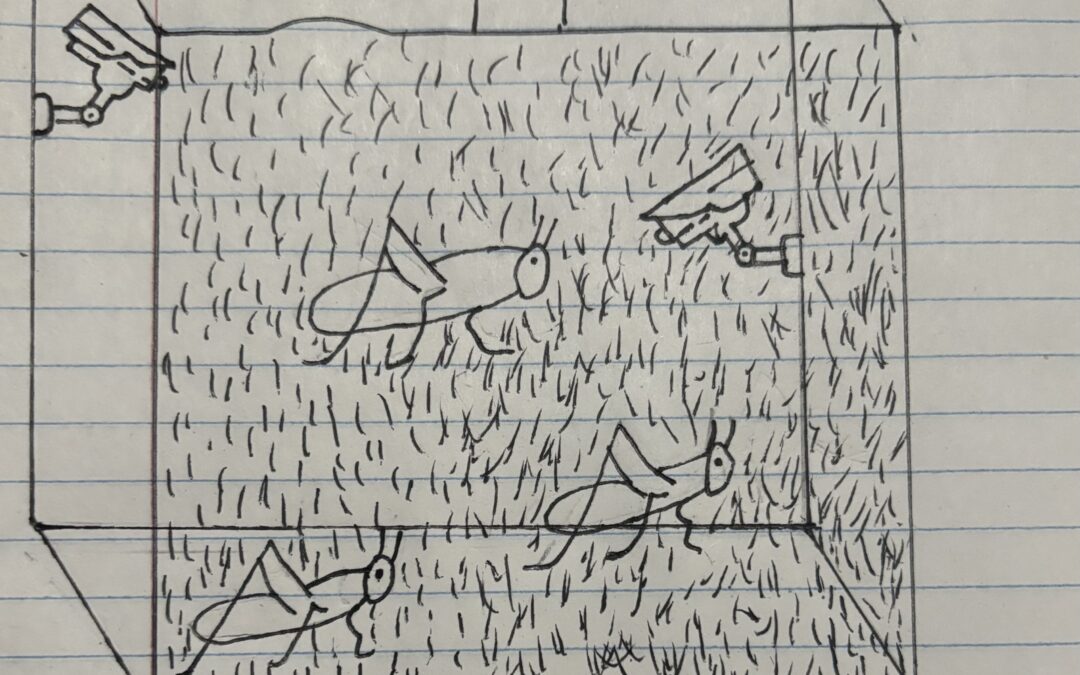
In the cricket populations in Hawaii, before the prevalence of the parasites, some crickets possessed genes that made it impossible for them to sing. This meant that the non-singing crickets were less likely to be killed by the parasites when they became abundant, and therefore were more likely to reproduce. This raises the question of how the crickets’ behavior can compensate for the absence of song as a way of attracting a mate. Consequently, biologist Will T. Schneider and his colleagues wanted to see if the crickets that could not sing would compensate for their inability to attract a mate through singing by using a different method. The researchers tested this in a laboratory environment. They created a patch of grass populated with crickets in a sealed room with cameras to record the crickets’ activities.
The researchers observed that the crickets that couldn’t sing their usual songs changed their approach to attracting a mate. They used their bodies to signal to others. Specifically, non-singing crickets employed visual cues like movements or posture to communicate interest to potential mates. By finding new ways to communicate and attract mates, the crickets can still reproduce and maintain their populations, even if they lose their singing ability. On a broader level, this suggests that organisms can change their behavior to compensate for genetic traits that negatively affect them. In other words, behavioral flexibility can reduce the negative effects of certain genes.
Summarized article:
Schneider, Will T., et al. “Behavioural plasticity compensates for adaptive loss of Cricket Song.” Ecology Letters, vol. 27, no. 3, Mar. 2024, https://doi.org/10.1111/ele.14404.
