
Did you know deer are more closely related to hippos than to dogs? While it may seem surprising, this is because deer and hippos are both part of a special group of animals called ungulates. Ungulates are just animals that walk on the very tips of their toes. They also have a special hard protective covering for their toes called a hoof, which is made of the same substance as our nails, called keratin. They’re also usually herbivorous, meaning they just eat plants. Some other well known ungulates include giraffes, goats, pigs, cows, horses, tapirs, and rhinoceroses.
Interestingly, when it comes to how neonate, meaning newborn, ungulates behave, there are two main categories of ungulate species: hiders and followers. Follower neonates walk with their moms immediately after they’re born, and rely on their moms to fight off or help them run away from predators. Followers typically also inhabit more open habitats like savannas.
Hider neonates on the other hand, live in more plant covered habitats like forests. They also walk as soon as they’re born, but they do not stay too close to their moms. Instead, to protect themselves from predators, they hide (sit or lie down) in plants about a school bus length or more away from their moms. They do this for the first few weeks to months of their life, getting food mostly from nursing their moms. Afterwards, they switch to a more active lifestyle where they search for food themselves.
However, we actually don’t know very much about what factors in a hider’s environment affect when they hide and how far away from their mom they hide. Recently though, scientific researchers have collected information about a species of deer, called mule deer and wrote an article titled Helicopter parenting: local-scale environment determines hiding and supervision in neonatal ungulates to try and figure out exactly this! That is, they wanted to figure out what factors determine when a neonate mule deer, called fawn, hides and what determines how far it hides from its mom, called a doe.
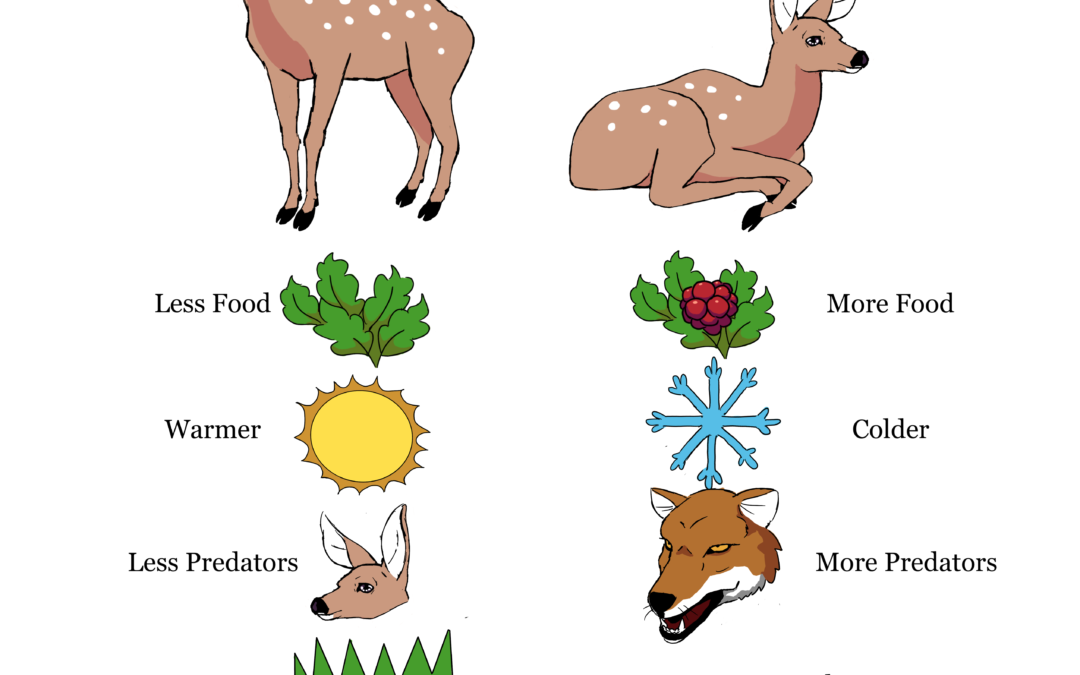
So what did the researchers do? Well first they made an educated guess, or hypothesis that things like: predators nearby, low outside temperature, lots of food for the doe and fawn, and tall grass nearby, would all increase fawn hiding amount and that predators nearby would increase hiding distance from the doe. To test this, they found several wild mule deer families in areas with lots of coyotes (their main predator) or with very few coyotes. Additionally they found deer in areas with very tall or very short grass and with lots of, or very little available food. Instead of being physically near and watching all of these fawns at once to see what factors changed their hiding behavior, the researchers attached special collars to them.
These collars had GPS tracking, meaning they told the researchers if the deer were moving and where the deer were. Since the researchers knew where all the deer were, they could know the distance between fawns and their doe mothers. They could also tell if the fawns were hiding or not because when fawns hide, they don’t move and are usually a specific distance or more away from their doe mothers—both things the GPS could tell them!
But what did the researchers find? First, they saw that when there were more predators nearby, the fawns hid more, and at a further distance away from their mother. They hid more when predators were near because hiding is a mule deer fawn’s main way of avoiding predators. To understand why they hid further away from their mother though, remember that neonate ungulates need their mothers for milk. This means if a predator sees a doe, which is far bigger and easier to spot than a fawn, it instinctively recognizes that there is a good chance a fawn is probably nearby. So the reason the fawns hide further away from their mother doe when predators are near is because they want avoid their doe mother giving away their position. The researchers also saw that when it was cold, they hid more. They did this to stay warm and rest—remember that hiding is just lying down in plants! Additionally, they also hid more when food was very available. This was because, despite being a hider ungulate, mule deer fawns still always need to be in the same area as their mom for milk. If food is very available, the doe does not need to go on long journeys to find food and the fawn doesn’t need to walk to follow her. This means the fawn could spend less time walking and more time lying down and hiding.
So far, these results all seem to align with the hypothesis of the researchers. However, contrary to their hypothesis, they saw that when the fawns’ favorite hiding spots, patches of grass, were short (but not so short the fawns couldn’t hide in them) the fawns also hid more. The reason is because, if the grass were taller everywhere, the vision of predators would be blocked more by the grass. This means the predators would have a harder time seeing the fawns whether or not they were hiding, so the fawns have less of a reason to hide.
To end, though learning about how baby animals behave is fun, and very cute, it’s also very important. Only by understanding where animals go, what they do, and why, can we understand how to protect them in a world where their habitats are always changing, usually because of humans.
References:
Brunet, M. J., Huggler, K. S., Burke, P. W., & Monteith, K. L. (2024). Helicopter parenting: Local-scale environment determines hiding and supervision in neonatal ungulates. Animal Behaviour, 218, 1–11. https://doi.org/10.1016/j.anbehav.2024.09.010
