
For humans, hide and seek is just a fun game, but for animals, it can be a matter of life or death. The animal being sought must be good at hiding because, if they aren’t, they will be eaten by a predator. One method that animals use to hide is camouflage, which is when an animal blends into their surrounding environment, making them harder to see. Some animals can even change color to better match their surroundings. One example of this is the Chameleon Prawn! While the ability to change colors makes hiding easier, it is only really helpful if, when you change color, you also hide in a place that matches your new color, not your old one. After realizing this, a group of scientists wanted to see how the background the Chameleon Prawns preferred to hide on changed as they turned a different color.
Firstly, the scientists wanted to see if changing colors actually made the prawns harder to see so they collected green and red Chameleon prawns. They put the green prawns with dulse, a type of red seaweed and the red prawns with sea lettuce, a green seaweed. Then, on days 0, 15, and 30 of the experiment, they took pictures of the prawns. These pictures were then made to mimic how a Goby, the Chameleon Prawn’s predator, would see the prawn and the seaweed. After examining these pictures, the scientists realized that as the prawns changed color to match the seaweed they were with, it became harder for gobies to see them!
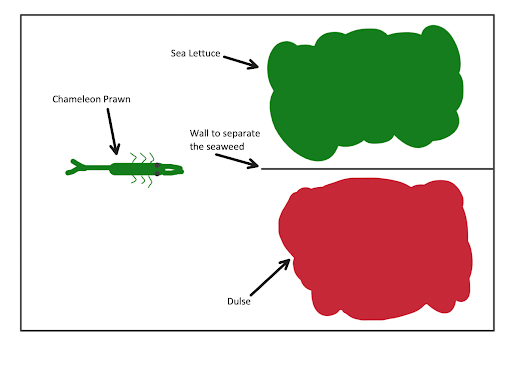
To see if the Prawns changed their behavior and began picking to hide in seaweed that matched their new color, the scientists put the prawns in small boxes with both dulse and sea lettuce. They then watched to see which one the prawn would pick (see figure). They found that, at first, the prawns preferred the seaweed that matched the color they were originally, but as time went on, they began to prefer the seaweed that was the color they were becoming.
So according to this study, chameleon Prawns are great at hide and seek as they can change color to match seaweed and change where they would normally hide to avoid standing out!
Green, S. D., Wilson, A., Stevens, M. (2024). Background selection for camouflage shifts in accordance with color change in an intertidal prawn. Behavioral Ecology, 35(5). https://doi.org/10.1093/beheco/arae060.
