
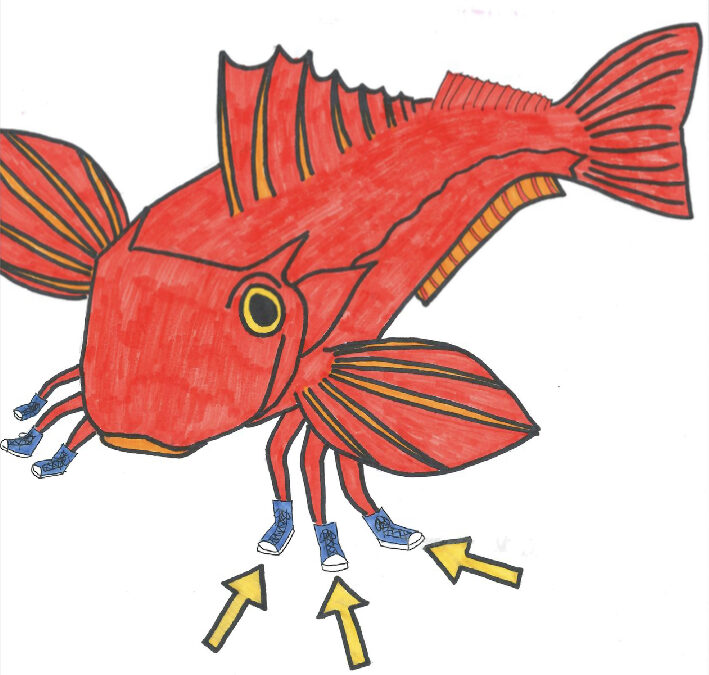
Remember that goldfish you got at the carnival last year? Goldie, was it? What did he look like? Fish swim in water, so they have tails to push themselves forward and fins to navigate around rocks and other obstacles. So, what would you say if I told you that there is a species of fish, just like Goldie and his goldfish friends, but with legs?
Sea robins are a unique species of fish that have six legs connected to their abdomens. Now, these legs don’t work like ours do. While we use ours to walk, run, and jump on land, they have a different purpose for their legs under the sea. They still use their fins to move around underwater like a regular fish, but at the same time they are digging and hunting for food on the sandy floor. And sometimes, when their fins get tired of swimming and they want to stay close to the ground to hide from predators, sea robins will simply walk, their six little legs carrying them swiftly across sand and coral.
But how is this possible? In this science experiment, researchers wanted to find out what made these legs work and how similar they are to the legs we have. They were curious about how specific proteins, which are molecules known as the “building blocks” of the body, impact the growth and use of these legs. In order to test this, they edited the genes of some of the sea robins. This allowed them to block specific proteins from affecting their development and then isolate the one most important for leg growth.
They found out that there is a protein called Tbx3 that is necessary for the growth of sea robin legs, the very same protein that creates the legs we have. The trait for legs has been passed down through generations, allowing humans and sea robins to have this surprising similarity. Just like our legs help us to run long distances and jump high, these fish have evolved to use their legs to find food more effectively, give their fins a rest when they’re tired, and dig for hidden treasures in the sand.
And now, when you picture poor, legless Goldie, think about how lucky you are to be more genetically similar to a sea robin.
Herbert, Amy L. et al., Ancient developmental genes underlie evolutionary novelties in walking fish, Current Biology (2024), Volume 0, Issue 0, https://www.cell.com/current-biology/fulltext/S0960-9822(24)01157-6
